
 menu icon in the top, right corner of the screen.
 icon above to close this box.
 icon at the bottom of the screen below the browser—if you don't see it, swipe up to unhide it.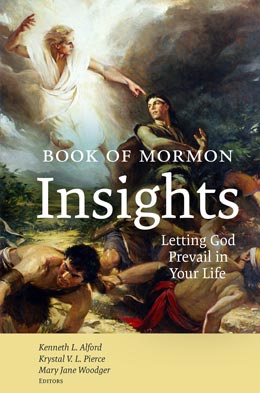
Matthew L. Bowen, "Rabbanah: Ammon as a Type of Jesus Christ," in Book of Mormon Insights: Letting God Prevail in Your Life, ed. Kenneth L. Alford, Krystal V. L. Pierce, Mary Jane Woodger (Provo, UT: Religious Studies Center, Brigham Young University; Salt Lake City: Deseret Book), 144–55.
Matthew L. Bowen is an associate professor of Religous Education at Brigham Young University-Hawaii.
 Mormon shows how Ammon, called "Rabbanah," meaning "powerful or great king," drew on divine power and used it within the Lamanite belief system to enlarge a generalized belief in the "Great Spirit" into faith in Jesus Christ and his atonement. Courtesy of Intellectual Reserve, Inc.
One of the many remarkable aspects of the Lamanite conversion narratives (Alma 17–27) is the transition of so many Lamanites from age-old grievances, warlike traditions, and general belief in a “Great Spirit” to a peaceable, unshakable faith in Jesus Christ, atoning “son of [the] Great God” (24:13). Christ’s power and love manifest in Ammon catalyzes this transition.
Divine power evident in Ammon’s exploits first leads King Lamoni to see him as the Great Spirit incarnate—the “Divine Warrior.” Mormon’s glossing of the Lamanite name-title Rabbanah as “powerful or great king” (Alma 18:13) strongly suggests its Semitic/
Recalling the Lamanite royal ideology of Rabbanah (with its Semitic roots) as “powerful or great king,” Mormon shows how Ammon drew on divine power and used it within the existing Lamanite belief system to enlarge a generalized belief in the “Great Spirit” into faith in Jesus Christ and his atonement, reflected in later speeches by Anti-Nephi-Lehi, Ammon, and Samuel the Lamanite.
The Power of the Great Spirit (Divine Warrior) Manifest in Ammon
Ancient Israelites conceived of Jehovah as a “Divine Warrior.”[4] Daniel L. Belnap, a professor of ancient scripture at Brigham Young University, has shown how Lehi’s sons inherited this concept,[5] which evidently continued among the descendants of Laman, Lemuel, and the sons of Ishmael. Indeed, it was within Lamoni’s worldview that the Great Spirit could “come down . . . to preserve . . . lives” (Alma 18:4).
Mormon later mentions that some Lamanites believed Ammon was a manifestation of “the Great Spirit that had always attended the Nephites, who had ever delivered them out of their hands; and they said that it was this Great Spirit who had destroyed so many of their brethren” (Alma 19:27; emphasis in all scriptural citations is mine). These Lamanites conceived of the Great Spirit as a Divine Warrior capable of manifesting himself in the flesh.
Since the Lamanite conception of the Great Spirit as a type of Divine Warrior necessarily implied power in war, Ammon’s fighting skills made him the ideal, if not the perfect, missionary.[6] Ammon’s response to the weeping of his fellow-servants at the loss of the king’s flocks reflects his recognition that the alignment of Christ’s divine power with his own abilities would activate the doctrine of Christ in the lives of these Lamanites: “Now when Ammon saw [their weeping] his heart was swollen within him with joy; for, said he, I will show forth my power unto these my fellow-servants, or the power which is in me, in restoring these flocks unto the king, that I may win the hearts of these my fellow-servants, that I may lead them to believe in my words” (Alma 17:29).
The rescue of Lamoni’s flocks from the plunderers provides Ammon with ample opportunity to demonstrate divine power through his fighting skills: “But Ammon stood forth and began to cast stones at them with his sling; yea, with mighty power he did sling stones amongst them; and thus he slew a certain number of them insomuch that they began to be astonished at his power” (Alma 17:36). Further attempts to kill Ammon result in further loss of life and limb (see vv. 37–38) and produces convincing witnesses among the king’s servants. Their testimony of Ammon’s “great power in contending” causes Lamoni to muse whether Ammon is the Great Spirit incarnate: “And when they had all testified to the things which they had seen, and he had learned of the faithfulness of Ammon in preserving his flocks, and also of his great power in contending against those who sought to slay him, he was astonished exceedingly, and said: Surely, this is more than a man. Behold, is not this the Great Spirit who doth send such great punishments upon this people, because of their murders?” (18:2).
Ammon’s fellow-servants reasoned that the evidence weighed in favor of Ammon being divine rather than human: “And they answered the king, and said: Whether he be the Great Spirit or a man, we know not; but this much we do know, that he cannot be slain by the enemies of the king; neither can they scatter the king’s flocks when he is with us, because of his expertness and great strength; therefore, we know that he is a friend to the king. And now, O king, we do not believe that a man has such great power, for we know he cannot be slain” (Alma 18:3). Their testimony alone regarding Ammon’s martial “expertness” and “great strength” was enough to convince Lamoni that Ammon was the Great Spirit: “And now, when the king heard these words, he said unto them: Now I know that it is the Great Spirit; and he has come down at this time to preserve your lives, that I might not slay you as I did your brethren. Now this is the Great Spirit of whom our fathers have spoken” (v. 4).
At this point Mormon reflects on the Lamanite tradition regarding the Great Spirit: “Now this was the tradition of Lamoni, which he had received from his father, that there was a Great Spirit. Notwithstanding they believed in a Great Spirit, they supposed that whatsoever they did was right; nevertheless, Lamoni began to fear exceedingly, with fear lest he had done wrong in slaying his servants” (Alma 18:5). Lamoni’s recognition that “whatsoever they did was right” was an incorrect tradition and that he had “done wrong in slaying his servants” was an important first step toward a more doctrinally complete understanding of Jesus Christ as the Great Spirit. President Henry B. Eyring has observed that Ammon taught Lamoni right from wrong by example through his service before he ever taught him by precept: “I have always focused before on how mixed up Lamoni was in his doctrine, without seeing the miracle. The miracle was that a spiritual need was created in a man, that he might be taught the gospel of Jesus Christ. His heart was broken. He felt guilt. And it came from the temporal things that Ammon had done.”[7]
Rabbanah: The Lamanite Concept of the “Great and Powerful King” and Its Origins
The axial moments in the Lamanite conversion narratives begin with Lamoni’s servants addressing Ammon by the singular title Rabbanah: “And one of the king’s servants said unto him, Rabbanah, which is, being interpreted, powerful or great king, considering their kings to be powerful; and thus he said unto him: Rabbanah, the king desireth thee to stay” (Alma 18:13). As noted at the outset of this article, Mormon’s glossing of Rabbanah as “powerful or great king” closely matches the Semitic/
Just as Jesus Christ did to those to whom he ministered in mortality as Suffering Servant (see Isaiah 53; Philippians 2:5–11), Ammon places himself completely at the service of the Lamanites. Having rejected Nephite kingship and scrupulously avoided any appearance of seeking Lamanite kingship,[8] Ammon enters Lamoni’s service with a full awareness that every action could build or undermine confidence in his message.
Nevertheless, at least one Lamanite had branded Ammon with an exceptional Lamanite royal name-title, the meaning of which tied Ammon closely to the Great Spirit. Ammon understood the doctrinal truth that the Great Spirit would, in time, “come down” and take upon him flesh. Mormon, living in the third century after Christ’s coming and having the benefit of hindsight and history, wishes his latter-day readers to see that Ammon’s “great power” and “great strength” prepared Lamoni and the Lamanites to understand the reality of Christ’s condescension. In the dialogue Mormon provides, we see Ammon helping Lamoni make that transition of belief: “I say unto you, what is it, that thy marvelings are so great? Behold, I am a man, and am thy servant; therefore, whatsoever thou desirest which is right, that will I do” (Alma 18:17). Ammon’s insistence on his being human does not stop Lamoni from asking whether he is the Great Spirit incarnate: “Who art thou? Art thou that Great Spirit, who knows all things? Ammon answered and said unto him: I am not” (vv. 18–19). As Dean R. Burgess, first counselor in the Young Men General Presidency, has noted, “Ammon knew who he was and what his true mission was.”[9]
Ammon’s denial changes the focus of the exchange to the divine “power” evident in Ammon’s discernment and in his martial feats: “And the king said: How knowest thou the thoughts of my heart? Thou mayest speak boldly, and tell me concerning these things; and also tell me by what power ye slew and smote off the arms of my brethren that scattered my flocks—and now, if thou wilt tell me concerning these things, whatsoever thou desirest I will give unto thee; and if it were needed, I would guard thee with my armies; but I know that thou art more powerful than all they” (Alma 18:20–21). Ammon recognizes this as the perfect opportunity to explain the power of Christ and to help Lamoni activate that power in his life via the doctrine of Christ, beginning with faith: “Now Ammon being wise, yet harmless, he said unto Lamoni: Wilt thou hearken unto my words, if I tell thee by what power I do these things? . . . And the king answered him, and said: Yea, I will believe all thy words” (vv. 22–23).
Anti-Nephi-Lehi’s Speech and Lamanite Faith in Jesus Christ
Responding to Lamoni’s invitation to speak boldly, Ammon boldly asks Lamoni the question “Believest thou that there is a God?” (Alma 18:24), to which Lamoni responds, “I do not know what that meaneth” (v. 25). The Nephite term for “God” was evidently unfamiliar to many Lamanites. In an attempt to bridge the terminological gap and arrive at a common belief, Ammon then asks, “Believest thou that there is a Great Spirit?” When Lamoni responds, “Yea,” Ammon affirms, “This is God” (vv. 26–27) and proceeds to teach Lamoni. Ammon’s insistence “I am a man” provides the perfect opportunity to teach the king about humanity’s creation, the fall of man, and the atonement of Jesus Christ, as well as give a doctrinally fuller explanation of the power of the Great Spirit that he (Ammon) exercised: “And a portion of that Spirit dwelleth in me, which giveth me knowledge, and also power according to my faith and desires which are in God” (vv. 34–35).
Subsequently, while Lamoni is “under the power of God” in a heavenly vision (Alma 19:6), Lamoni’s wife approaches Ammon with increasing knowledge of the nature of the Great Spirit and Ammon: “The servants of my husband have made it known unto me that thou art a prophet of a holy God, and that thou hast power to do many mighty works in his name” (v. 4). This recognition and her surpassing faith led to an even greater transformation (see vv. 29–36). Later, Lamoni’s father sees the “great love Ammon has for Lamoni” and is moved to learn the gospel of Jesus Christ for himself (20:26). His whole household is converted (see Alma 22).
Still later, Mormon records a speech by Lamoni’s brother, Anti-Nephi-Lehi, which reflects the Lamanites’ now more doctrinally complete understanding of the nature of Jesus Christ and his atonement (see Alma 24). This enriched perspective results from the teaching of Ammon, Aaron, and their companions and includes the recognition that the “Great Spirit” is the “great God” who has sent them to teach the gospel of Jesus Christ: “I thank my God, my beloved people, that our great God has in goodness sent these our brethren, the Nephites, unto us to preach unto us, and to convince us of the traditions of our wicked fathers” (v. 7). In using the appellation “our great God,” Anti-Nephi-Lehi preserves the key adjective associated with the being whom the Lamanites have formerly recognized as the Great Spirit.
Moreover, Anti-Nephi-Lehi recognizes the role of the Holy Ghost as an entity distinct from the Great God or Great Spirit in opening their hearts to the preaching of Ammon and his brethren: “And behold, I thank my great God that he has given us a portion of his Spirit to soften our hearts, that we have opened a correspondence with these brethren, the Nephites. And behold, I also thank my God, that by opening this correspondence we have been convinced of our sins, and of the many murders which we have committed” (Alma 24:8–9).
Anti-Nephi-Lehi extols Christ’s greatness and power manifest in his atoning for the sins of the Lamanites in spite of their severity and removing guilt from their hearts: “And I also thank my God, yea, my great God, that he hath granted unto us that we might repent of these things, and also that he hath forgiven us of those our many sins and murders which we have committed, and taken away the guilt from our hearts, through the merits of his Son” (Alma 24:10). Although it was “all [the Lamanites] could do . . . to repent sufficiently before God” (v. 11), Christ took their sins away through his atoning power. Anti-Nephi-Lehi knew that the old warrior culture was not compatible with what the atoning “blood of the Son of the Great” God would achieve: “Nay, let us retain our swords that they be not stained with the blood of our brethren; for perhaps, if we should stain our swords again they can no more be washed bright through the blood of the Son of our great God, which shall be shed for the atonement of our sins” (24:13). The power of Christ’s atoning love was greater than anything the Lamanites had ever experienced in warrior culture. The true power of the Great Spirit was love:
And the great God has had mercy on us, and made these things known unto us that we might not perish; yea, and he has made these things known unto us beforehand, because he loveth our souls as well as he loveth our children; therefore, in his mercy he doth visit us by his angels, that the plan of salvation might be made known unto us as well as unto future generations. (Alma 24:14)
Samuel the Lamanite Prophet and the Generational Legacy of Lamanite Faith in Christ
Donald W. Parry, BYU professor of the Hebrew Bible, has demonstrated that Samuel the Lamanite deftly used the same prophetic speech forms used by prophets in ancient Israel and Judah.[10] This suggests that Samuel the Lamanite had a thorough knowledge of the prophetic books in the scriptures. He also knew the righteous traditions of the people of Ammon—the righteous Lamanites from whom he descended. For example, he describes God in terms very similar to those used by Anti-Nephi-Lehi (e.g., “my great God,” “our great God”). Samuel prophesies to the Nephites in Zarahemla, “And it shall come to pass, saith the Lord of Hosts, yea, our great and true God, that whoso shall hide up treasures in the earth shall find them again no more, because of the great curse of the land, save he be a righteous man and shall hide it up unto the Lord” (Helaman 13:18).
Samuel uses a similarly “Lamanite” name-title for Christ in one other instance. Mormon included the following prophecy as part of the climax of Samuel’s speech:
Yea, I say unto you, that in the latter times the promises of the Lord have been extended to our brethren, the Lamanites. . . . And this is according to the prophecy, that they shall again be brought to the true knowledge, which is the knowledge of their Redeemer, and their great and true shepherd, and be numbered among his sheep. Therefore I say unto you, it shall be better for them than for you except ye repent. (Helaman 15:12–14)
Samuel’s use of the name-title “their great and true shepherd” parallels his earlier designation of Jehovah as “our great and true God” in Helaman 13:18. Regarding this and other passages in which Shepherd is used as a divine title, BYU emeritus professor of ancient scripture Dana M. Pike wrote: “The use of ‘shepherd’ as a title for Jehovah or Jesus was an appropriate expression of the intersection between the roles of a human shepherd—leading, protecting, providing for a flock—and Jesus’s role as Savior of God’s children.”[11] The name-title “their great and true shepherd” has a third point of convergence: Samuel recognizes that the Great Spirit in whom the Lamanites have historically believed and the Great God in whom the righteous Lamanites have come to believe is also the Lamanites’ Great Shepherd: Jesus Christ. This kinsman Redeemer and Great and True Shepherd—the true Rabbanah—would, in accordance with and fulfillment of the Abrahamic covenant, act in future generations to ensure that the Lamanites would be brought into God’s fold (i.e., church).
Notably, Ammon uses this same language to describe how the Lord has used him, his brothers, and their companions as “instruments” in his service: “And this is the blessing which hath been bestowed upon us, that we have been made instruments in the hands of God to bring about this great work” (Alma 26:3). Ammon’s service to the Lamanites as shepherd over the king’s flocks, in which he gathered and defended them, typified the greater work that he and his brethren accomplished. This service thus constitutes a type of that which Jesus Christ as the true Rabbanah is performing in gathering and protecting the Lamanites today, a day in which many more “thousands of them do rejoice, and have been brought into the fold of God” (v. 4).
Ammon’s Deferential Praise of Jesus Christ’s Great Power
Reflecting on the fourteen-year mission to the Lamanites that he, his brothers, and their associates had undertaken, Ammon is led to glory in the Lord. His praise maximizes the Lord’s role in the Lamanite conversions and minimizes his own: “Yea, I know that I am nothing; as to my strength I am weak; therefore I will not boast of myself, but I will boast of my God, for in his strength I can do all things; yea, behold, many mighty miracles we have wrought in this land, for which we will praise his name forever” (Alma 26:12). He extols the Lord’s “great power” (vis-à-vis his own): “Therefore, let us glory, yea, we will glory in the Lord; yea, we will rejoice, for our joy is full; yea, we will praise our God forever. Behold, who can glory too much in the Lord? Yea, who can say too much of his great power, and of his mercy, and of his long-suffering towards the children of men? Behold, . . . I cannot say the smallest part which I feel” (v. 16). The mutual love that Ammon, his brethren, and their Lamanite converts feel for each other is the love of Christ: “And now behold . . . , has there been so great love in all the land?” (v. 33).
Ammon’s words should be considered against the backdrop of Alma 18:13, where Lamoni’s servant addresses him as “Rabbanah,” the “powerful or great king.” Ammon was not offering general praise to the Lord of his great power but of the very power the Lord had exercised in and through Ammon himself—the power under which Lamoni, his wife, and his servants became converted in Lamoni’s court and the power of divine love that changed their hearts such that “they had no more desire to do evil” (19:33; see 24:10–14).
Ammon had been honored by the Lamanites from a doctrinally incomplete perspective as “Rabbanah.” Christ’s power in Ammon as warrior had garnered their attention, but it was the power of Christ’s love in Ammon for Lamoni and all the Lamanites that turned them to Jesus as the true Rabbanah. Ammon’s “faithfulness” (Alma 18:2, 10; Hebrew ʾĕmûnâ = “faithfulness”) helped them turn general belief in a Great Spirit into a faith Mormon describes thus: “And as sure as the Lord liveth, so sure as many as believed, or as many as were brought to the knowledge of the truth, through the preaching of Ammon and his brethren, . . . the power of God working miracles in them—yea, I say unto you, as the Lord liveth, as many of the Lamanites as believed in their preaching, and were converted unto the Lord, never did fall away” (23:6). They were “firm in the faith of Christ, even unto the end” (27:27), the people of faithfulness.
Conclusion and Application
The ascription of an originally Semitic Lamanite royal title—Rabbanah, the “powerful or great king”—to Ammon (Alma 18:13) reflected the identification of Ammon as “the Great Spirit” incarnate as Divine Warrior in Lamoni’s household. Through Ammon’s calculated use of this Lamanite concept in Lamoni’s service, the alignment of Christ’s great power and Ammon’s skills in fighting catalyzes the transition of many Lamanites from a general belief in a “Great Spirit” to unshakable faith in Jesus Christ as the atoning “son of the great God.” Christ’s “great love,” manifested in Ammon and eventually shared by all the converted Lamanites and their missionaries (20:26; 26:33), played an even more crucial long-term role.
Elder Jonathan S. Schmitt of the Seventy has recently taught that many of the Savior’s name-titles can be names that we take upon ourselves as we acquire his attributes: “Jesus wants us to be good shepherds, particularly in our families and as ministering brothers and sisters.”[12] Ammon, like Jesus, was a good shepherd—a “great and true shepherd” in this sense. He became a Rabbanah, a spiritual giant through whom Christ could exercise his atoning “great power” and “great love.” We too can and should become “great and true shepherds” and Rabbanahs in this sense.
Notes
[1] Ludwig Koehler and Walter Baumgartner, The Hebrew and Aramaic Lexicon of the Old Testament (Leiden: Brill, 2001), 1175, hereafter HALOT; and Paul Y. Hoskisson et al., Book of Mormon Onomasticon, “Rabbanah,” https://
[2] HALOT, 1176–78.
[3] See Alma 18:2–3, 8, 13; 19:15, 24; 25:6; 26:16.
[4] See, for example, Patrick D. Miller, The Divine Warrior in Early Israel (Cambridge: Harvard University Press, 1973), passim; and Charles Sherlock, The God Who Fights: The War Tradition in Holy Scripture (Lewiston, NY: Edwin Mellen, 1993), passim.
[5] Daniel Belnap, “‘I Will Contend with Them That Contendeth with Thee’: The Divine Warrior in Jacob’s Speech of 2 Nephi 6–10,” Journal of the Book of Mormon and Restoration Scripture 17, no. 1 (2008): 20–39.
[6] In addition to Ammon’s exploits in Alma 17, his encounter with Lamoni’s father in Alma 20:20–22 further evidences Ammon’s skills in hand-to-hand combat.
[7] Henry B. Eyring, “The Book of Mormon Will Change Your Life,” Ensign, February 2004, 14.
[8] See Matthew L. Bowen, “The Faithfulness of Ammon,” Religious Educator 15, no. 2 (2014): 66.
[9] Dean R. Burgess, “Do You Know Who You Are?,” Ensign or Liahona, May 2008, 53.
[10] Donald W. Parry, “‘Thus Saith the Lord’: Prophetic Language in Samuel’s Speech,” Journal of Book of Mormon Studies 1, no. 1 (1992): 181–83.
[11] Dana M. Pike, “Jesus, the Great Shepherd-King,” in Celebrating Easter: The 2006 BYU Easter Conference, ed. Thomas A. Wayment and Keith J. Wilson (Provo, UT: Religious Studies Center, Brigham Young University, 2006), 68.
[12] Jonathan S. Schmitt, “That They Might Know Thee,” Liahona, November 2022, 105.
