
 menu icon in the top, right corner of the screen.
 icon above to close this box.
 icon at the bottom of the screen below the browser—if you don't see it, swipe up to unhide it.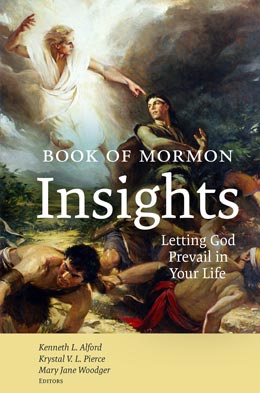
Mark Mathews, "Enos: Developing Unshakable Faith in Christ," in Book of Mormon Insights: Letting God Prevail in Your Life, ed. Kenneth L. Alford, Krystal V. L. Pierce, Mary Jane Woodger (Provo, UT: Religious Studies Center, Brigham Young University; Salt Lake City: Deseret Book), 80–90.
Mark Mathews is a religious educator for the Church Educational Sydtem who has taught at Brigham Young University and in seminary and institute program in Utah.
 After Enos received multiple revelations, his faith in Jesus Christ became unshaken. His story shows that a most valuable lesson is how to seek and receive revelation. Courtesy of Intellectual Reserve, Inc.
The Book of Mormon is a book of revelation. It was recorded by revelation, translated by revelation, and revelation is one of its major themes. As Book of Mormon scholar Terryl L. Givens explained:
The [Book of Mormon] . . . hammers home the insistent message that revelation is the province of everyman. . . . That may well be the Book of Mormon’s most significant and revolutionary—as well as controversial—contribution to religious thinking. The particularity and specificity, the vividness, the concreteness, and the accessibility of revelatory experience—those realities both underlie and overshadow the narrated history and doctrine that constitute the record. The “knowability” of all truth, the openness of mystery, the reality of personal revelation find vivid illustration within the record and invite reenactment outside of it.[1]
Although many accounts in the Book of Mormon teach us about revelation, I believe that no story therein more completely teaches and illustrates how to receive and recognize personal revelation from the Lord than the story of Enos. That beautiful, short account shows us how to qualify for revelation, how revelation usually comes, and why we all need revelation in our lives. In this essay we will examine Enos’s account to learn that revelation from the Lord requires work and effort on our part, that it does not usually come by dramatic signs but by the voice of the Spirit to our minds, and that receiving revelation line upon line throughout our lives can lead to unshakable faith in the Lord Jesus Christ.
“My Father . . . Taught Me”
The foundation for Enos’s first revelatory experience was the teachings he received in the home. He explained, “My father . . . was a just man—for he taught me . . . in the nurture and admonition of the Lord—and blessed be the name of my God for it” (Enos 1:1). As used here, the word just means “faithful or righteous.”[2] Enos is saying that because his father was a righteous man, he taught his son about the Lord, and these teachings were a great blessing in his life. Similarly, Nephi introduced himself by saying, “I, Nephi, having been born of goodly parents, therefore I was taught somewhat in all the learning of my father” (1 Nephi 1:1). The message is clear: good parents teach the gospel in the home (see Alma 36:17). The Book of Mormon strongly supports the idea promoted by President Russell M. Nelson of “a home-centered Church.”[3]
Of all the things we could teach our children in the home, the story of Enos shows that a most valuable lesson is how to seek and receive revelation. Elder Richard G. Scott taught seminary teachers something that applies even more to parents: “If you accomplish nothing else in your relationship with your students than to help them recognize and follow the promptings of the Spirit, you will bless their lives immeasurably and eternally.”[4] Sometimes the efforts of parents to teach their children may seem unproductive, but the story of Enos gives us hope. He records that “the words which I had often heard my father speak concerning eternal life, and the joy of the saints, sunk deep into my heart” (Enos 1:3). When the frequent teachings of his parents finally sunk in, he knew what to do to get revelation for himself. Apparently, he had learned that in the home.
“The Wrestle Which I Had before God”
The desire of Enos’s heart was to receive a remission of his sins from the Lord and to know that by personal revelation. To receive this required a “wrestle . . . before God” (Enos 1:2). Similarly, Alma describes “wrestling with God in mighty prayer” for a blessing he desired (Alma 8:10). The term wrestle in these verses denotes a struggle,[5] teaching us in this context that receiving revelation from the Lord requires work and effort on our part and that prayer is a form of that work.
Similarly, the Lord taught Oliver Cowdery that revelation does not usually come just by casually asking for it. Instead, he was told to first “study it out in your mind; then you must ask me if it be right” (Doctrine and Covenants 9:8).
Consistent with this, President Harold B. Lee taught, “If you want to get revelation, do your homework.”[6] This “homework” usually includes prayerful wrestling before God like Enos.
“I Went to Hunt Beasts in the Forests”
Enos includes the setting and circumstance of his revelatory experience because it seems to be an important contributing factor. The important element does not seem to be the hunting or even the forest, but that he was alone in quiet places. This gave time for the Spirit of the Lord to work on him and inspire him to think deeply about the things of God with unusual earnestness. It gave him an opportunity to hear the Lord in a way that is hard to do with our typical daily distractions. This is an important lesson to all of us to set apart personal quiet time in our lives because “reverence invites revelation” and “inspiration comes more easily in peaceful settings.”[7]
President M. Russell Ballard shared this counsel: “The people of earlier times experienced solitude in ways we cannot imagine in our crowded and busy world. Even when we are alone today, we can be tuned in with our mobile devices, laptop computers, and televisions to keep us entertained and occupied. . . . I have wondered if those who lived in the past had more opportunity than we do now to see, feel, and experience the presence of the Spirit in their lives. Seemingly, as our world gets brighter, louder, and busier, we have a greater challenge feeling the Spirit in our lives.”[8] Like Enos, we must learn to turn down the world for a moment and take time to listen to the Lord so we can hear him when he speaks by a still, small voice.
“The Words . . . Sunk Deep into My Heart. And My Soul Hungered”
Enos’s description of what followed is beautiful and poetic. He states that the “words which I had often heard my father speak . . . sunk deep into my heart. And my soul hungered” (Enos 1:3–4). This deep yearning to know and experience the things of God was motivated by the word of God sinking deep into his heart as he pondered. Pondering invites revelation.
There are several examples of this in the scriptures. Nephi wrote, “As I sat pondering in mine heart I was caught away in the Spirit of the Lord,” whereupon he received a glorious vision of Jesus Christ (1 Nephi 11:1). Leading Joseph Smith to receive the First Vision was his reading of James 1:5, which “seemed to enter with great force into every feeling of my heart. I reflected on it again and again” (Joseph Smith—History 1:12). The great vision of degrees of glory was received by Joseph Smith and Sidney Rigdon “while [they] meditated upon [the] things” they had learned from the scriptures (Doctrine and Covenants 76:19). Finally, President Joseph F. Smith received a vision of the spirit world’s work of redemption for the dead as he “sat in [his] room pondering over the scriptures; and reflecting upon the great atoning sacrifice” of Jesus Christ (Doctrine and Covenants 138:1–2). As these examples confirm, pondering the things of God like Enos invites revelation from the Lord.
“And I Cried unto Him in Mighty Prayer”
Having cultivated the climate for revelation, Enos then prayed to receive it. He states, “I kneeled down before my Maker, and I cried unto him in mighty prayer and supplication for mine own soul” (Enos 1:4). Perhaps the most basic principle of revelation is that it comes in response to prayer. As President Boyd K. Packer taught, “No message appears in scripture more times, in more ways than, ‘Ask and ye shall receive.’”[9]
But Enos’s example shows that the type of prayer the Lord requires is not casual or superficial. To receive revelation like Enos did, we must cry unto the Lord in mighty prayer. This phrase denotes a heightened intensity in prayer that reflects the soul’s sincere desire. Jesus Christ himself demonstrated this in his suffering in Gethsemane. Luke records that “being in an agony [Jesus] prayed more earnestly” (Luke 22:44). As this verse illustrates, not all prayers are created equal, even for Jesus Christ. When he needed greater help, he prayed with greater intensity. Commenting on this, Elder Bruce R. McConkie taught, “Note it well. The Son of God ‘prayed more earnestly’! He who did all things well, whose every word was right, whose every emphasis was proper . . . ‘prayed more earnestly,’ teaching us . . . that all prayers, his included, are not alike, and that a greater need calls forth more earnest and faith-filled pleadings.”[10]
Enos explains that the reason for his prayerful intensity is that he desired a “remission of [his] sins” and was supplicating for salvation “for [his] own soul” (Enos 1:2, 4). Interestingly, this desire in part prompted the First Vision. Joseph Smith explained: “My mind became seriously impressed with regard to the all-important concerns for the welfare of my immortal soul. . . . Therefore, I cried unto the Lord for mercy, . . . and the Lord heard my cry in the wilderness, . . . and I saw the Lord. And he spake unto me, saying, ‘Joseph, my son, thy sins are forgiven thee.”[11] Like Joseph, Enos prayed with sincerity and intensity because he felt his soul depended on it. And like Joseph’s prayer, Enos’s prayer was answered by revelation granting him a remission of sins. Mighty prayers invite powerful revelation.
“That It Reached the Heavens”
Famously, Enos prayed “all the day long . . . , and when the night came I did still raise my voice” (Enos 1:4). Interpreting this experience, Elder Richard G. Scott taught, “We don’t know exactly what happened, but it is not likely that he was on his knees praying all that time. You’ve had the experience of when something urgent is needed to be resolved, you pray, you ponder, you pray more, you formulate commitments and decisions, you present them to the Lord, you pray more and get feelings of guidance from Him.”[12]
Much is sometimes made about the length of Enos’s praying, but it is important to remember that he was not trying to set some sort of record. The reason for his lengthy praying was simple: he was determined to pray until his petition “reached the heavens” and he obtained an answer (see Enos 1:4). There is an important lesson in this for us. There will be blessings in our lives that we will pray for that will not be answered immediately. Enos’s example shows us that when this happens, we should continue to pray in faith, according to God’s will, until we receive an answer. Sometimes this may take years, even decades. Sometimes people pray for a lifetime. These prayers will make Enos’s seem quite short comparatively. The important thing is not the length of time on our knees; rather, it is the intensity and consistency with which we pray in faith and faithfully wait upon the Lord for an answer.
In praying for these desires of our hearts, there is no need to feel we should pray continuously for some excessive amount of time. Elder David A. Bednar explained that “steadiness over time is far more effective, far less dangerous, and produces far better results [than an occasional burst of effort.] . . . An attempt to pray one time for several hours likely will not produce the same spiritual results as meaningful morning and evening prayer offered consistently over several weeks. And a single scripture-reading marathon cannot produce the spiritual growth of steady scripture study across many months.”[13]
“The Voice of the Lord Came into My Mind”
Enos knew his prayer had “reached the heavens” when he received a response from the Lord. He recorded, “And there came a voice unto me, saying: Enos, thy sins are forgiven thee” (Enos 1:5). When he asked how that was possible, he was told, “Because of thy faith in Christ, whom thou hast never before heard nor seen” (v. 8). Although experiences like Joseph Smith’s First Vision may condition us to expect dramatic revelations in response to our humble prayers, we must remember that dramatic experiences like that were often put in the scriptures precisely because they are unusual. Enos’s experience shows that more commonly we receive revelation without appearances from the Lord. Enos did say he heard a voice, but he later clarified it was not an audible voice to his ears but a spiritual voice to his mind. He recorded, “Behold, the voice of the Lord came into my mind again” (v. 10; emphasis added). President Boyd K. Packer explained that “these delicate, refined spiritual communications are not seen with our eyes, nor heard with our ears. And even though it is described as a voice, it is a voice that one feels, more than one hears.”[14] This experience of Enos shows that the most common form of revelation is not when the Lord dramatically speaks through signs to our eyes and ears, but when he subtly speaks through his Spirit to our minds and hearts.
The Lord taught this lesson to the prophet Elijah when he did not speak dramatically through fire, whirlwinds, and earthquakes as he had before on Mount Sinai (see Exodus 19:16–19). This time on the same “mount of God” (1 Kings 19:8) he spoke through “a still small voice” (1 Kings 19:12). The lesson is timeless. Although the Lord can appear and speak dramatically with signs attending, more commonly he speaks to us spiritually through the inspired thoughts and feelings of the spirit of revelation.
In fact, experiencing these promptings from the Holy Ghost is evidence of the very thing that Enos sought, the remission of sins. President Henry B. Eyring explained, “If you have felt the influence of the Holy Ghost today, you may take it as evidence that the Atonement is working in your life.”[15]
“A Desire for the Welfare of My Brethren”
After Enos received the revelation and blessing that he sought, his desires turned outward toward the spiritual welfare and eternal salvation of others: “Now, it came to pass that when I had heard these words I began to feel a desire for the welfare of my brethren, the Nephites; wherefore, I did pour out my whole soul unto God for them” (Enos 1:9). He later offered a similar prayer for the Lamanites, and both of these prayers were answered by revelation.
One lesson this teaches us is that revelation for us often comes as we pray for others. Lehi demonstrates this principle. After he heard the prophets invite the people of Jerusalem to repent, Lehi “prayed unto the Lord, yea, even with all his heart, in behalf of his people. And it came to pass as he prayed unto the Lord, there came a pillar of fire and dwelt upon a rock before him; and he saw and heard much (1 Nephi 1:5–6). Commenting on this, Elder David A. Bednar taught, “Please note that the vision came in response to a prayer for others and not as a result of a request for personal edification or guidance.”[16]
“My Faith Began to Be Unshaken”
Having learned through his experience the pattern for receiving and recognizing revelation from the Lord, Enos continued to apply these principles. After his initial “wrestle . . . before God,” he later recorded “struggling in the spirit” and praying unto the Lord “with many long strugglings” to receive revelation that came only after he “prayed and labored with all diligence” (Enos 1:2, 10–12). Enos had learned the combination to unlock the heavens, and he used it to receive revelation and blessings throughout his life.
As he repeated this pattern, he experienced something sacred that shows us why receiving personal revelation is so important. He explained, “After I, Enos, had heard these words [by revelation], my faith began to be unshaken in the Lord” (Enos 1:11). One results of receiving regular revelation from the Lord is that these spiritual experiences strengthen our faith in him every time. Over time, consistent revelation can make our faith in Christ unshakable.
Enos’s father Jacob taught this same principle when he recorded that he and his people “have many revelations . . . ; and having all these witnesses . . . our faith becometh unshaken” (Jacob 4:6). He later demonstrated this when Sherem came seeking to “shake [him] from the faith,” but because of the “many revelations” he had received throughout his life, he “could not be shaken” (v. 5). As the account of Enos powerfully teaches us, this kind of unshakable faith does not necessarily come from one big experience with the Lord, but from many spiritual experiences of revelation that accumulate and reinforce each other over time.
The experience of President Joseph F. Smith illustrates this principle:
When I as a boy first started out in the ministry, I would frequently go out and ask the Lord to show me some marvelous thing, in order that I might receive a testimony. But the Lord withheld marvels from me, and showed me the truth, line upon line, precept upon precept, here a little and there a little, until he made me to know the truth from the crown of my head to the soles of my feet, and until doubt and fear had been absolutely purged from me. He did not have to send an angel from the heavens to do this, nor did he have to speak with the trump of an archangel. By the whisperings of the still small voice of the Spirit of the living God, he gave to me the testimony I possess. And by this principle and power he will give to all the children of men a knowledge of the truth that will stay with them.[17]
It was through regular experiences with revelation that Enos gained the same faith that his fathers had, for the Lord declared to him that “their faith was like unto thine” (Enos 1:18). This means that Enos had the same degree of faith in Christ as Lehi, Jacob, and Nephi, who had all seen the Lord in vision. The difference, though, is that Enos never records seeing the Lord during his lifetime. His testimony came simply by the power of the Holy Ghost, but his knowledge was just as sure and his faith just as unshakable as if he had seen the Lord face to face.[18]
Enos seems to allude to this at the end of his book. He records that he will soon die and that he knows that when he does, he will rest with his Redeemer. “Then shall I see his face,” he concludes (Enos 1:27; emphasis added). That beautiful closing testimony is reminiscent of Elder Bruce R. McConkie’s, who at the end of his life and ministry testified, “I am one of his witnesses, and in a coming day I shall feel the nail marks in his hands and in his feet and shall wet his feet with my tears. But I shall not know any better then than I know now that he is God’s Almighty Son, that he is our Savior and Redeemer, and that salvation comes in and through his atoning blood and in no other way.”[19]
Most likely that knowledge of the Lord will come to us as it did to Enos. As we wrestle before God, reverently ponder his word, and faithfully pray to receive his help for ourselves and others, we can receive revelation upon revelation until our faith becomes unshakable.
Notes
[1] Terryl L. Givens, “The Book of Mormon and Dialogic Revelation,” Journal of Book of Mormon Studies 10, no. 2 (2001): 21–22, https://
[2] Joseph F. McConkie and Robert L. Millet, Doctrinal Commentary on the Book of Mormon (Salt Lake City: Bookcraft, 1987–92), 2:96.
[3] Russell M. Nelson, “Opening Remarks,” Ensign or Liahona, November 2018, 7.
[4] Richard G. Scott, “Helping Others to Be Spiritually Led,” CES Symposium on the Doctrine and Covenants and Church History, August 11, 1998, 1–12, https://
[5] This may be an allusion to the prophet Jacob, after whom Enos’s father is named. Jacob’s “wrestle” with God is described in Genesis 32:22–32. See John A. Tvedtnes and Matthew Roper, “Jacob and Enos: Wrestling before God,” Insights: A Window on the Ancient World, vol. 21, no. 5 (2001): 2. Interestingly, the Hebrew word for Jacob is similar to the name Jacob, and Enos may have been engaging in a form of wordplay. See Matthew L. Bowen, “‘And There Wrestled a Man with Him’ (Genesis 32:24): Enos’s Adaptations of the Onomastic Wordplay of Genesis,” Interpreter: A Journal of Mormon Scripture 10 (2014): 153.
[6] Quoted in Henry B. Eyring, “Waiting upon the Lord,” Brigham Young University devotional, September 30, 1990, speeches.byu.edu.
[7] Boyd K. Packer, “Reverence Invites Revelation,” Ensign, November 1991, 21–23.
[8] M. Russell Ballard, “The people of earlier times experienced solitude in ways we cannot imagine in our crowded and busy world,” Facebook, November 8, 2020, https://
[9] Packer, “Reverence Invites Revelation,” 21. President Packer listed the following examples: Matthew 21:22; James 4:3; 1 John 3:22; 1 Nephi 15:11; Enos 1:15; Mosiah 4:21; Doctrine and Covenants 4:7; and Moses 6:52.
[10] Bruce R. McConkie, “Why the Lord Ordained Prayer,” Ensign, January 1976, 8.
[11] “History, circa Summer 1832,” 3, The Joseph Smith Papers, accessed October 14, 2022, https://
[12] Scott, “Helping Others to Be Spiritually Led,” 1–12.
[13] David A. Bednar, “Steadfast and Immoveable, Always Abounding in Good Works,” New Era, January 2008, 5.
[14] Boyd K. Packer, “Candle of the Lord,” Ensign, January 1983.
[15] Henry B. Eyring, “Gifts of the Spirit for Hard Times,” Ensign, June 2007, 23.
[16] David A. Bednar, “Pray Always,” Ensign or Liahona, November 2008, 43.
[17] Teachings of Presidents of the Church: Joseph F. Smith (Salt Lake City: The Church of Jesus Christ of Latter-day Saints, 1998), 201.
[18] D. Todd Christofferson, “Becoming a Witness of Christ,” Ensign, March 2008, 59–62.
[19] Elder Bruce R. McConkie, “The Purifying Power of Gethsemane,” Ensign, May 1985, 11.
