
 menu icon in the top, right corner of the screen.
 icon above to close this box.
 icon at the bottom of the screen below the browser—if you don't see it, swipe up to unhide it.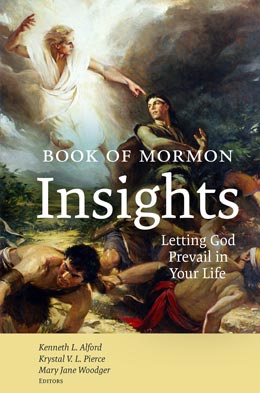
Christ and the Cup
Kevin L. Tolley
Kevin L. Tolley, "Christ and the Cup," in Book of Mormon Insights: Letting God Prevail in Your Life, ed. Kenneth L. Alford, Krystal V. L. Pierce, Mary Jane Woodger (Provo, UT: Religious Studies Center, Brigham Young University; Salt Lake City: Deseret Book), 242–53.
Kevin L. Tolley is director of the Institutes of Religion in Riverside, California.
 The Savior used the vivid, multidimensional image of the bitter cup to reveal his identity and mission to the Nephites. Jesus Christ Visits the Americas, by John Scott. Courtesy of Intellectual Reserve, Inc.
Nephite spectators were confused at the appearance of Jesus in Bountiful, thinking they were looking at an angel descending out of heaven (see 3 Nephi 11:8). Thus, as an initial introduction, the Savior carefully chose imagery that would resonate with his audience. His short, meaningful descriptions of his divinity had deep theological import for the Nephites. For example, in stating, “I have drunk out of that bitter cup” (v. 11), he at once revealed his identity and divine mission. The symbol of the bitter cup had roots in the ancient world and was called by a variety of names in the Hebrew Bible (e.g., the cup of fury, astonishment, trembling, and desolation). This imagery was used throughout prophetic literature. The cup also had a subtle presence in Nephite theology, often being associated with temple gatherings. For the Nephites, the symbol of the bitter cup was a vivid identifier of his character and divinity. The profound theological implications underlying this symbol are also vital to our spiritual journey today.
The Cup in a Trial of Ordeal
The cup is featured in Numbers 5, which describes a trial held to determine the faithfulness of a pregnant woman. If a woman was suspected of adultery but there was “no witness against her” (v. 13), she was to be brought to the tabernacle for a trial by ordeal. A priest would prepare bitter water for her to drink,[1] a process designed to produce “a curse” on the guilty (vv. 18–27).[2] In the Hebrew Bible the grammatical and lexical connections in this passage indicate the cup was considered more than bitter, but poisonous.[3] If manifested, the physical effects of the curse would determine the woman’s guilt; further, the ordeal of the bitter cup would “induce a miscarriage.”[4] Symbolically, this cup represented a curse to the guilty, a divine retribution for sin. Theologically, the bitter cup was associated with divine justice meted out as a result of a broken covenant and shattered relationship.
The Cup in Prophetic Literature
This cup appears to make other appearances in prophetic literature. Following common practice in the ancient Near East, Isaiah 51 personifies Jerusalem as a woman.[5] Whereas in Isaiah 54:11–12, Jerusalem is portrayed as an elegant woman adorned by Jehovah with the mural crown, in Isaiah 51 she appears intoxicated. She is called to awaken and arise—to “sober up” or “rouse herself”[6]—because her state of ruin is about to end: “Awake, awake, stand up, O Jerusalem, which hast drunk at the hand of the Lord the cup of his fury; thou hast drunken the dregs of the cup of trembling, and wrung them out” (v. 17). Here the cup is full of God’s “fury” or anger.[7] The root used for angermight also denote “the cup of his poison” or “venom” (see Deuteronomy 32:24, 33; Job 21:20). This cup was also known as “the cup of trembling” (Isaiah 51:17) or “the cup of staggering,”[8] the connotations being that even a sip can cause disorientation and that drinking all of it will cause death for the wicked.[9] Further, the cup was a symbol of one’s fate and destiny (see Psalm 16:5).[10]
In other prophetic literature, the cup contains liquid that causes the drinker to be “filled with shame” and left “uncovered,” that is, exposed (Habakkuk 2:16). Ezekiel says the cup is filled with “drunkenness and sorrow” and is called the cup of “astonishment and desolation” (Ezekiel 23:33). Such effects are the consequences of violated covenants.[11] In other texts of the Hebrew Bible, the cup is associated with red wine (see Isaiah 51:21; Psalm 75:8)[12] and has the image of the blood of war, slaughter, and destruction. Figuratively, it is “the grapes of wrath.” It is the eliciting of a verdict, a proof of guilt, and the imposition of a penalty.[13] All the guilty must partake of the cup of punishment (see Jeremiah 49:12). The warning is that within the cup resides the results of every misdeed, no matter how slight. The contents are collected and concocted into the awful consequences of our actions. Justice dictates that we drink our just deserts. The retribution is fair but awful. As one author worded it, “It is blood for blood, foaming vengeance for foaming malice.”[14] The sinful sediments sink to the bottom. The King James Version of the text refers to dregs—here the low points in a person’s life, those events we want to have buried at the bottom.[15] The text suggests, as one scholar proposes, the command “imbibing to the very last drop” (see Ezekiel 23:34).[16] Thus the text alludes to experiencing the full penalty of sins, imbibing the awful consequences to the very last drop.
The woman Jerusalem immediately receives the remarkable message that Jehovah wishes to take away the deserved cup (see Isaiah 51:22). One scholar observed that “God will serve as His own intercessor. Though He had to dispense justice to Israel (and to us from time to time), He also pleads on their (own) behalf.”[17] The cup is taken away, along with the punishment, heartache, sorrow, and pain. The King James Version of Isaiah reads, “Thus saith thy Lord the Lord, and thy God that pleadeth the cause of his people, Behold, I have taken out of thine hand the cup of trembling, even the dregs of the cup of my fury; thou shalt no more drink it again” (Isaiah 51:22). In a loving gesture, the cup is taken from her hand by Jehovah and she is promised that she will never drink the vile concoction again. The nature of Jehovah is revealed. His love and mercy are shown in this singular act.
Temple Imagery
The cup is alluded to in early Israelite worship in the tabernacle. The Hebrew Bible does not always give a complete description of the rites and rituals associated with the ancient temple. Although “the cup” is often referred to as a symbolic item in Israelite belief, the exact use and function of the cup in Israelite worship have been clouded over time.
Liquid offerings were regularly offered in the ancient temple.[18] These offerings came in two forms, either inside or outside the temple. Drink offerings performed in the outer courtyard were poured on the altar or at the altar’s base.[19] The other form occurred inside the tabernacle. On the table of shewbread were placed cups and bowls (see Exodus 25:29; compare Numbers 4:7). These were made of gold (see Exodus 25:29; 37:16), in contrast to the cups and bowls associated with the outer court, which were made of brass (see Exodus 27:2; 38:3). The material and location of these two sets of cups indicate they had different functions.
Compared to other religious sanctuaries in the Ancient Near East, the table in the Holy Place of the tabernacle carries interesting religious significance. In pagan temples it was often depicted as an offering table to feed the deity (or idol) that would reside there.[20] The priestly authors of the Hebrew Bible would often downplay the anthropomorphic aspects of Jehovah, and therefore the God inside the tabernacle did not need anything to drink or eat (see Exodus 30:9; compare Psalm 50:13).[21] The table was probably originally designed to be a symbolic offering for Jehovah.[22] A wine offering to Jehovah is compatible with biblical literature. Hannah brought wine as an offering on her journey to the tabernacle (see 1 Samuel 1:24), and Jehovah is also depicted with a cup of wine in his hand (see Psalm 75:8; compare Habakkuk 2:16; Jeremiah 51:7).[23] This would parallel themes well known from Israel’s neighbors in the Near East whose gods are depicted sitting on their throne as kings, each holding a goblet, cup, or bowl in his hand. Hebrew imagery would have shown Jehovah sitting enthroned in the temple with a cup in hand.[24]
The Book of Mormon Use of the Cup
Although temple imagery is rarely described in the Book of Mormon, liturgical aspects of the ancient temple permeate the book. The imagery of the cup made its way into Nephite theology and is mentioned in four contexts: Jacob’s sermon at the temple (see 2 Nephi 8:17–21), King Benjamin’s sermon at the temple (see Mosiah 3:25–26; 5:5), Alma’s counsel to his son Coriantumr (see Alma 40:26), and Christ’s appearance at the temple in Bountiful (see 3 Nephi 11:11). As will be seen the symbol of the “cup of wrath” or “bitter cup” is notably included in temple settings.
Jacob at the temple
Isaiah’s message about the cup is reflected in a speech by the prophet Jacob, Nephi’s younger brother. Connections between Jacob’s speech 2 Nephi 6–10) and ritual aspects have already been identified and examined.[25] Although the text of Jacob’s speech provides no specific historical context or setting, there is reason to believe that the sermon was in conjunction with the temple gathering associated with the fall festivals.[26] Jacob acts as the consecrated high priest (see 2 Nephi 5:26; 6:2; compare Leviticus 16:32) who has gathered the people of Nephi around the temple (see Leviticus 16:29–34; 23:27; Numbers 29:1–2) to teach, prophesy, and bless Israel (see 2 Nephi 6:1–5). Although it is not explicitly mentioned, the setting appears to be the fall gathering to commemorate the Day of Atonement and the beginning of a new year. These celebrations were associated with the evaluation of the covenant bond between the people and their God, the purpose being to remember and renew this bond through ritual activity (see Leviticus 23:24; 2 Nephi 9:39–46, 51–52). The central feature of this assembly was atonement (see 2 Nephi 9:7, 10–16; Leviticus 16:16, 30, 33) and the expulsion of sin out of the community (see 2 Nephi 9:8–10, 16, 19; Leviticus 16:5–10, 20–22).
As part of his speech at the newly established Nephite temple, Jacob, acting as high priest, quotes extensively from Isaiah, including the section referring to Jehovah’s taking the cup as a symbol of his ability to save a fallen people (see 2 Nephi 8:17–22; compare Isaiah 51:17–22). One scholar suggests that the text of Isaiah 51 had gained such popularity that it might have later functioned “as part of a liturgical performed in the Jerusalem temple” to celebrate YHWH’s ongoing role in sustaining the temple.[27] Quoting Isaiah, Jacob reminds those gathered at the temple that God sees them as “my people” (2 Nephi 8:16) despite shortcomings and failures (see v. 17) and that it is through the rites of sacred covenants that God will take the cup of his people’s deficiencies. This imagery represents fresh starts and new beginnings.
Benjamin at the temple
King Benjamin’s speech (Mosiah 1–6) also appears to be set sometime during the Israelite autumn festivals.[28] Amid this festival gathering, Benjamin is drawn repeatedly back to this cup imagery. He compares an individual’s and a community’s unrighteous actions, specifically a person who refuses to repent and becomes “an enemy to God” (Mosiah 2:38) and a community that is “no more blameless in the sight of God” (3:22). One’s “lively sense of his own guilt” (2:38)[29] is equated with the community’s “awful view of their own guilt” (3:25). Each will “shrink from the presence of the Lord” (2:38; 3:25) and feel the anguish of “an unquenchable fire” (2:38; compare 3:27). The imagery of the cup of wrath appears in both sections. The one who yields to this evil spirit is willfully rebelling against Jehovah and “drinketh damnation to his own soul” (2:33), a phrase repeated in Mosiah 3:25, where it clarifies, “Therefore, they have drunk out of the cup of the wrath of God.”[30] At the conclusion of the address, King Benjamin admonishes his people to enter into a covenant with God. Speaking for his people, he declares, “We are willing to enter into a covenant with our God to do his will” so that “we may not drink out of the cup of the wrath of God” (5:5) Keeping covenants appears to be the antithesis of this cup.
Alma and his son
Alma 40 stands in contrast to the previous two examples. As opposed to a public festival gathering in the temple, the setting is private and intimate, where issues of individual worthiness can be discussed. Speaking to his son Corianton, Alma warns his son of the consequences of his action. Using similar terminology from King Benjamin, Alma cautions that the wicked will be “consigned to partake of the fruits of their labors” (Alma 40:26; compare Mosiah 3:24–27. Those who are found wicked will “drink the dregs of a bitter cup” (Alma 40:26; compare Mosiah 3:18, 25–26). Although there is no specific reference to a liturgical context for this counsel, thematic elements remain concerning the cup containing God’s displeasure for wicked actions. It is interesting to note that the name of the cup shifts once again. The cup has been referred to as “the cup of his fury” (Isaiah 51:17), the “cup of astonishment and desolation” (Ezekiel 23:33), and the “cup of the wrath of God” (Mosiah 3:26; 5:5), but now it has become the “bitter cup” (Alma 40:26; compare 3 Nephi 11:11). With each title, a new dimension of the cup is revealed.
The cup in 3 Nephi 11
Third Nephi 11 has long been considered the crown jewel of the Book of Mormon because it features the appearance of the Son of God to the Nephites. The text depicts some twenty-five hundred men, women, and children gathered around the temple in Bountiful (see 3 Nephi 17:25). This gathering was probably associated with the New Year Festival.[31] Christ’s appearance would herald a new age. Through the din of the crowd, the Nephites heard a distinct voice with the introduction “Behold my Beloved Son” (3 Nephi 11:7). Although they repeatedly heard the voice, they did not understand. Even after seeing the descent of a man dressed in white, “they thought it was an angel” (v. 8). To clear the confusion, Jesus introduced himself in a quick succession of identifiable titles. One title that must have resonated with his Nephite audience was an old title used by ancient Israelite prophets like Isaiah and Jeremiah. It contained a symbol that Nephite prophets like Jacob and Benjamin also used, a symbol that must have been a part of the liturgy in which the people had come to the temple to participate. Jesus introduced himself by saying, “I have drunk out of that bitter cup which the Father hath given me, and have glorified the Father in taking upon me the sins of the world” (v. 11). This title of drinker of the bitter cup would have connected the Nephite audience to an important fact: the man standing before them was the one who had taken their cup and removed the pain and sorrow, the blood and anguish, the debilitating consequences of broken covenants and shattered lives. It was a clear declaration that the great Jehovah stood before them.
Half a world away, the Savior himself had previously described the initial moments of the Atonement using similar imagery. In Gethsemane, he prayed, “O my Father, if this cup may not pass away from me, except I drink it, thywill be done” (Matthew 26:42). While describing his atonement to the Prophet Joseph Smith, Jesus referred to suffering that “caused myself, even God, the greatest of all, to tremble because of pain, and to bleed at every pore, and to suffer both body and spirit—and would that I might not drink the bitter cup, and shrink” (Doctrine and Covenants 19:18). Thus the image of the cup connects with the theological underpinnings of the Atonement itself and is woven into the symbols of the ancient temple. The powerful concept at play is that individually and collectively we carry a cup of consequences for sin, and it is Jesus Christ who willingly takes the cup in a great act of redemptive mercy.
The Cup Imagery in Sacrament
Symbols of the ancient temple gatherings are still used in modern religious congregations. Temple imagery permeates the ordinance of the sacrament. Elder Delbert Stapley taught that “by partaking of the Sacrament we renew all covenants entered into with the Lord.”[32] In doing so we come with our bitter cups of broken covenants and trade them for the clear and cleansing cup of the sacrament. We are not always ready to give up our sins, but jealously hold on to our cups of misery. As the sacrament tray is passed, we are offered a small cup, a small portion of clarity and cleanliness. The clear water represents what the Savior is offering: life-giving, clear, clean water. We partake of this cup “in remembrance of the blood of thy Son” (Moroni 5:2), even the blood of “the Lamb of God, which taketh away the sin of the world” (John 1:29). In ancient Israel, the blood of the lamb ritually represented a type of spiritual detergent with the ability to make one clean. Symbolically we bring our cups, filthy and vile, filled with shortcomings, failure, and pain. As we partake of the sacrament, we symbolically give Him our cup of bitterness. He repeatedly takes it—week after week, day after day, in every moment. We trade retribution for salvation. Though the emblems of the sacrament are small portions and hardly a feast, it can fill the participant with new hope. The sacrament can bring a new beginning, a new era in our life through this trade. The Savior’s identity is wrapped in the imagery of the cup. He is the one who took the cup of judgment, retribution, fury, astonishment. He is the one who continues to take the cup today. We symbolically place our cups of guilt, sorrow, and pain before the Savior. He in turn promises to return a cup that is clear and pure. Yet this remarkable exchange does not end there—he offers us so much more. At his return he promises to come and sit with his Saints, a cup in hand (see Doctrine and Covenants 27:5), offering us a place at the table he has prepared with a cup of salvation that “runneth over” (Psalm 23:5).
Notes
[1] The Hebrew מררה is often translated as “poison,” specifically the poison of a snake (see Job 20:14, 16). See Ludwig Koehler and Walter Baumgartner, The Hebrew and Aramaic Lexicon of the Old Testament (Leiden, Netherlands: Brill, 1994), 639; hereafter HALOT.
[2] ארר in the piel form means to “bring under curse.” See HALOT, 91.
[3] William McKane, “Poison, Trial by Ordeal and the Cup of Wrath,” Vetus Testamentum 30, no. 4 (1980): 478. See HALOT, 1167–68, s.v. ראש.
[4] McKane, “Poison, Trial by Ordeal and the Cup of Wrath,” 477–78.
[5] See Alison R. Gray, “Reflections on the Meaning(s) of עיר in the Hebrew Bible,” in The City in the Hebrew Bible: Critical, Literary and Exegetical Approaches, ed. James K. Aitken and Hilary Marlow (London: T&T Clark, 2018), 18.
[6] Shalom M. Paul, Isaiah 40–66: Translation and Commentary (Grand Rapids, MI: Eerdmans, 2012), 376.
[7] “God’s wrath springs from wounded love.” Jan Leunis Koole, Isaiah III: Historical Commentary on the Old Testament (Kampen, Netherlands: Kok Pharos), 2:206.
[8] Paul, Isaiah 40–66, 377.
[9] See Erhard S. Gerstenberger, Psalms: Psalms Part 2 and Lamentations (Grand Rapids, MI: Eerdmans, 2001), 83.
[10] See Paul, Isaiah 40–66, 377.
[11] See Gregory Glazov, The Bridling of the Tongue and the Opening of the Mouth in Biblical Prophecy (Sheffield, England: Sheffield Academic, 2001), 146.
[12] See also McKane, “Poison, Trial by Ordeal and the Cup of Wrath,” 488. Compare Genesis 49:11–12; Isaiah 63:2–6.
[13] See McKane, “Poison, Trial by Ordeal and the Cup of Wrath,” 490–91.
[14] Charles H. Spurgeon, The Treasury of David: Containing an Original Exposition of the Book of Psalms (Toronto: Funk & Wagnalls, 1892), 392.
[15] KJV Isaiah 51:17 translates קבעת as “dregs.” The meaning of the Hebrew word קבעת is “cup.” See HALOT, 1062. Psalms 75:8 uses the term dregs (שׁמר) in association with this cup of retribution. Apparently the cup does have some kind of pulp or lees that sink to the bottom. It could refer to “grime stuck at the bottom of a well,” “poison that has been steeped in a vessel,” a symbolic representation of the weightier sins. See HALOT, 1585, s.v. שׁמר.
[16] Paul, Isaiah 40–66, 377.
[17] Kerry Muhlestein, Learning to Love Isaiah: A Guide & Commentary (American Fork, UT: Covenant Communications, 2021), 422.
[18] The drink offering represents an ancient form of worship. It is often prescribed (mostly negatively through prohibitions) but never described. See Baruch A. Levine, Numbers 1–20, vol. 4a of The Anchor Bible (New York: Doubleday, 1993), 385–92.
[19] See Jacob Milgrom, Numbers: The Traditional Hebrew Text with the New JPS Translation Commentary (Philadelphia: Jewish Publication Society, 1990), 26. See also Wisdom Ben Sira (Ecclesiasticus) 50:14–21; and Josephus, Antiquities, 3.9.4.
[20] See Menahem Haran, Temple and Temple Service in Ancient Israel (Oxford: Clarendon Press, 1978), 216.
[21] See Jacob Milgrom, Leviticus 1–16: A New Translation with Introduction and Commentary,vol. 3 of The Anchor Bible (Doubleday: New York, 1991), 59.
[22] See Pernille Carstens, “The Golden Vessels and the Song to God Drink-Offering and Libation in Temple and on Altar,” Scandinavian Journal of the Old Testament 17, no. 1 (2003): 121; and Haran, Temple and Temple Service in Ancient Israel, 216–17.
[23] See Pernille Carstens, “Why Does the God Have a Cup in His Hand?,” Scandinavian Journal of the Old Testament 12 (1998): 224.
[24] Ancient gods and kings were often depicted in art as sitting on a cherubim throne holding a cup in hand. See Menahem Haran, “The Bas-Reliefs on the Sarcophagus of Ahiram King of Byblos in the Light of Archaeological and Literary Parallels from the Ancient Near East,” in Israel Exploration Journal 8, no. 1 (1958): 21–22; Gordon Loud, The Megiddo Ivories (Chicago: University of Chicago Press, 1939), plate 4.2a–b; and James B. Pritchard, The Ancient Near East: Supplementary Texts and Pictures Relating to the Old Testament (Princeton, NJ: Princeton University Press, 1969), 451, 477.
[25] See John S. Thompson, “Isaiah 50–51, the Israelite Autumn Festivals, and the Covenant Speech of Jacob in 2 Nephi 6–10,” in Isaiah in the Book of Mormon, ed. Donald W. Parry and John W. Welch (Provo, UT: Foundation for Ancient Research and Mormon Studies; Salt Lake City: Deseret Book, 1998), 123–50; and David E. Bokovoy, “Ancient Temple Imagery in the Sermons of Jacob,” Interpreter: A Journal of Latter-day Saint Faith and Scholarship 46 (2021): 31–46.
[26] See John W. Welch, “The Temple in the Book of Mormon: The Temples at the Cities of Nephi, Zarahemla, and Bountiful,” in Temples of the Ancient World: Ritual and Symbolism, ed. Donald W. Parry (Salt Lake City: Deseret Book, 1994), 297–387. See also William Hamblin, “Jacob’s Sermon (2 Nephi 6–10) and the Day of Atonement,” https://
[27] Marvin A. Sweeney, Isaiah 40–66 (Grand Rapids, MI: Eerdmans, 2016), 199.
[28] See Hugh Nibley, “Old World Ritual in the New World,” in An Approach to the Book of Mormon (Salt Lake City: Deseret Book, 1988), 295–310. See also John A. Tvedtnes, “King Benjamin and the Feast of Tabernacles,” in By Study and Also by Faith (Salt Lake City: Deseret Book, 1990), 2:197–237; and Terrence Szink and John W. Welch, “King Benjamin’s Speech in the Context of Ancient Israelite Festivals,” in King Benjamin’s Speech: “That Ye May Learn Wisdom” (Provo, UT: Foundation for Ancient Research and Mormon Studies, 1998), 147–223.
[29] All instances of italic for emphasis in scripture citations are mine.
[30] Brant A. Gardner, Second Witness: Analytical and Contextual Commentary on the Book of Mormon (Salt Lake City: Greg Kofford Books, 2007), 3:162.
[31] See John A. Tvedtnes, “The Timing of Christ’s Appearance to the Nephites,” The Most Correct Book: Insights from a Book of Mormon Scholar (Salt Lake City: Cornerstone, 1999), 251–69; S. Kent Brown and John A. Tvedtnes, “When Did Jesus Appear to the Nephites in Bountiful?,” FARMS Paper (Provo, UT: FARMS, 1989); and John W. Welch, The Sermon at the Temple and the Sermon on the Mount: A Latter-Day Saint Approach (Salt Lake City: Deseret Book, 2010), 29.
[32] Delbert L. Stapley, “This Pearl Beyond Price,” in Conference Report, October 1965, 14. Elder David A. Bednar also said, “As we partake of the sacrament, we look to the temple.” “Honorably Hold a Name and Standing,” Ensign or Liahona, May 2009, 97.
