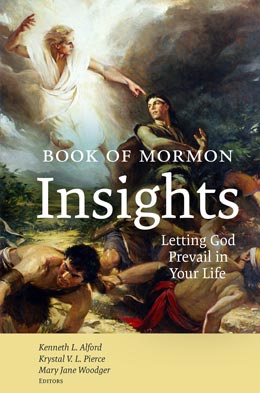
Abinadi and the Witness of Jesus Christ

Nicholas J. Frederick

Nicholas J. Frederick, "Abinadi and the Witness of Jesus Christ," in Book of Mormon Insights: Letting God Prevail in Your Life, ed. Kenneth L. Alford, Krystal V. L. Pierce, Mary Jane Woodger (Provo, UT: Religious Studies Center, Brigham Young University; Salt Lake City: Deseret Book), 92–102.

Nicholas J. Frederick is an associate professor in the Department of Ancient Scripture at Brigham Young University.

Abinadi before King NoahIn one of the most dramatic scenes in the Book of Mormon, Abinadi offers a fervent defense before King Noah that included a powerful witness of Jesus Christ reinforced by the words of Isaiah. Courtesy of Intellectual Reserve, Inc.

The Book of Mormon is truly “Another Testament of Jesus Christ.” The Nephite prophets, beginning with Nephi and ending with Moroni, are consistent in their witness of Jesus’s divinity, his majesty, and his mission.[1] The Nephite prophet Abinadi, who lived about 150 BC, is a wonderful example of this witness. Arrested and brought before King Noah and his court, and facing a possible death sentence, Abinadi delivers a defense speech that presents the Book of Mormon’s clearest attempt to deconstruct the dual roles of Jesus Christ as human and God, as Father and Son. In other words, Abinadi’s speech provides one of the best examples in the Book of Mormon of Christology, the study of who Jesus Christ is. As such, it is also one of the more theologically complicated parts of the Book of Mormon, as both Noah’s priests and Abinadi use passages from Isaiah to support their positions and substantiate their arguments.

In this essay we will explore the arguments laid out by both Abinadi and the priests of Noah, with an eye especially toward how understanding this crucial interaction can strengthen our testimony of the Savior and his nature. We will do this by looking first at how Abinadi contrasts the law of Moses with redemption through Jesus Christ. Second, we will explore the use of Isaiah passages by Noah’s priests and Abinadi. Finally, we will consider how Abinadi’s use of Isaiah leads him to lay out one of his most complicated ideas, namely the dual roles of Jesus as Father and Son. Ultimately, we seek to further understand what Abinadi means when he asks what our mortal experience would be like “if Christ had not come into the world” (Mosiah 16:6).

The Book of Mormon account provides little detail about Abinadi’s life before his initial public rebuke of King Noah, only that he was “a man among them” (Mosiah 11:20). While the well-known painting by Arnold Friberg hints toward an Abinadi advanced in age, he could just as easily be twenty as seventy.[2] Noah had released all the priests who had served his father Zeniff and replaced them with priests of his own (see 11:5), and perhaps Abinadi had been part of that group, a friend to the former king and a foe to the present one. Noah clearly holds Abinadi in low regard, asking wrathfully, “Who is Abinadi, that I and my people should be judged of him?” (v. 27). Yet judge him Abinadi does. In a first visit he delivers a series of conditional prophecies (“except they repent and turn to the Lord . . . ,” vv. 20–25). This first visit is followed up by a second visit in which the previously conditional prophecies have now become unconditional prophecies (“And it shall come to pass that . . . ,” 12:2–8). Noah and his priests, however, argue that Abinadi has no grounds for his condemnation. After all, Noah and his people “are strong, we shall not come into bondage, or be taken captive by our enemies; yea, and thou hast prospered in the land, and thou shalt also prosper” (v. 15). The foundational Nephite covenant, repeated throughout the Book of Mormon, states that “inasmuch as ye shall keep my commandments, ye shall prosper” (1 Nephi 2:20; see 2 Nephi 1:9, 20; Jarom 1:9; Omni 1:6; Mosiah 1:7; 2:22, 31). Noah and his priests prospered; thus (in their minds) they were keeping the commandments. Abinadi, quite simply, must be mistaken, and so he is cast into prison (Mosiah 12:17).

With Abinadi in prison, the priests counsel together to find something “wherewith to accuse him.” However, Abinadi “answered them boldly, and withstood all their questions” (Mosiah 12:19). Finally, perhaps as a last resort, the priests decide to ask Abinadi to interpret a passage from Isaiah, 52:7–10:

How beautiful upon the mountains are the feet of him that bringeth good tidings; that publisheth peace; that bringeth good tidings of good; that publisheth salvation; that saith unto Zion, Thy God reigneth; Thy watchmen shall lift up the voice; with the voice together shall they sing; for they shall see eye to eye when the Lord shall bring again Zion; Break forth into joy; sing together ye waste places of Jerusalem; for the Lord hath comforted his people, he hath redeemed Jerusalem; The Lord hath made bare his holy arm in the eyes of all the nations, and all the ends of the earth shall see the salvation of our God? (Mosiah 12:21–24)

While the priests’ reasoning for picking this particular passage is not obvious, they likely believed that whatever interpretation Abinadi provided would be grounds for condemnation.[3] After all, did not they, as priests, bear the responsibility of interpreting scripture? Seizing his chance, Abinadi defers providing an interpretation and instead assails the priests’ arrogance in presuming to understand scripture yet perverting the words of the Lord. For the next three and a half chapters, Abinadi will illustrate for the priests the foundation of sand upon which they have built their house, for they have missed one essential gospel truth—salvation comes only in and through Jesus Christ.[4]

Abinadi begins this section of his speech by differentiating between the law of Moses and redemption through Jesus Christ. The law of Moses undoubtedly played a significant role in the religious order laid down by Moses in the Hebrew Bible, and adherence to its tenets was expected of Jehovah’s people. But the primary significance of the law of Moses came through understanding that its “performances” and “ordinances” served as “types of things to come” (see Mosiah 13:30–31). According to Abinadi, the Law of Moses directs the attention of believers toward the true manner of salvation, faith in Jesus Christ, but it does not bring redemption in and of itself. Nephi understood this principle. He wrote that he and his children kept the law of Moses because they were commanded to, but all the while they were aware of the “deadness of the law” (2 Nephi 25:27). The prophets and teachers who came after Nephi continued in this belief (see Jarom 1:11). The priests of Noah, however, lack this awareness, and this is their fundamental theological mistake. They claim to be followers of the law of Moses, which may be true (Abinadi’s words in Mosiah 12:34–37 suggest otherwise), but they misinterpret the law of Moses to be the means of their salvation rather than a “type” of redemption through the Savior (Mosiah 12:32). Noah and the priests, frustrated at Abinadi’s chastisement, attempt to lay their hands on him, but in a remarkable moment, Abinadi undergoes a transformation: “and his face shone with exceeding luster, even as Moses’ did while in the mount of Sinai, while speaking with the Lord” (13:5). The implication is clear—Abinadi stands in Moses’s place. It is he, not the priests of Noah, who can properly explicate the Mosaic tradition and interpret Moses’s law. It is Abinadi who speaks “with power and authority from God” (v. 6).

Having established the true nature of the law of Moses, Abinadi shifts his focus to the topic of who the Messiah will be. If salvation comes not through the law but through the Messiah, what kind of being will the Messiah be? Abinadi asserts that Moses, as well as other prophets, have testified about the coming of the Messiah, chiding the priests for their lack of scriptural acuity.[5] The wording of Abinadi’s claim is crucial: “Have they not said that God himself should come down among the children of men, and take upon him the form of man, and go forth in mighty power upon the face of the earth? Yea, and have they not said also that he should bring to pass the resurrection of the dead, and that he, himself, should be oppressed and afflicted?” (Mosiah 13:34–35).

Abinadi declares that the Messiah will be more than a man, more than a prophet. Furthermore, the Messiah, remarkably, will be “God himself.” Jehovah, the divine being supposedly worshipped by the priests, the Lord himself, will “take upon him the form of man.” The priests’ confusion is understandable on this point. Logically, Gods do not aspire to become humans; rather, humans aspire to become Gods. Why would God do this? Why would he desert his heavenly throne to assume an earthy existence? Abinadi focuses on two key reasons why it is necessary for God to become human: to “bring to pass the resurrection of the dead” and to be “oppressed and afflicted.”

As a means of demonstrating to Noah’s court the rationale behind what may initially have seemed absurd, Abinadi returns to the text that began this entire debate, the book of Isaiah. Whereas the priests attempted to use Isaiah 52:7–10 to expose Abinadi as a false prophet, in an ironic turn Abinadi will use Isaiah 53 to demonstrate he is a true prophet. Isaiah 53 is one of that prophet’s grandest compositions, a prophecy about a suffering servant who, afflicted and oppressed, will lead Israel to salvation, a figure Abinadi equates with “God himself,” the Messiah. This servant, Isaiah prophesies, will grow up “as a tender plant, and as a root out of dry ground” (Isaiah 53:2). Rather than initiating his arrival with a grand entrance, such as arriving on a chariot in Jerusalem or Rome, as might be expected of “God himself,” the Messiah will experience life as each of us does, born as a baby and gradually increasing in learning and experience. The reference to “dry ground” may be a reference to Nazareth, a small town in Galilee that is a far cry from a city like Jerusalem. Isaiah further states that the servant will possess “no form nor comeliness; and when we shall see him there is no beauty that we should desire him” (Isaiah 53:2). Those living in the ancient world associated physical attractiveness with deity, but the Messiah will not appear any different in physical appearance from those around him. His life will be a difficult one, as he will be “despised and rejected of men; a man of sorrows, and acquainted with grief” (Isaiah 53:3). In words that are somehow just as true today as they were two thousand years ago, each of us, Isaiah suggests, bears some responsibility for this since “we hid as it were our faces from him” and “we esteemed him not” (v. 3; emphasis added).

The mission of this servant, Isaiah continues, is to bring healing through his own individual suffering. “He hath borne our griefs, and carried our sorrows. . . . He was wounded for our transgressions, he was bruised for our iniquities” (Isaiah 53:4–5). It would be a mistake, Isaiah warns, to look at the servant and see him as “stricken, smitten of God” (v. 4) because of what he himself had done; rather, he suffers in our place. In a statement filled with resounding pathos, Isaiah illustrates the paradox of the suffering servant and salvation: “the chastisement of our peace was upon him; and with his stripes we are healed” (v. 5). Realistically, “chastisement” does not always result in “peace,” and bloody welts or wounds (“stripes”) rarely cause someone to be “healed.” Yet this is precisely what the servant (i.e., the Messiah) will do. He will suffer in place of the guilty; he will pay the penalty incurred by the rebellious. Could anyone other than “God himself” endure such pain? We can begin to appreciate why Abinadi would turn to Isaiah 53 at this point in his argument. The priests’ claim that salvation comes through the law of Moses pales in comparison to the condescension of God. They must be made to see just how faulty their assumption is and come to recognize the divine merit required to bring to pass salvation. But salvation at what cost? The servant will be led as “a lamb to the slaughter,” yet he “openeth not his mouth” (v. 7).

Fortunately, the servant finds resolution in verse 10: “Yet it pleased the Lord to bruise him; he hath put him to grief; when thou shalt make his soul an offering for sin he shall see his seed, he shall prolong his days, and the pleasure of the Lord shall prosper in his hand.” Abinadi will resolve the meaning behind “he shall see his seed” later on, but here we want to highlight the first phrase: “it pleased the Lord to bruise him.” “The Lord” (Heb. Yahweh) refers to Jehovah, the God of the Israelites. Him refers to Jehovah’s servant who suffers on behalf of the people. So, in other words, we might say, “It pleased Jehovah to bruise the Messiah, Jesus.” Latter-day Saints understand Jehovah and Jesus to be the same being, with “Jehovah” being the title given to the premortal Jesus Christ in his role as God of Israel before his condescension.[6] When Abinadi says that “God himself” will come down, it is Jehovah he is referring to. On the surface, that statement seems to make little sense: It pleased (the premortal) Jesus to bruise (the mortal) Jesus? How can that be when they are the same person?

Abinadi turns to this very question as chapter 15 opens. Here readers encounter what is undeniably one of the most difficult and misunderstood passages in the entire Book of Mormon.[7] The confusion arises due to Abinadi’s use of two titles: “Father” and “Son.” Often, readers of scripture (including Latter-day Saints) associate any reference to “Father” with Heavenly Father, Elohim, the father of our spirits. Likewise, readers typically associate any reference to “Son” with Jesus Christ, the “only begotten” son of Heavenly Father in the flesh. Yet such a reading makes little sense when we consider Abinadi’s use of Isaiah 53. Thus far, Abinadi has been arguing that “God himself,” Jehovah, will come down to earth as the Messiah, the servant who will suffer on behalf of Israel. To put it simply, one being (God himself) will play two roles (Jehovah/Messiah). It is this duality of roles that Abinadi refers to when he begins his discussion of “Father” and “Son” in Mosiah 15.[8]

As Abinadi explains, Jesus Christ can accurately be referred to as “Son” due to his condescension, because he came to earth to assume a mortal body and “dwelleth in flesh” (Mosiah 15:2). Because Jesus was “conceived by the power of God,” he can also accurately be called the “Father” (v. 3). As Jesus progressed through mortality, he found occasion to subject his mortal or human self, what Abinadi terms the “flesh,” to the “Spirit,” or his immortal or divine self (v. 5). But he did not yield to temptation; rather, Jesus allowed himself to be mocked, scourged and crucified, “cast out, and disowned by his people” (v. 5). Together, the mortal nature of Jesus, the “Son,” and the immortal nature of Jesus, the “Father,” are “one God, yea, the very Eternal Father of heaven and of earth” (v. 4). Similarly, when Jesus says, “the spirit indeed is willing, but the flesh is weak” (Matthew 26:41), he is not talking about different people but how people have different natures. The reason why Jesus needed to possess both natures is laid out in subsequent verses: “the will of the Son” is “swallowed up in the will of the Father,” and Jesus, through his sacrifice, achieves “victory over death” and receives the power “to make intercession for the children of men” (Mosiah 15:7–8).

Abinadi now seeks to resolve the phrase from Isaiah 53 that thus far had gone unmentioned: what does it mean that the servant will “see his seed?” (v. 10). Isaiah’s prophecy does not refer to any physical offspring the servant will have, but rather to his spiritual progeny. Jesus, the suffering servant who overcame death and lives again, now functions as Father for those who take his name upon them, what King Benjamin referred to as “the children of Christ, his sons, and his daughters” (Mosiah 5:7).[9] When those of us who serve as his disciples declare our loyalty to him, we are “spiritually begotten,” newborns in the gospel who strive to emulate the image and ideals of our spiritual parent. And who is the “seed” that Jesus will look upon?

Behold I say unto you, that whosoever has heard the words of the prophets, yea, all the holy prophets who have prophesied concerning the coming of the Lord—I say unto you, that all those who have hearkened unto their words, and believed that the Lord would redeem his people, and have looked forward to that day for a remission of their sins, I say unto you, that these are his seed, or they are the heirs of the kingdom of God. (Mosiah 15:11)

Additionally, Abinadi includes “they whose sins he has borne” and “every one that has opened his mouth to prophesy, that has not fallen into transgression” as deserving to be called “his seed” (vv. 12–13). Here, fittingly, Abinadi returns to the beginning and quotes Isaiah 52:7 and answers the question first posed to him by the priests all the way back in Mosiah 12:20–24. Prophets do indeed bring words of peace, as Isaiah had said, and Abinadi stands vindicated as a prophet, for he has fulfilled Isaiah’s words and brought words of peace, the true “good news” that God himself will condescend, live a mortal life, be raised up, and provide spiritual salvation for all those who come unto him.

As for the meaning of Isaiah 52:8–10, Abinadi explains that Zion is redeemed and the arm of the Lord revealed not through any sort of temporal conquest and restoration of land, as the priests may have supposed, but through the conquest of death and the restoration of the body at the First Resurrection. This resurrection, Abinadi explains, includes all the prophets and those who have heard their words, those who died in ignorance before the mortal ministry of Jesus, and finally (and reassuringly for parents everywhere) “little children [, who] also have eternal life” (see Mosiah 15:24–25). Rather ominously, Abinadi warns that those who “have known the commandments of God” but do not follow them shall have “no part in the first resurrection” (v. 26). Even the most stubborn of Noah’s priests could hardly have mistaken who Abinadi had in mind as he uttered these last words of warning.

Unfortunately for Abinadi, but hardly surprising considering his audience, the trial ends not with his deserved vindication but with his condemnation. After much deliberation, the priests seem to settle on a charge of blasphemy (see Leviticus 24:16) due to Abinadi’s claim that “God himself shall come down among the children of men” (Mosiah 15:1), although the real issue seems to be Noah’s claim that Abinadi “hast spoken evil concerning me and my people” (17:8).[10] Abinadi responds to the charge by declaring that his death will “stand as a testimony against you at the last day” (v. 10). Abinadi’s words have such an effect on King Noah that he is willing to release Abinadi until the priests convince him to follow through with the punishment by adding an additional charge against Abinadi, the claim that he “has reviled the king” (v. 12; see Exodus 22:28).[11] Abinadi is bound and burned to death, but not before uttering one final prophecy, that Noah and his priests “shall suffer, as I suffer, the pains of death by fire” (v. 18).[12]

For me, one of Abinadi’s key contributions, one of the reasons I continue to return again and again to his story, is that he forces his readers to grapple with the question of what would our world, our lives, be like if the Savior were absent from it. Toward the end of his speech, Abinadi states: “And now if Christ had not come into the world, speaking of things to come as though they had already come, there could have been no redemption. . . . There could have been no resurrection” (Mosiah 16:6–7). It is as if he is saying, “Now that I have told you just how important the Messiah is, what it means that ‘God himself’ would come down and live among us, I want you to imagine what things would be like if he did not.” We are fortunate that we live in a world where the Book of Mormon and its words are constantly at our fingertips. We may still search for Jesus, but that is usually with the assumption that we can find him. What would our lives be like if there were no Jesus? What would motivate us? Where would we find our peace and solace? What would we cling to when our fears and anxieties became too intense? How would we grapple with the suffering or death of loved ones? I, for one, am glad I do not have to worry about discovering the answers to those questions, although I am grateful to Abinadi for forcing me to ponder them.

Notes

[1] See, for example, 1 Nephi 11–14 and Ether 12.

[2] For a discussion of Friberg’s work, particularly his portrayal of Abinadi, see Paul C. Gutjahr, The Book of Mormon: A Biography (Princeton: Princeton University Press, 2012), 166–73.

[3] Joseph M. Spencer astutely teases out some of the more likely (and less likely) reasons for the priest’s decision to cite Isaiah 52:7–10 in his book An Other Testament: On Typology (Salem, OR: Salt Press, 2012), 142–47. See also John W. Welch, The Legal Cases in the Book of Mormon (Provo, UT: Brigham Young University, 2008), 175–77.

[4] A thorough exploration of both Abinadi’s and the priests’ interpretation of Isaiah 52:7–10 can be found in Frank F. Judd Jr., “Conflicting Interpretations of Isaiah in Abinadi’s Trial,” in Abinadi: He Came Among Them in Disguise, ed. Shon D. Hopkin (Provo, UT: Religious Studies Center, Brigham Young University, 2018), 67–92.

[5] It is hard to know what Abinadi has in mind here as far as Moses’s teaching on the coming of the Messiah. Deuteronomy 18:15–18 would be the most likely candidate, supposing Abinadi is not referring to something preserved only on the brass plates, which do seem to contain much more explicit messianic prophecies than the Hebrew Bible does today. See 1 Nephi 19:8–17 and Alma 33:12–17.

[6] See the discussion in Charles R. Harrell, This Is My Doctrine: The Development of Mormon Theology (Salt Lake City: Greg Kofford Books, 2011), 177–78.

[7] Harrell, in This Is My Doctrine, 109–12, does a nice job untangling the possible interpretations of Mosiah 15:2–5 (and other places in Restoration scripture where a similar distinction is made in respect to Jesus’s dual roles).

[8] For other places where Jesus is identified in a similar fashion, as “Father” and “Son,” see 3 Nephi 1:14, Ether 3:14, and Doctrine and Covenants 93:2–4. This role of Jesus as both “Father” and “Son” was clarified in a 1916 First Presidency letter. See James R. Clark, comp., Messages of the First Presidency of the Church of Jesus Christ of Latter-day Saints, 6 vols. (Salt Lake City: Bookcraft, 1965–75), 5:27, 31–32.

[9] For a discussion of the similarities between King Benjamin’s speech and Abinadi’s speech, including the possibility that Abinadi was the angel seen by King Benjamin, see Todd Parker, “Abinadi: The Man and the Message (Part 1),” FARMS Book of Mormon Lecture Series (Provo: UT: FARMS, 1996), https://archive.interpreterfoundation.org/farms/pdf/preliminary_reports/Parker-Abinadi-The-Man-and-the-Message-part-1-and-The-Message-and-the-Martyr-Part-2-1996.pdf.

[10] See discussion in Welch, Legal Cases in the Book of Mormon, 193–95.

[11] See discussion in Welch, Legal Cases in the Book of Mormon, 199–201.

[12] The manner of death suffered by Abinadi is ambiguous. While modern artistic depictions show Abinadi suffering death in something akin to being “burned at the stake,” the manner of death was likely much different and more painful. See discussion in Mark Alan Wright and Kerry Hull, “Ethnohistorical Sources and the Death of Abinadi,” in Abinadi: He Came Among Them In Disguise, 209–32.