
 menu icon in the top, right corner of the screen.
 icon above to close this box.
 icon at the bottom of the screen below the browser—if you don't see it, swipe up to unhide it.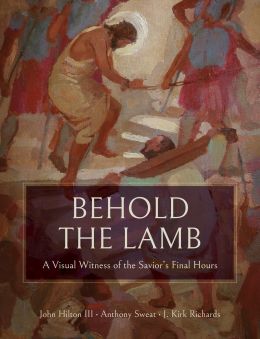
Introduction
John Hilton III, Anthony Sweat, and J. Kirk Richards, "Introduction," in Behold the Lamb: A Visual Witness of the Savior's Final Hours (Provo, UT: Religious Studies Center, Brigham Young University, 2026), 1–5.
 Image 1
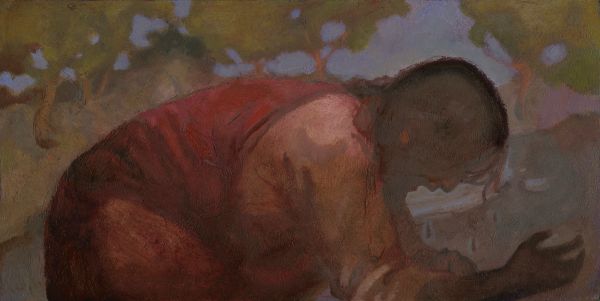 Image 2
 Image 3
 Image 4
 Image 5
 Image 6
Imagine you were asked to choose one of the above paintings to hang in your home. Which would you choose and why?
What did you decide? Did your preference lean toward a moment of Christ in the Garden of Gethsemane, prayerfully submitting to his Father’s will, or the image of his ultimate sacrifice on the cross? While both moments are central to the Savior’s Atonement, research indicates that Latter-day Saints have a strong preference for depictions of Gethsemane over Calvary. In 2019, these same six artistic images—one painting of Gethsemane and one of Calvary from three artists representing different periods and styles to mitigate artistic bias—were given to 853 BYU students in a survey asking which one they would choose to hang in their home. In total, 97 percent chose one of the Gethsemane images. In contrast, when given the same six images to students at a Christian university, 34 percent selected a painting of the Crucifixion.[1]
This disparity in artistic preferences reveals a distinctive feature of Latter-day Saint theology and culture. Although President Jeffrey R. Holland shared that in the temple room where the First Presidency and Twelve meet hang paintings of both Christ’s Crucifixion and the Resurrection,[2] Crucifixion artwork typically does not appear in Latter-day Saint Church buildings. As scholar Douglas J. Davies observed, “Amidst Christian traditions, Mormonism stands out both iconographically and theologically in the way it gives higher priority to Christ in Gethsemane than to Christ on the Cross.”[3]
This visual imbalance is particularly striking given the doctrinal emphasis placed on Christ’s death in scripture and prophetic teachings. Although many Latter-day Saints focus on Gethsemane more than Calvary when contemplating the Savior’s Atonement, the standard works heavily emphasize the significance of Christ’s Crucifixion relative to his suffering in Gethsemane.[4] While at least two powerful passages of scripture explicitly teach that Christ suffered for our sins in Gethsemane, more than fifty verses specifically link Christ’s death with our salvation.[5] Joseph Smith spoke of Christ’s death more than thirty times but referred to Gethsemane only once.[6] Across thousands of talks by Church leaders recorded in the Journal of Discourses and given in general conferences through 2020, for each reference to the atoning power of Gethsemane, there are more than five references to the atoning power of Christ’s death.[7] None of this is meant to downplay the eternal importance of what transpired in Gethsemane, but to limit our focus mostly on Gethsemane—both artistically and salvifically—misses scriptural and prophetic emphases on the doctrinal significance of Christ’s Crucifixion.
Some Latter-day Saints we have spoken with have felt that it was primarily in Gethsemane that Christ suffered for our sins. And yet in 2018, President Russell M. Nelson taught, “In the Garden of Gethsemane, our Savior took upon Himself every pain, every sin, and all of the anguish and suffering ever experienced by you and me and by everyone who has ever lived or will ever live. Under the weight of that excruciating burden, He bled from every pore. All of this suffering was intensified as He was cruelly crucified on Calvary’s cross.”[8] Whatever we conceptualize as transpiring in Gethsemane was intensified on the cross, indicating its vital importance in the Savior’s Atonement, and suggesting that artwork representing this event would indeed be valuable.
The Power of Art and This Book’s Purpose
Art not only reflects cultural values but also has the power to shape and transform them. Its didactic and visual impact can embed truths deeply into the hearts and minds of individuals, often more profoundly than written or spoken words. Think of how Arnold Friberg’s masterful Book of Mormon paintings have highlighted key stories in the text for generations of Saints. But what if Friberg had not painted Samuel the Lamanite dramatically evading arrows on the wall, but instead painted the siege of the Gadianton robbers in 3 Nephi 3? While we can’t say definitively, it is likely that story would be much better known and used by Church members than at present. This is because, as one art historian has written, “[Art] has the power to shape belief, influencing the way Mormons tell scriptural stories and understand doctrinal lessons.”[9]
Because art has the capacity to catalyze cultural change, it presents a powerful opportunity to instill in Latter-day Saints a deeper appreciation for the atoning significance of Christ’s sacrifice on Calvary. That is what this book aims to accomplish. Many Christian faiths readily embrace and some abound in beautiful and moving Crucifixion-centered artistic imagery. For various reasons, as of yet, the Latter-day Saint corpus of imagery has relatively few Crucifixion images compared to images of Gethsemane and the Resurrection. There is a great need to create, accumulate, and celebrate contemporary Latter-day Saint paintings of the final hours of Christ’s life.
Although some Latter-day Saints are uncomfortable focusing on Christ on the cross,[10] the scriptures repeatedly invite us to reflect upon the Savior’s Crucifixion. For example, Mormon wrote to his son Moroni, “May Christ lift thee up, and may his sufferings and death . . . rest in your mind forever” (Moroni 9:25; emphasis added). Similarly, Jacob wrote, “We would to God that we could persuade all [to] . . . believe in Christ, and view his death” (Jacob 1:8; emphasis added). Commenting on this passage, scholar Deidre Green wrote, “The operative definition of the word view during Joseph Smith’s time was ‘to survey intellectually; to examine with the mental eye; to consider the subject in all its aspects.’ Additionally, a sense from the Latin root is that of reaching or extending toward the object one views. Jacob desires for everyone to contemplate thoroughly the multifaceted death of Christ in a way that requires each person to reach or extend toward it.”[11]
In a modern revelation, Jesus Christ himself commanded, “Look unto me in every thought; doubt not, fear not. Behold [meaning “view”] the wounds which pierced my side, and also the prints of the nails in my hands and feet” (Doctrine and Covenants 6:36–37; emphasis added). These scriptural invitations call us to view the Crucifixion not as a symbol of despair but as focal point of our faith in Jesus Christ. Not to avoid it, but to embrace it. Thus, it may be that increasing the awareness, availability, quantity, and quality of artistic images of the crucified Christ will help Latter-day Saints feel greater spiritual contemplation as they “behold . . . the prints of the nails in [his] hands and feet.”
The purpose of this book is to showcase contemporary artwork from Latter-day Saint artists depicting the events from the final twelve hours of Christ’s life—Good Friday—from his trial before Caiaphas to his burial. Although our first chapter begins and concluding chapter ends with images by Anthony Sweat portraying Gethsemane and the resurrected Lord, we have purposely not focused on Gethsemane or Resurrection artwork in this volume, because there is already an abundant artistic curriculum in existence for Latter-day Saints on those central subjects. Instead, we hope to shine a light on an underdeveloped yet important area of Latter-day Saint artwork. Our hope is that highlighting the events of Good Friday and the Lord’s death through artwork can deepen our understanding of and appreciation for the Savior’s redemptive suffering and help us “view his death” (Jacob 1:18).
In 2023, artists Julie Ann Lake-Diaz, Emilie Buck Lewis, and Maureen Merrell organized an art exhibit titled “The Greatest Act of Love” based on the book Considering the Cross, by John Hilton III. Inspired by this exhibit and hoping to help foster and bring together more artworks to assist in a visual canon of Crucifixion-centered imagery, the authors of this book put out a call for Good Friday artwork on social media and reached out to many of our connections in the Latter-day Saint art community. Some who responded are well-established and influential artists, others are newer and may be lesser known. All were eager to contribute to the project and share their faith in Christ through their artwork. We express deep gratitude for each of their contributions, without which this book would not be possible. We also recognize limits to this approach. While we made specific efforts to invite artists from diverse backgrounds and locations, our call resulted in less international representation than we desired. Additionally, our call was limited to contemporary Latter-day Saint artists so that we could obtain commentaries on their works for this book, which left out notable Crucifixion artwork from generations past. Lastly, there are many excellent contemporary Crucifixion-related artworks that have been and continue to be created that we were unable to include in this volume, which artworks we acknowledge and applaud. Even with these limitations, we hope the body of artwork this book contains acts as a powerful sample representation of and continued catalyst for a corpus of Latter-day Saint Crucifixion imagery that will inspire people today and in years to come.
Housekeeping Items
Before concluding this introduction, a few housekeeping items will be helpful in understanding this book’s organization and text:
- We organized the artwork into chapters that progress chronologically around key events from Christ’s trial before Caiaphas to his burial. An introduction to each chapter provides a scriptural summary of these key events during those hours of Good Friday. Each image is then displayed, accompanied by an “artist’s reflection” from the artist on some of the reasons for and personal meaning found in creating the artwork. There is also an “artistic commentary” provided by J. Kirk Richards and Anthony Sweat analyzing artistic aspects and elements in each image to help the viewer better understand the image in the language of art (in cases where the artist is one of the authors of the book, the “artist’s reflection” and “artistic commentary” have been combined). When commenting on others’ artwork, our independent interpretations are not definitive and may not always reflect exactly what the artist intended nor what you as the viewer see. That interpretive variety is part of the beauty and potency of art. In addition, accompanying each image is a breakout box providing additional related insights from scriptures, church leaders, or historical sources.
- Unless otherwise designated, Bible verses come from the King James Version. At times we cite other Bible translations for clarity or fresh expressions of ideas.
- Because some of the authors of this book have written extensively on the Savior’s Crucifixion, much of the chapter introductions and breakout boxes reuse or revise previously published materials, primarily from Considering the Cross and the articles that provided an underpinning for that book.[12]
Conclusion
The Savior’s Atonement is vast; it began in the premortal life and extends throughout the eternities as our Lord makes at-one God’s children and kingdom. Latter-day Saints tend to emphasize three specific aspects of the Savior’s Atonement: his suffering in Gethsemane, his death on Calvary, and his glorious Resurrection. Because Latter-day Saints already embrace artwork depicting Gethsemane and the Resurrection, these are not the focal point of this volume. This book is an invitation for Latter-day Saints to more deeply connect with Christ’s redemptive sacrifice on the cross through the gift and power of visual art.
When Jesus Christ defined his gospel, central in his definition was his Crucifixion. He said, “This is the gospel which I have given unto you—that I came into the world to do the will of my Father, because my Father sent me. And my Father sent me that I might be lifted up upon the cross; and after that I had been lifted up upon the cross, that I might draw all [people] unto me” (3 Nephi 27:13–14). The Savior himself also defined his death as his greatest act of love, saying, “Greater love hath no man than this, that a man lay down his life for his friends” (John 15:13). By examining and embracing artistic depictions of the Savior’s greatest act of love, we hope to foster a richer, more complete appreciation of his Atonement—one that fully encompasses both the agony of Gethsemane and his suffering on Calvary. Through this exploration, we aim to inspire a renewed commitment to understanding, appreciating, and believing Christ’s sacrifice as the ultimate expression of divine love and the foundation of our salvation.
Let us “behold the Lamb of God” (1 Nephi 11:21).
Notes
Guide to images: (1) Harry Anderson, Jesus Praying in Gethsemane, 1973, © Intellectual Reserve, Inc.; (2) J. Kirk Richards, Gethsemane, 2015, courtesy of J. Kirk Richards; (3) Harry Anderson, The Crucifixion, ca. 1970, © Intellectual Reserve, Inc.; (4) Carl Heinrich Bloch, Christ at Gethsemane, 1880; (5) J. Kirk Richards, Crucifixion, 2015, courtesy of J. Kirk Richards; (6) Carl Heinrich Bloch, Christ on the Cross, 1870.
[1] John Hilton III, Anthony Sweat, and Josh Stratford, “Latter-day Saints and Images of Christ’s Crucifixion,” BYU Studies Quarterly 60, no. 2 (2021): 49–79.
[2] See Jeffrey R. Holland, “Lifted Up upon the Cross,” October 2022 general conference, www.churchofjesuschrist.org.
[3] Douglas J. Davies, Mormon Culture of Salvation (Routledge, 2000), 46.
[4] John Hilton III, “Teaching the Scriptural Emphasis on the Crucifixion of Jesus Christ,” Religious Educator 20, no. 3 (2019): 132–53.
[5] Mosiah 3:7 and Doctrine and Covenants 19:16–19 reference Christ atoning for our sins in Gethsemane. Other verses either do not mention Gethsemane or are not explicit that Christ atoned for our sins in Gethsemane. For a complete list of scriptural passages about the death of Christ, see John Hilton III, “Teaching the Scriptural Emphasis on the Crucifixion,” Religious Educator, 20, no. 3 (2019): 132–53.
[6] For a comprehensive discussion of Joseph Smith’s teachings regarding these topics, see John Hilton III, “Joseph Smith, Gethsemane, and the Crucifixion of Jesus Christ,” in How and What You Worship, ed. Rachel Cope, Carter Charles, and Jordan T. Watkins (Religious Studies Center, Brigham Young University; Deseret Book, 2020), 303–29.
[7] For an analysis of these references, see John Hilton III, Emily K. Hyde, and McKenna Grace Trussel, “The Teachings of Church Leaders Regarding the Crucifixion of Jesus Christ: 1852–2018,” BYU Studies Quarterly 59, no. 1 (2020): 49–80.
[8] Russell M. Nelson, “The Correct Name of the Church,” October 2018 general conference, October 2018, www.churchofjesuschrist.org; emphasis added.
[9] See Jennifer Champoux, “Wise or Foolish: Women in Mormon Biblical Narrative Art,” BYU Studies Quarterly 57, no. 2 (2018): 72.
[10] See John Hilton III et al., “Latter-day Saints and Images of Christ’s Crucifixion,” BYU Studies Quarterly 60, no. 2 (2021): 49–79.
[11] Deidre Nicole Green, Jacob: A Brief Theological Introduction (Neal A. Maxwell Institute for Religious Scholarship, 2020), 22.
[12] Those articles are as follows: John Hilton III, Jesse Vincent, and Rachel Harper, “‘Last at the Cross,’” BYU Studies Quarterly 61, no. 3 (2022): 31–58; Ryder Seamons and John Hilton III, “Remembering Christ’s Blood Which Was Shed,” Religious Educator 23, no. 3 (2022): 109–25; John Hilton III, Emily K. Hyde, and Megan Carter, “An Atoning Priority in the Hymns of Calvary and Gethsemane,” Journal of Mormon History 48, no. 3 (2022): 110–33; Hilton and others, “Latter-day Saints and Images of Christ’s Crucifixion”; Hilton, “Teachings of Church Leaders on Christ’s Final Seven Statements,” Religious Educator 22, no. 1 (2021), 78–99; Hilton and others, “The Teachings of Church Leaders Regarding the Crucifixion of Jesus Christ: 1852–2018”; John Hilton III and Joshua P. Barringer, “The Use of Gethsemane by Church Leaders, 1859–2018,” BYU Studies Quarterly 58, no. 4 (2019): 49–76; and John Hilton III, “Teaching the Scriptural Emphasis on the Crucifixion of Jesus Christ,” Religious Educator 20, no. 3 (2019): 133–53. All these articles are available for free at http://
