
 menu icon in the top, right corner of the screen.
 icon above to close this box.
 icon at the bottom of the screen below the browser—if you don't see it, swipe up to unhide it.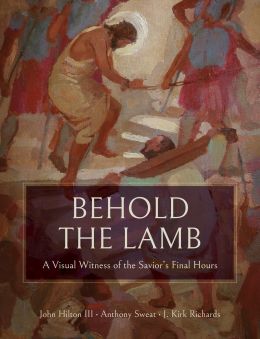
Christ in Gethsemane
John Hilton III, Anthony Sweat, and J. Kirk Richards, "Christ in Gethsemane," in Behold the Lamb: A Visual Witness of the Savior's Final Hours (Provo, UT: Religious Studies Center, Brigham Young University, 2026), 6–10.
It is around 6:00 a.m. on a Friday morning—perhaps corresponding to April 7, AD 30, on our calendar[1]—and one of the most famous interviews of eternity is taking place between the arrested Jesus of Nazareth and the local Roman governor, Pontius Pilate. The previous twelve hours had been filled with some of the most consequential events in history: Christ and his disciples had shared the Last Supper, after which they crossed the Kidron Valley to a “place called Gethsemane” (Matthew 26:36), a familiar retreat for them (John 18:1–3). When Jesus entered Gethsemane, he “began to be sorrowful and very heavy” (Matthew 26:37). Elder Neal A. Maxwell said, “Jesus knew cognitively what He must do, but not experientially. He had never personally known the exquisite and exacting process of an atonement before. Thus, when the agony came in its fulness, it was so much, much worse than even He with his unique intellect had ever imagined!”[2]
Withdrawing from his disciples, Jesus “fell on the ground, and prayed that, if it were possible, the hour might pass from him” (Mark 14:35). In the depths of his anguish, he was “in . . . agony,” and “his sweat was as it were great drops of blood falling down to the ground” as he bore the sins of all humanity (Luke 22:44; see Doctrine and Covenants 19:16–19). The Savior’s “anguish for the wickedness and the abominations of his people” was beyond our comprehension (Mosiah 3:7). He cried, “Abba, Father, all things are possible unto thee; take away this cup from me: nevertheless not what I will, but what thou wilt” (Mark 14:36). His anguish was so intense that an angel appeared to him to give him strength (Luke 22:43).
After trembling “because of pain” and suffering “both body and spirit” (Doctrine and Covenants 19:18), the Savior concluded his prayers and woke up his sleeping disciples. At that moment, Judas arrived, leading a band of men armed with weapons and torches to betray the Savior with a kiss (Matthew 26:47). The Lord spoke in bold power to the band of men with weapons and torches, “Whom seek ye?” They answered him, “Jesus of Nazareth.” Jesus saith unto them, “I am he” (John 18:4–5). The sheer power of his words caused the armed crowd to fall backward.
In the chaos, Peter sought to defend Jesus, severing the ear of the high priest’s servant (John 18:10). Yet, in an act of mercy, the Savior healed the man’s ear. Although he could have called upon twelve legions of angels to defend him (Matthew 26:53), the Lord surrendered himself willingly to those who betrayed and despised him, even as his disciples “forsook him, and fled” (Mark 14:50).
These sacred events in Gethsemane illuminate the Savior’s infinite love and perfectly meek obedience. His agony was not forced upon him; he chose to endure it. With incomprehensible resolve, he completely submitted to the Father’s will, driven by his profound love for each of us. As Paul later testified, “For our sake he made him to be sin who knew no sin, so that in him we might become the righteousness of God” (2 Corinthians 5:21 NRSV).
In Gethsemane’s quiet solitude, Christ bore the crushing weight of sin, a suffering beyond mortal understanding. Again, as always, he submitted his will to God’s. His sacred experience in Gethsemane calls us to reflect on the magnitude of his sacrifice and approach him with humility and gratitude, reminding us of redemption made possible only through his atoning love.
A Place Called Gethsemane
 Anthony Sweat
A Place Called Gethsemane, 2024
Oil on board, 48" x 48"
Artist’s Reflection
On the night he was betrayed and arrested, Jesus and his disciples went to a “place called Gethsemane” (Matthew 26:36). Many know that Gethsemane means “oil press” in Hebrew. What is less common knowledge, however, is that among the groves on the Mount of Olives there was a literal place where the olives were processed and pressed into oil. This facility was in a cave that had a crushing basin, beam press, and other implements related to processing oil. During the offseason of olive harvesting, and especially with the crowds in Jerusalem, it is likely that this cave facility was rented out to pilgrims at the Passover. It may be where Jesus and his disciples went to spend the night, given its covered shelter and proximity just outside Jerusalem’s walls.[3]
The scriptural record is not clear who goes where in the Garden of Gethsemane when Jesus asks his disciples to “sit ye here, while I go and pray yonder” (Matthew 26:36). It is specific that he took Peter, James, and John apart from the group and asked them, “Tarry ye here, and watch with me” while Jesus went “a little further” (Matthew 26:37–39). It is possible that Jesus and his eleven apostles were out in the garden trees. It may also be that the apostles took shelter in the Gethsemane grotto or cave, and Jesus went out into the solitude of the olive trees. In this scene, however, I represented Jesus praying in the solace and privacy of the cave, while his disciples went out into the terraced olive groves to keep watch of passersby on the nearby road. Their watch turns to sleep as the Lord suffers and descends alone so low that he asks God to remove this salvific burden.
The crushing stone and basin seem to rest on his shoulder, while the horizontal mashing pole suggests the impending cross. In the background, the beam press sits ready to press with weight. James and John sleep at the bottom right, and Peter with his sword at the bottom left. The arresting chief priests are top right, while in the top left Judas points to the Lord in betrayal. The circle and square composition suggest heaven and earth, which rested on and were borne by the beautiful soul of Jesus that fateful night. He descended below them all so we might rise above it all.
by Anthony Sweat
A Place Called Gethsemane Insights
While we commonly refer to “the Garden of Gethsemane,” this is not a scriptural term. Matthew and Mark refer to this location as “a place which was named Gethsemane” (Mark 14:32, compare Matthew 26:36), and John refers to Jesus entering “a garden” (John 18:1). We often merge these passages to refer to “the Garden of Gethsemane.” Luke refers to this same location as “the mount of Olives” (Luke 22:39), suggesting it was part of the larger olive grove on the mountainside.
Notes
[1] Most scholars believe Christ was crucified in either AD 30 or 33. For an overview of issues with dating Christ’s birth and death, see Lincoln H. Blumell and Thomas A. Wayment, “When Was Jesus Born? A Response to a Recent Proposal,” BYU Studies Quarterly 51, no. 3 (2012): 53–81.
[2] Neal A. Maxwell, “Willing to Submit,” April 1985 general conference, www.churchofjesuschrist.org. Lorenzo Snow connected the experience of Gethsemane and Calvary, saying, “When He knelt there in the garden of Gethsemane, what agony He must have experienced in contemplating His sufferings on the cross!” “Discourse by President Lorenzo Snow [May 8, 1899],” Millennial Star 61, no. 34 (August 24, 1899): 531.
[3] See Matthew J. Grey and Richard Neitzel Holzapfel, A Place Called Gethsemane: Seeing the New Testament Story and Site in Its First-Century Context (Deseret Book, 2025); Matthew J. Grey, “Olive Processing and Ritual Purity in the ‘Place of the Oil Press’: Reexamining the 1st Century Features and Functions of Jerusalem’s Gethsemane Grotto,” in To Explore the Land of Canaan: Studies in Biblical Archaeology in Honor of Jeffrey R. Chadwick, ed. Aren M. Maeir and George A. Pierce (De Gruyter, 2022).
