
 menu icon in the top, right corner of the screen.
 icon above to close this box.
 icon at the bottom of the screen below the browser—if you don't see it, swipe up to unhide it.
The Yigo Guam Temple
Po Nien (Felipe) Chou
Po Nien (Felipe) Chou, "The Yigo Guam Temple," in Battlefields to Temple Grounds: Latter-Day Saints in Guam and Micronesia, ed. R. Devan Jensen and Rosalind Meno Ram (Provo, UT: Religious Studies Center, Brigham Young University; Salt Lake City: Deseret Book), 275–92.
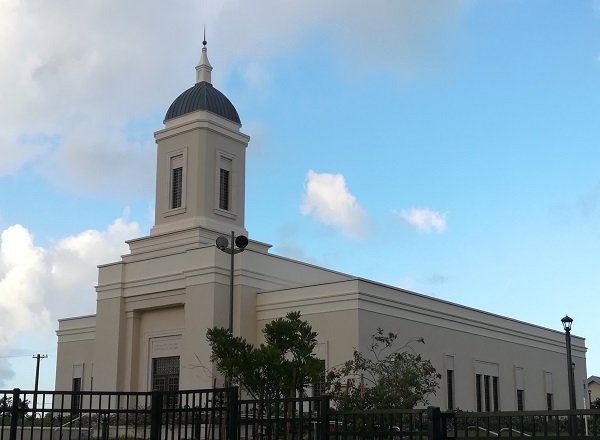 Yigo Guam Temple in December 2021. Courtesy of Po Nien (Felipe) Chou.
The Yigo Guam Temple is the first temple built and dedicated in Micronesia. Serving more than five thousand Church members in Guam and other islands in Micronesia,[1] it has two ordinance rooms (for endowments and sealings), a baptistry, dressing rooms, and an office for the temple president. Although it is the smallest temple in the Church at 6,800 square feet, it contains everything that is necessary to provide all the temple ordinances and accompanying blessings restored in this last dispensation.
Temple Excursions and Fundraising
Before the temple was built, the Saints in Guam and Micronesia would have to raise money for temple excursions. For many of them, attending the temple was cost-prohibitive and required tremendous faith and sacrifice. Nevertheless, their personal sacrifices and fundraising efforts, along with support from the Church and others, helped many to participate in special temple trips through the years. Yigo Guam Temple president Marlo Lopez recalled, “We had two temple excursions a year, one in the summer and one in November. For the one in the summer, we always [went] to the Manila temple because that was our temple district. . . . [In November] we would go to the different temples in Asia”—those in Taipei, Tokyo, Seoul, and Hong Kong.[2] Still, most members went to the temple in the Philippines because it was “most cost-efficient . . . to stretch your dollar,” according to Bishop Jan Tison of the Dededo Ward in Guam.[3]
Fredivic Nicerio, president of the Barrigada Guam Stake, explained that many members raised funds through “philanthropists, Dollar Generals, babysitting, car washes, selling food plates, . . . yard work, and other things . . . to pay for temple trips.”[4] Bishop Tison recalled:
We had car washes, and we have really strict rules about these car washes, because they can’t . . . [be sponsored by] The Church of Jesus Christ of Latter-day Saints; otherwise, that would threaten the nonprofit status of the Church. . . .
We would pick a site around Guam, sometimes next to a gas station. . . . And we would set up there these hoses, soap buckets, [and] we [would] do that from maybe 8 a.m. to 2 p.m. We will do that maybe three or four times, or maybe four or five times a year, and whatever we raise out of those funds will be basically what we use to pay for the youth tickets to get to the temple. . . .
I always told the youth, “It’s not just financial preparation but also spiritual preparation.” . . . So really very early on, you have a select group of youth who are prepared financially and spiritually to go to the temple every year. . . .
I always treated the temple trip as kind of the highlight or the capstone experience of the year. . . .
It’s not a sacrifice for us to go to the temple. It’s a blessing. . . . The blessings that come back to us are priceless, are limitless. . . .
You are also able to build a lot of character and a lot of spirituality because you have to sacrifice to get to the temple.[5]
Stake member Laura Kho recalled that the fundraising also included bake sales.[6] President Nicerio added, “As the youth go to the temple, the blessings from the temple always come back [with them] with high spirituality, and [then they] share their stories in testimony meetings.”[7]
Personal Sacrifices and Experiences
Although the Church’s temple patron fund helped many members visit the temple for their first time to receive their own ordinances, many members also sacrificed much to help make the journey to the temple, especially early on. Bishop Tison remembered, “I had to pay for my own [airfare and other travel expenses], same for my wife and kids.”[8] President Lopez said, “There was no temple fund [initially], so you had to come up with your own airfare to get to the temple to get your endowment to get sealed. But later, we had this temple fund, but it still did not cover everything and so many of our youth here . . . have been doing car washes to supplement the temple funds.”[9]
While members of the Church in the military stationed in Guam or nearby islands were better off financially to travel to the temple, most of the local members were not able to do so as easily. “The Church subsidies [or temple patron fund] help the first-time temple visitors go to the temple,” President Nicerio said, “but our local members are not financially stable enough to go often. It costs around US $1,000 dollars to go to the temple including airfare, housing, food.”[10] President Ronald E. Roberts, first counselor in the Yigo Guam Temple presidency, pointed out that for those in the outer islands, “these trips didn’t come easy, . . . and it’s a great sacrifice for them just to save the money to make that trip.” Roberts clarified that airplane tickets from the outer island to Guam alone are very expensive, and on top of that there’s the added expense of the trip to Manila or other temples.[11]
Ilden Ioanis and his wife, Elisda, from Pohnpei, reviewed the challenges and blessings that came to their family as they prepared for their trip to the Philippines. They needed plane tickets for each of them and their children. Elisda said, “When we were planning to go to the temple, we had to plan it for a long time. We really decided [that] we don’t have enough money to pay for that . . . but me and my husband . . . decided . . . to sell one car [and other things] we had to pay for the [airplane] tickets.” They had a budget and did lots of fundraising activities like washing cars and selling fish. Elisda was grateful for their decision to sell the car. “I could not believe we were actually on the plane since we had never flown before,” she said. “The first time I entered the temple, I was so happy and it was wonderful. . . . I heard my [deceased] uncle’s voice [when] we were doing the temple work for him.” Ilden added, “On the same trip, I was with my mom and my siblings to be sealed to my dad, who passed away.”[12]
Herman Walter, a former district president from Chuuk, recalled flying from Chuuk to Guam to join other members going to the Tokyo Japan Temple:
I didn’t know [anyone]. . . . I arrived early [at] the terminal in Guam. And then I finished check-in. And then I sit down on the chair. And I’m really scared because that’s the first time for me [to fly on a plane or to come to Guam]. I know Japan is big. I’ll be lost. And then I sit down on a chair [and] I just pray, “Father in Heaven, really, please help me to know the people that I will be going with.” And then I sit there, and I saw one guy walk in, and the Spirit just told me that that’s one of the persons [going to Japan]. . . . Then I stand up from the chair and then I can see the Pohnpeian guy was checking in. I asked, “Brother, where are [you] going? I’m going to visit the Tokyo Temple.” Oh, wow. He said, “Yes, we’ve been looking for you!” . . . I met with [Elder] Bill Davis [Area Seventy in Guam] and the guy looking for him, . . . and then we went from there to Tokyo.[13]
Finding Property for the Yigo Guam Temple
Tamio Clark, a real estate agent in Guam, recalled receiving a request for information about local commercial real estate. Clark was told that the client needed someone who could maintain a high degree of confidentiality and to send a sample of his own work for consideration. Clark assumed the need was finding potential sites for the military. After he was told that he was being hired for the job to locate a site, he was told that the client from Salt Lake City was The Church of Jesus Christ of Latter-day Saints.[14]
I immediately knew what it was about. . . . So I mentioned to them that I have to give you some disclosure here, . . . and I said, “Well, I have to be honest with you. I’m actually a member of this church, and on top of that, I just got called to be a bishop.” And then they said, “Then you probably already know what this is about.” I said, “Yes, I do!” And they said, “You know, it’s very confidential. Nobody can know about this. You can’t tell anybody. You can’t even tell the members of the Church. You can’t tell Elder Bill Davis. This is confidential. Only the prophet can make any announcement about a temple.” So I said, “Yes, I understand.”[15]
Clark went to work and gathered information on Church-owned properties, then showed other potential sites. Initially, they considered the Barrigada chapel since the mission office and the service center, including the distribution center, were at the same location.[16] Elder Takashi Wada of the Quorum of the Seventy recalled visiting Guam with Bishop Dean M. Davies of the Presiding Bishopric, who came to determine the “right location for the temple site” for “those who are upon the isles of the sea.” Bishop Davies and others offered a prayer together so they “would feel and then recognize the location which the Lord had prepared.”[17] Elder Bill Davis recalled the experience as follows:
Bishop Davies came to Guam, and called us all together, . . . and he said that they were here specifically to look at [potential] temple sites. But their preference, because this is going to be a new small temple, was to look at current Church sites. . . . Sowe went up toTalisay; then we came here [Barrigada]. And then we went to Yigo. We looked at all three sites. And all of us said, if it’s going to be anywhere, it’s got to be here at Barrigada because Barrigada is centrally located, it’s close to the airport, there’s a hotel within walking distance, etc. . . .
Bishop Davies asked us all to kneel down and pray about it. . . . We discussed each of the properties, the pluses and minuses. And when we all prayed about it, we all came to the consensus that it should be up in Yigo. AndI don’t know why because there’s no hotels up there. It’s about as far from the airport as you can get.Also, forthose on the southern side of the island, it would be a major thing to go up to Yigo, but we all just felt that that’s where it should be.
Number one, we actually had extra property behind the chapel, which was our recreational property. . . . When we prayed about it, we got this super strong feeling that it really needs to be up in Yigo. . . . It’s amazing what [can happen when] . . . worthy priesthood holders kneel down for a very specific purpose to find out what is the Lord’s will.[18]
Clark had a strong feeling about Yigo. “I was told that the prophet would be making any announcement, so I kept quiet and didn’t say anything,” he said. When President Russell M. Nelson announced that the temple in Guam would be in Yigo, Clark was overjoyed.[19]
Russ Tanner, from Special Projects at Church headquarters in Salt Lake City, traveled to Guam to gather information and to document potential temple sites for consideration. After he and others had done due diligence and submitted the report, they waited for a decision from the President of the Church. Once the announcement was made, they began their work of planning and carrying out the project.[20]
Announcement of the Temple
When President Nelson announced plans to build twelve temples, including the Yigo Guam Temple, it was the highest number ever announced on the same day. A Church News article reported that “missionaries from the Church of Jesus Christ first arrived in [Guam in] 1957, and today there are more than 2,500 Latter-day Saints in Guam. This will be the territory’s first Latter-day Saint temple.”[21]
Although members in Guam typically attended a delayed broadcast of general conference, as soon as the new temple was announced, messages began flooding through social media. Elder Davis recalled, “All the messages [began] flying in. . . . Everybody was excited, you know. A lot of prayers were answered.”[22] Bishop Tison said, “I read it on Facebook, and then everyone started to say, you know, reunion when we get here . . . [for] the dedication.”[23]
Kitaela Kalima was sweeping the floor outside when she received a text and call from a friend in the United States. “I began jumping for joy with my broom. I just could believe it. . . . I never thought this would come in my lifetime.”[24] Melsihner Hadley was driving when her children called and told her President Nelson had just announced a temple in Yigo. “I almost jumped out of the car,” she said. “I was so happy because I never thought that I would see a temple in my islands in my lifetime. I always prayed for it. . . . But I didn’t think it was going to happen, and then it happened, so I was so happy.”[25]
The temple announcement was a wonderful surprise for Tina Roberts too. “We didn’t expect it to be that soon, but we knew it was the Lord’s timing,” she said. “The members [were] ecstatic!”[26] For Nanette Delfin “it was unbelievable. . . . It was like a dream come true.”[27] The members and leaders throughout Micronesia were overjoyed to hear the announcement of the first temple in Guam and Micronesia. President Nicerio was eager to share his excitement and enthusiasm with the members in stake conference.[28] Maderson Ramon, an early pioneer from Pohnpei and Chuuk, said, “The Lord heard all the pleadings from everybody here. Instead of going to Japan or Manila, . . . we will have a temple in the region where our people from the islands can come.”[29]
Temple Groundbreaking
After the announcement, the meetinghouse in Yigo, previously dedicated in 1988, was demolished to make way for the new temple. The Church Newsroom provided the following announcement in 2019:
The First Presidency of The Church of Jesus Christ of Latter-day Saints has announced groundbreaking dates in 2019 for two temples—Pocatello Idaho (March 16) and Guam (May 4). . . .
Elder Yoon Hwan Choi, president of the Asia North Area for the Church, will preside at the event. . . . It is anticipated that the groundbreaking services will be transmitted via internet to local chapels within the proposed temple district. . . .
. . . The temple will be located at the corner of Marine Corps Drive and Melalak Drive in the village of Yigo on the north end of Guam.
This will be the first temple in Guam, an unincorporated and organized territory of the United States in Micronesia in the western Pacific Ocean. The temple was first announced October 7, 2018, by Church President Russell M. Nelson.
Construction on the temple with an adjacent meetinghouse is expected to begin in 2019 and is anticipated to take about two years to complete.[30]
Elder Davis was assigned to coordinate the groundbreaking ceremony, and he received very specific directions on how to prepare for it. He called and set apart various committee members to assist.[31]
On May 4, 2020, members of the Church and community gathered for the special event. Guests included CHamoru representatives and government and community leaders. Bishop Tison noted, “We knew that the temple groundbreaking was not only for the Saints, but also for all Guam residents. . . . They would be able to feel the importance and significance of that event. So we had people from the interfaith community, . . . government people, . . . basically everyone.”[32] The temple site was also sacred ground for the local CHamoru people.
During the groundbreaking ceremony for the Yigo Temple on May 4, 2019, Leonard Iriarte, a member of Guam’s interfaith council representing the indigenous [CHamoru] culture, said he was thinking about his grandparents who first took him to this ground. He knows ancestors are important to our church, and said the site of the temple is the old hunting ground of his ancestors, with a spring nearby where villagers would get water after the storms.
Iriarte said he believes it is appropriate to build a temple such as this because “the Yigo site is already sacred ground. It has always been sacred ground to my family.” He wished his grandparents could be alive so they could attend the groundbreaking, and said he was sure they were there at the ceremony. He salutes The Church of Jesus Christ of Latter-day Saints and was very happy to be a part of the groundbreaking ceremony. “The temple can only have a positive effect on the larger community,” he said, “not just for the Church and the community but for the region as well, especially since people from other parts of the Pacific will come to the temple when it is completed.”[33]
Tina Roberts noted that the new temple would be built on the site where the Yigo meetinghouse previously stood. Elder Wada spoke about his experience joining Bishop Davies in prayer a couple of months earlier to be able to recognize the location the Lord had prepared for his house. He also spoke about the importance of prayer, scripture study, inviting others to hear the gospel, strengthening families through the ordinances of the temple, and bringing the names of deceased ones to the temple. Elder Kazuhiko Yamashita, a General Authority Seventy, spoke of the groundbreaking ceremony and customs and invited attendees to record the special inspirations and promptings they would have related to the sacred ordinances of the temple.[34]
Elder Yoon Hwan Choi, then serving as the President of the Asia North Area, said that “a temple is a university for us to learn how to return to Heavenly Father.”[35] He explained that a temple is not just a beautiful building, but a place to learn how to be close to the Lord and receive the confidence that we can become like him one day. He further remarked that the Yigo Guam Temple was not just for the members but for all the people. Afterward, he offered the dedicatory prayer on the temple site:
Our dear Father in Heaven, as we bow our heads before Thee, we express our gratitude for Thy great blessing for us to receive the holy temple in Yigo, Guam. Our hearts are filled with happiness, joy, and love to Thee. We Thy sons and daughters are gathered together to participate in the groundbreaking for a house of the Lord. We thank Thee for these magnificent grounds Thou hast created and chosen. Under the direction of the First Presidency and by the authority of the holy priesthood, which I hold, I dedicate this ground for the purpose of the building of the House of the Lord at this location.
Heavenly Father, we ask Thee to bless this spot to hallow and sanctify it. Please bless all who participate in the construction of this temple, that no harm, no danger, no delay may hinder its proper completion. . . . We ask Thee that the neighboring people in this part of Thy vineyard and the visitors from all different parts of the world may all be touched by Thy spirit and feel the eternal significance of this great and sacred project. We thank Thee for this special blessing of Thy house in this island so that all Thy faithful children, not only the members who live in Guam, but also all faithful members or neighbors’ islands are able to receive special blessings in Thy house. . . . Heavenly Father, may we ask Thy blessings upon all members of Guam and Micronesia, including many other neighbor islands, that they are able to sanctify their daily lives as they faithfully prepare themselves to be worthy to enter Thy holy house. . . .
We love Thee, Heavenly Father. . . . We humbly dedicate this spot of ground for this sacred purpose, in the name of Jesus Christ, amen.[36]
Stake president Fredivic Nicerio said, “We are so grateful for the promises that have been given to us, who are upon the isles of the seas, and that we are able to witness the building of the temple here in our islands.” He added that the temple would be “a place of refuge, and a place of safety, and a place of peace and happiness for our families to be united forever.”[37] The groundbreaking included gold shovels, and everyone was given a chance to participate in turning over the soil, including Church leaders, youth, and children, as well as CHamoru and interfaith representatives from the community.[38] Elder Davis made sure to prepare little shovels so the children could participate in the ceremony. This gesture impressed the CHamoru and interfaith guests, who “thought it was a testament of how the Church treats the family and how important the family is to the Church.” Elder Davis reflected further on the inspired selection of the temple site and on positive interactions with local CHamoru leaders at the groundbreaking:
The leader of the local CHamoru chant group . . . said, “You know, I understand why your church picked this property for your temple. . . . This is very sacred land to the CHamorus, . . . and we knew that it [the temple] should be up here.” We didn’t know that that was sacred land for the local CHamorus. He said, “Thereason why this land is so sacred is because we used to farm here, we used to fish here, . . . we used to hunt here. And this land always provided for our families. And our ancestors told us to treat this land as sacred land.” . . . Up in the hills there’s actually a little stream. . . . So [this place] provided water for the families. [The CHamoru leader] said, “This is very sacred land. In fact, I can feel my ancestors here. And I know my grandmother and my grandfather [are] both here right now in spirit. . . .” You know, spiritually was just another testament that we had chosen the correct site.
Before I went up [to the groundbreaking], I was leaving my office and something prompted me. I said, you know, maybe I should take some CHamoru Book of Mormons with me. . . . The Book of Mormon had been translated into CHamoru many years ago, and I just happened to have three copies in my office. . . . And soI put them in my little bag and went up there, and the sister missionaries were talking with them [CHamoru guests] . . . about the Book of Mormon and the beliefs of the Church. . . . So I gave them [the missionaries] the three copies. And they went back to him [the CHamoru leader] and said, “We’dlike to give you this as a gift from us. It’s the Book of Mormon. What we’re talking about is in your language.” And he took it [and] said, “You know what? I’m going to read this because it’s in my language.[39]
The CHamoru representatives performed a traditional chant.[40] Leonard Iriarte, who led the chant, said during an interview at the groundbreaking, “I was feeling incredible feelings listening to . . . all the others speaking and visualizing in my mind that I was thinking of my grandparents. I think my grandparents are here right now, right now.”[41] Kitaela Kalima recalled how in the interview the CHamoru guests said the temple site was a sacred burial place for their ancestors and that they could feel them participating in the ceremony. She added that during the groundbreaking, “I knew that my great auntie [who had passed away] was there. The Spirit was very strong, and I knew that she was there, right there. . . . She has been waiting for the temple as well. . . . I am sure she was jumping for joy there too.”[42]
Building a Remote Temple
 Yigo Guam Temple in May 2022. Courtesy of The Church of Jesus Christ of Latter-day Saints.
Russ Tanner, who oversaw the temple construction, noted that the Yigo Guam Temple was to be a new version of the smaller remote temple designs. A remote temple, he explained, is “a small temple with all of the essential items that it needs but small enough to accommodate a small Church population.” An architectural firm in Salt Lake City worked with a local architect in Guam who had previously done work on Church meetinghouses. They worked to adapt the remote temple design for the Yigo Guam Temple, and then the special projects team presented the plan to the Presiding Bishopric, which was then reviewed and approved by the First Presidency.[43]
Tanner recalled that President Russell M. Nelson had asked for “something small and simple, but beautiful and worthy of being a temple, and that it needed to have everything that a temple has.” In addition, the back part of the chapel next to the temple would serve as an arrival center, providing a waiting area to welcome patrons so they could refresh themselves if they traveled from afar. Plans were also made for the distribution center to relocate there as well to provide supplies and temple clothing. Overall, the Yigo Guam Temple would be about 6,800 square feet, which would make it the smallest temple in the Church.[44]
The First Temple President and Matron
 Yigo Guam Temple matron and assistants, from left: first assistant Tina Roberts (Hawaiian), matron Memnet Lopez (Filipina), second assistant Melsihner Hadley (Pohnpeian).
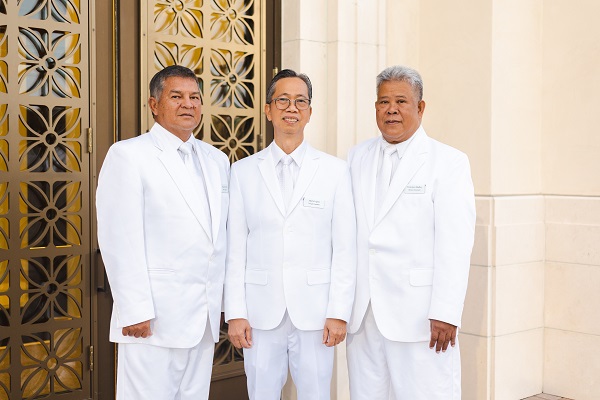 Yigo Guam Temple Preidency, from left: first counselor Ronald Roberts (CHamouru), President Marlo O. Lopez (Filipino), second counselor Francisco Hadley (Pohnpeian).
Lopez remembers being in the Conference Center in Salt Lake City when she heard the announcement of the Yigo Guam Temple in 2018. She was excited and hoped she could attend the dedication with her husband, Marlo. Then in March 2020 they received a call to come visit with President Dallin H. Oaks, First Counselor in the First Presidency. When they arrived at the Church Administration Building, they learned that President Oaks was called into a meeting with President Nelson, so they instead were asked to meet with President Henry B. Eyring, Second Counselor in the First Presidency. He extended a call for them to serve as the first temple president and matron of the Yigo Guam Temple.[45]
Sister Lopez recalled, “When we left Guam [years ago], we thought that was it—we would never be coming back to the island. But the Lord sent us back to serve the people. . . . It was very humbling to know that I would be returning back to the island as a temple matron and that my husband and I were called to this sacred assignment.” She added, “The Lord entrusted us with this calling, and so it’s just very humbling, and we’re grateful that we’re given a chance to grow more spiritually in this calling.”[46]
President Lopez, a Filipino who lived in Guam for many years, was inspired and blessed to call two wonderful counselors. President Ronald Roberts, first counselor, is a local CHamoru; and President Francisco Hadley, second counselor, is from Pohnpei. The diversity represented in this temple presidency is symbolic of how the Yigo Guam Temple is truly a temple for all the various people and cultures in Micronesia. Temple ordinance workers also come from diverse backgrounds and include those in the military and those from the islands of Micronesia. President Lopez noted that as “they come in and go [from the temple], we have a wide variety and diversity in our temple workers, and in our temple leadership. And so that creates that feeling that the Yigo Guam Temple is our temple. It’s a local temple for all and not just for one.” He continued: “If you’re in Pohnpei you can also say that that’s our temple. If you are in Palau, that’s our temple [and so forth]. So we want to create the feeling that this is the temple for all of the people in Micronesia.”[47]
Challenges and Blessings
The global COVID-19 pandemic posed challenges for the construction of the temple, including delay in supplies and materials delivery among other things. Another challenge was a local warehouse fire that destroyed the temple furniture sent ahead for the open house and dedication. Despite these setbacks, progress on the temple continued. Original artwork commissioned for the temple was redone, and new temple furnishings were made and delivered.[48] President and Sister Lopez, who were called to their service on March 11, 2020, arrived in Guam on July 18, 2021, at the request of the Asia North Area Presidency. This was before the dates for the open house and dedication had been confirmed.
President Lopez said that once on the island, he and Sister Lopez began making “temple ministering visits” to the home of Church leaders and members. Because of the challenges of the pandemic and warehouse fire, their focus during those visits was to minister, provide support, and renew the excitement of the Saints for the upcoming temple. The Area Presidency felt that the presence of the temple president and matron on the island would help to bring balance and counter the attacks of the adversary. “We also tried to bring the spirit of the temple in their homes,” President Lopez said. “We offered prayers and we prayed with them. And then I would bless their homes that they would be a sanctuary, similar to the blessings that they would receive in the temple. . . . I blessed their homes that they would be a house of God.” President Lopez shared other aspects of those visits:
We asked them questions like, How did you feel about the announcement of the temple? What are some of the things that you’re doing as you prepare for the opening of the temple? What are your expectations of the temple? . . .
We asked them if they had any questions, even their children. They would ask us questions, and we would respond. . . . They liked that they [could] feel the temple through us. So we’ve been doing that.
We have called temple ordinance [workers] in their homes when we visited them. We set them apart in their homes, with their families. And so we’re trying to somehow make them feel that their home is also as sacred as the temple by having the temple president in your homes. So that is what probably one of our most delightful experiences so far.[49]
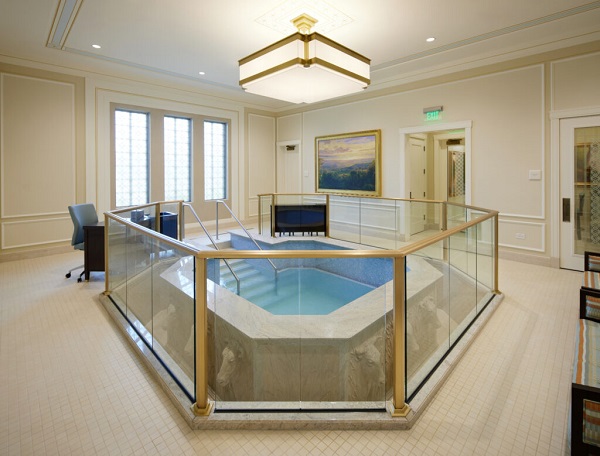 Baptistry, Yigo Guam Temple. Courtesy of The Church of Jesus Christ of Latter-day Saints.
Although President and Sister Lopez had anticipated calling only thirty to forty ordinance workers, members’ enthusiastic desire to serve in the temple led to the calling of more than one hundred ordinance workers. This required great flexibility since 92 percent of the workers are employed rather than retired (the latter being common in other temple districts). Thus the temple presidency had to be sensitive and flexible to accommodate the diversity of time, energy, health, and travel needs of their temple workers. They have also started off-site training. In some cases, patrons from the other islands will bring their own temple workers so they can speak in their own languages to address needs arising from the vast multiplicity of languages in Micronesia. Temple workers’ role, Sister Lopez said, is to provide a “positive, uplifting, edifying spiritual experience for all the patrons when they come to the temple, so that they will want to return and keep coming back,” while also ensuring that the ordinances are performed and recorded properly.[50]
 Sealing room, Yigo Guam Temple. Courtesy of The Church of Jesus Christ of Latter-day Saints.
Sister Lopez affirmed that although “our temple might be the smallest temple of the Church, it has everything that it needs. As small as it is, it stands majestically on that holy spot, and it will perform the same purpose that the Lord intends it to be for the saving and exalting ordinances for the Saints on the islands. . . . We are blessed as a people. [The temple] will just bring so many blessings to the people of the islands.”[51]
The temple also brought many missionary opportunities. Sister Tina Roberts told how several of her coworkers began asking about the temple when it was being built. “They are asking lots of questions, and so it’s been a wonderful missionary tool. I’ve been able to talk with so many of my coworkers, . . . and I just love to see the excitement in them too.” She emphasized that the temple is not only for the Saints, but also for everyone in the community.[52]
Temple Open House and Dedication
Roderick and Lori Boss were asked to serve as temple committee coordinators in Guam. Upon receiving instructions and official information from Salt Lake City, they organized the members into various subcommittees of the temple open house committee. The subcommittees addressed needs such as communications, finance, history, hosting, music, parking and transportation, physical facilities, safety and security, technology, translation, ushers, and youth devotionals. Many members helped to prepare for the temple open house, which would serve members and the broader public in Guam as well as throughout Micronesia, including people in Saipan, Palau, Yap, Chuuk, Pohnpei, and Kosrae.[53]
 Celestial room, Yigo Guam Temple. Courtesy of The Church of Jesus Christ of Latter-day Saints.
The open house for the Yigo Guam Temple ran May 4–14, 2022, except for Sunday. Thereafter a youth devotional was held on May 21. Elder David A. Bednar of the Quorum of the Twelve presided at the three dedicatory sessions on Sunday, May 22, and offered the dedicatory prayers.[54] The Church News reported:
[Elder Bednar] was joined by his wife, Sister Susan Bednar; Elder Michael John U. Teh, a General Authority Seventy, and his wife, Sister Grace Teh; and Elder John A. McCune, a General Authority Seventy and second counselor in the Asia North Area Presidency, and his wife, Sister Debbra McCune.
The temple will serve 2,500 members in the Barrigada Guam Stake and thousands more from the surrounding islands of Micronesia. The Namoneas Chuuk District (600 miles southeast of Guam), the Panasang Pohnpei Stake (400 miles east of Chuuk) and the Kosrae Micronesia District (300 miles east of Pohnpei) are also part of the temple district.[55]
Excerpts from Elder Bednar’s dedicatory prayer follow:
O God, the Eternal Father, . . . we gratefully acknowledge and witness that Thou art mindful of Thy children . . . and remember Thy people who are upon the isles of the sea. . . .
We thank Thee that this beautiful house of the Lord has been constructed in Guam on this sacred site. . . .
We dedicate and consecrate unto Thee and unto Thy Son the Yigo Guam Temple of The Church of Jesus Christ of Latter-day Saints. . . .
Heavenly Father, we pray that this holy temple will be a source of light and truth to all people from every nation, kindred, and tongue.[56]
Sister Lopez, the first temple matron, explained the significant of the temple to the people in Guam and Micronesia. She said, “It is a micro temple for Micronesia people. . . . Our temple might be one of the smallest temple of the church, but it has everything that it needs. It has [all the temple] ordinances.” She continued, “Even with that small temple, . . . it will just bring so much blessing to the island and to the people.” [57]
Roderick and Lori Boss said that because it was so expensive for members from other islands to fly to Guam, after the dedicatory services on Sunday and cleaning on Monday, the temple immediately opened for ordinance work on Tuesday. The local members, who were eager to receive their own temple ordinances, graciously allowed their brothers and sisters from other islands to receive theirs first since they had traveled so far.[58] As a result, a great spirit of unity, love, and sacrifice permeated this sacred occasion.
Conclusion
“The temple is on a sacred ground,” President Lopez said. “The ground has been sacred for the ancient CHamoru people. And so it was very relevant and meaningful for them to have a sacred edifice . . . built on a sacred ground for their ancestors.” Commenting on the temple’s beauty and prominent location, he said: “The temple is on the main highway, the main road, so everybody could see the temple. It’s lighted in the evening. It’s the most lighted structure on the island. We fly in in the evening to Guam, [and] you can see the temple brightly lighted in the evening, so it’s a beautiful structure.”[59] Many people in the community have been similarly touched by this sacred edifice rising majestically from sacred ground.
Many members of the Church in Micronesia recognize the importance of having a temple in their midst. For instance, Diego Sablan in Saipan said, “The Lord is fulfilling his promises for this area, and I see it happening. I think the Lord is pushing the work here faster than we think. . . My ancestors here in Micronesia need their work done.”[60] Bishop Jan Tison added, “I knew that it was necessary here. . . . It fills a need because . . . all these members that live in Micronesia [did not] have access to the temple. So how [were] they going to be able to obtain their temple blessings . . . other than through this temple that’s on Guam.”[61]
A Church report of an interview with Yigo Guam Temple president Marlo Lopez echoes common themes heard in Micronesian members’ remarks about their new temple:
President Lopez [said], “Whatever faith people are in, it’s the grandeur of the building that is a manifestation of the existence of God.” He reminds us that the land the temple is on is “holy ancestral ground. The islanders are storytellers of their ancestors which is a temple key to connect with their ancestors.” What better way to honor their holy ground than with a temple where ordinances can link ancestors with their families.
This beautiful temple of the Lord, announced on October 7, 2018, will give the people of these islands an opportunity for blessings found nowhere else. . . .
[The] Yigo Guam Temple. . . “is not only a blessing to the members of the Church but also to all the people in Micronesia and the islands.”[62]
President Ronald Roberts said, “I remember a talk from President Hinckley . . . on how he traveled to many of the islands, several different small islands, and just the feeling he had [that] these members aren’t able to have access to the temple . . . [and had] to travel long distances.” Roberts added that it showed “that we out here in the islands, the smaller islands, are not forgotten.”[63]
Sister Memnet Lopez, matron of the Yigo Guam Temple, reflects the feelings and bright outlook of many faithful Latter-day Saints in Micronesia with this observation: “The Lord heard the quiet, righteous longings and prayers of the members for a temple. I feel the temple will work its miracle on the people here in Guam and the islands.”[64]
Notes
[1] “On Sacred Ground—The Yigo Temple,” December 22, 2020, https://
[2] Marlo Oliveros Lopez and Memnet Panes Lopez, Zoom interview by Po Nien (Felipe) Chou and Petra Chou, November 23, 2021.
[3] Jan-David Tison, interview by Po Nien (Felipe) Chou, December 18, 2021, Barrigada, Guam.
[4] Fredivic Nicerio, interview by Clinton Christensen and Richard Fee, November 20, 2019, Church History Library, The Church of Jesus Christ of Latter-day Saints, Salt Lake City, Utah (hereafter CHL).
[5] Tison, interview (slightly edited for concision).
[6] Laura Kho, interview by Po Nien (Felipe) Chou, December 22, 2021, Barrigada, Guam.
[7] Nicerio, interview.
[8] Tison, interview.
[9] Lopez and Lopez, interview.
[10] Nicerio, interview.
[11] Ronald Earl Roberts and Tina Marie Roberts, interview by Po Nien (Felipe) Chou, January 14, 2022, Barrigada, Guam.
[12] Ilden Ioanis and Elisda Ioanis, interview by Po Nien (Felipe) Chou, December 20, 2021, Barrigada, Guam.
[13] Herman Walter and Serafina Walter, interview by Po Nien (Felipe) Chou, December 22, 2021, Salt Lake City and Guam.
[14] Tamio Clark, interview by Po Nien (Felipe) Chou, December 21, 2021, Barrigada, Guam.
[15] Clark, interview.
[16] Clark, interview.
[17] The Church of Jesus Christ of Latter-day Saints, Yigo Guam Temple Groundbreaking Ceremony, video post on Facebook, May 5, 2019, https://
[18] William Davis, interview by Po Nien (Felipe) Chou, December 21, 2021, Barrigada, Guam.
[19] Clark, interview.
[20] Russ Tanner, interview by Po Nien (Felipe) Chou, December 22, 2021, Barrigada, Guam.
[21] “President Nelson Announces Plans to Build 12 New Temples,” Church News, October 7, 2018, https://
[22] Davis, interview.
[23] Tison, interview.
[24] Kitaela Kalima, interview by Po Nien (Felipe) Chou, December 19, 2021, Barrigada, Guam.
[25] Francis and Melsihner Hadley, interview by Po Nien (Felipe) Chou, December 18, 2021, Barrigada, Guam.
[26] Roberts and Roberts, interview.
[27] Oscar Delfin and Nanette Delfin, interview by Po Nien (Felipe) Chou, December 20, 2021, Barrigada, Guam.
[28] Nicerio, interview.
[29] Maderson Ramon and Nalinda Ramon, interview by Po Nien (Felipe) Chou, December 19, 2021, Barrigada, Guam.
[30] “Temple Groundbreakings Announced for Pocatello and Guam,” Church Newsroom, February 1, 2019, https://
[31] Davis, interview.
[32] Tison, interview.
[33] “On Sacred Ground—The Yigo Temple.”
[34] Yigo Guam Temple Groundbreaking Ceremony.
[35] “On Sacred Ground—The Yigo Temple.”
[36] Yigo Guam Temple Groundbreaking Ceremony.
[37] Nicerio, interview.
[38] Yigo Guam Temple Groundbreaking Ceremony.
[39] Davis, interview.
[40] Davis, interview.
[41] Yigo Guam Temple Groundbreaking Ceremony, May 4, 2019, YouTube video, https://
[42] Kalima, interview.
[43] Russ Tanner, interview by Po Nien (Felipe) Chou, December 22, 2021.
[44] Tanner, interview.
[45] Marlo Oliveros Lopez and Memnet Panes Lopez, interview.
[46] Lopez and Lopez, interview.
[47] Lopez and Lopez, interview.
[48] Davis, interview.
[49] Lopez and Lopez, interview.
[50] Lopez and Lopez, interview.
[51] Lopez and Lopez, interview.
[52] Roberts and Roberts, interview.
[53] Roderick Boss and Lori Boss, interview by Po Nien (Felipe) Chou, January 13, 2022, Barrigada, Guam.
[54] Church Newsroom, “Dedication Date Announced for the Yigo Guam Temple: Public Open House to Be Held in May,” January 12, 2022, https://
[55] Jon Ryan Jensen, “Elder Bednar Dedicates First Temple in Guam, Asking Members to ‘Connect Jesus Christ with the Temple,’” Church News, May 23, 2022, https://
[56] “Read Elder Bednar’s Blessing upon the Saints in Guam in the Dedicatory Prayer of the Yigo Temple,’” Church News, May 25, 2022, https://
[57] Lopez and Lopez, interview.
[58] Boss and Boss, interview.
[59] Lopez and Lopez, interview.
[60] Diego Manglona Sablan, interview, CHL.
[61] Jan-David Tison, interview.
[62] “New Yigo Temple President and Matron Arrive on Guam,” Newsroom, July 25, 2021, https://
[63] Roberts and Roberts, interview. See 2 Nephi 29:7.
[64] “New Yigo Temple President and Matron Arrive on Guam.”
