
 menu icon in the top, right corner of the screen.
 icon above to close this box.
 icon at the bottom of the screen below the browser—if you don't see it, swipe up to unhide it.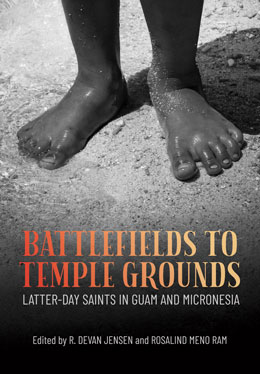
Reflections on the Church in Guam and Micronesia
Rosalind Meno Ram and R. Devan Jensen
R. Devan Jensen and Rosalind Meno Ram, "Reflections on the Church in Guam and Micronesia," in Battlefields to Temple Grounds: Latter-Day Saints in Guam and Micronesia, ed. R. Devan Jensen and Rosalind Meno Ram (Provo, UT: Religious Studies Center, Brigham Young University; Salt Lake City: Deseret Book), 293–96.

After five centuries of colonial and Christian intrusion and influence on their shores, Micronesians have, in large part, decolonized their islands and returned to indigenous rule. They have also chosen to preserve close legal and cultural ties with the United States (particularly in Guam, the Commonwealth of the Northern Mariana Islands, and the Federated States of Micronesia) and with the United Kingdom in Kiribati. Micronesians have handled such waves of colonization “through adaptation, assimilation and accommodation deeply rooted in the kinship doctrine of eaea fengen (sharing) and alilis fengen (assisting each other).”[1]
Economic development in Micronesia trails behind that of many nations, so emigration remains an important tool for individuals and families seeking to improve their economic and educational conditions. Emigration throughout the Pacific and beyond is a common but often misunderstood phenomenon, wrote Father Francis X. Hezel. “Labeled as brain drain, emigration was for a long time generally considered a threat to island nations, inasmuch as it was thought to deprive them of those educated people who might work the economic miracles needed to make their countries self-reliant.” Yet emigration is viewed by citizens of the Federated States of Micronesia as an important provision to allow the “drain-off of excess population” and “a safety valve in the event that the nation should fail to meet its economic development goals.”[2] In fact, emigration, “far from being seen as a menace that threatens to deplete the islands’ human resources, is counted upon as an essential element in the Micronesian states’ strategy for economic and political survival.”[3] So emigration may be viewed as a beneficial strategy for many Micronesians.
Missionaries and Members in Micronesia
This book demonstrates that the Pacific War devastated the land and populations of many islands like a raging typhoon. In the wake of the war came individual members of The Church of Jesus Christ of Latter-day Saints. Initially meeting on aircraft carriers and in loosely organized groups in tents and huts, these pioneering members began to build homemade meetinghouses or worship in Quonset huts.
Latter-day Saint missionaries and members eventually became part of the landscape in Guam and Saipan in the 1970s, spreading throughout eastern and western Micronesia by the 1980s. This book shows how the gospel message took root and spread quickly in Kiribati, the Marshall Islands, and several islands in the Federated States of Micronesia. In percentages of population who are Latter-day Saint, three Micronesian nations are in the top ten in the world. Membership reached about 18 percent of the population in Kiribati. Membership reached just over 9 percent in the Marshall Islands. And membership reached about 6 percent in the Federated States of Micronesia.[4]
Church growth remained slower in areas where the Catholic presence was especially strong, such as Guam or Saipan, or where island cultures were especially strong, such as in Yap and Palau. In Guam there are just over 2,500 members, or about 1.5 percent of the total population.[5] Despite the global nature of the Church, it continues to be perceived as an American church given its administrative structures and culture.
Mission leaders and missionaries tried to master many languages and integrate Church practices into existing cultural communities on each island. Calling and mentoring indigenous leaders and seminary teachers were important to the growth of the Church in each island. Mission leaders who tended to find lasting success in retaining converts found a balance between strict calls to obedience to Church protocols and kind and gentle nurturing and mentoring of indigenous leaders. If we were to offer advice to missionaries serving in Micronesia, we would emphasize learning the language and culture and nurturing with kindness—teaching practical skills while emulating Christian virtues. We would also suggest focusing on learning from local members as much as seeking to teach them.
Crosscurrents of Culture
Our tour of island history has revealed cultural jarrings at almost every step, not only in the form of Micronesians’ subjection before and after the Pacific War but also in their personal dilemmas of being torn by the tense interplay between traditional lifeways and Western influences, including those that come with conversion to the restored gospel. Negotiating the crosscurrents of culture—chiefly and family clans, colonial culture, and Church patterns and expectations—has been a persistent challenge. New converts sometimes struggle with the competing demands of family, community, and faith cultures. With culturally reinforced habits such as partaking of alcohol, betel nut, tobacco, or sakau (kava), new converts sometimes return to them, allowing their religious commitments to slip. In certain regions such as Chuuk, the number of members over time have risen and fallen and risen again like the tides in the lagoon.
Today Christian religions in Micronesia continue to play a major role in the many islands, much like competing sports teams. Some of the earlier tension that existed in the 1970s and 1980s has decreased in intensity, becoming a mostly congenial competition to win converts to worship according to the prescriptions of the various faith traditions. Father Hezel said in a recent interview, “The tense relationship between different religions persisted for a long time. Even when I first came to Micronesia in the early1960s, there were bad feelings among the older Catholic priests toward other religious groups. But by my return to the islands in the early 1970s, attitudes were already changing. By the 1980s the whole mindset had changed in Catholics and other denominations. Suddenly I was invited to go to ceremonies, even ordination ceremonies in the Protestant church, and speak at them. And I soon had many friends who were ministers in Chuuk and in Pohnpei. We had no problem talking about church matters or anything else. Actually the same thing was true with Latter-day Saints.”[6]
As authors and Latter-day Saint missionaries who once served in this area, we feel grateful that some of these Pacific battlefields are now, after decades of negotiating cultural differences, becoming peaceful temple grounds for members to worship Jesus Christ, make sacred covenants, and seal families for eternity. Now the challenge remains for Latter-day Saints to find time to serve their neighbors and build bridges in civic and social settings along with their neighbors of other faiths.
Notes
[1] Puas, Federated States of Micronesia’s Engagement with the Outside World, 1.
[2] Hezel, Micronesians on the Move, 3.
[3] Francis X. Hezel, “Micronesian Emigration: The Brain Drain in Palau, Marshalls and the Federated States,” http://
[4] Matthew Martinich, “Growth of The Church of Jesus Christ of Latter-day Saints (LDS Church),” April 25, 2018, http://
[5] Martinich, “Growth of The Church of Jesus Christ of Latter-day Saints (LDS Church).”
[6] Francis X. Hezel, interview by Fred E. Woods and R. Devan Jensen, July 8, 2020.
