
 menu icon in the top, right corner of the screen.
 icon above to close this box.
 icon at the bottom of the screen below the browser—if you don't see it, swipe up to unhide it.
Pioneers in Pohnpei
R. Devan Jensen
R. Devan Jensen, "Pioneers in Pohnpei," in Battlefields to Temple Grounds: Latter-Day Saints in Guam and Micronesia, ed. R. Devan Jensen and Rosalind Meno Ram (Provo, UT: Religious Studies Center, Brigham Young University; Salt Lake City: Deseret Book), 127–48.
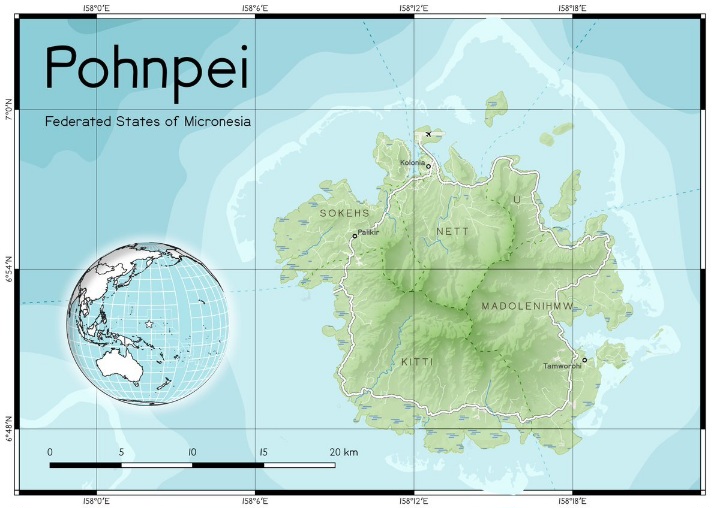 Map of Pohnpei. Christianity in Pohnpei dates back to the nineteenth century.
Pohnpei is a lush, rainy tropical island in the Eastern Caroline Islands. It is home to Palikir, the capital city of the Federated States of Micronesia. Surrounding Pohnpei are the islands of Mwokil, Pingelap, Kosrae, Nukuoro, Kapingamarangi, and Sapwuahfik. Pohnpei is also home to the archaeological ruins of Nan Madol, where an ancient line of rulers called the Saudeleurs once dominated the island. After the Saudeleurs fell, several chiefdoms ruled the island for centuries until European and Asian powers exerted control.[1] The currents of chiefly and clan structures, colonialism, and Christianity have mingled to create strong cultural waves for islanders to navigate.
Let’s examine how Christianity and colonial influences arrived in Pohnpei and, in process of time, created an entry point for The Church of Jesus Christ of Latter-day Saints there too. This latter story is best told by first-person accounts of many early converts. Those early accounts and my own missionary experience confirm solid patterns in the Church’s reception in Pohnpei and converts’ degree of assimilation into it. First, Latter-day Saint converts initially face strong peer pressure to return to their former Protestant (Congregational) and Catholic churches, respectively 52 percent and 40 percent of the island’s religious population.[2] Though islanders can be generally easygoing, there is tremendous pressure to belong to mainstream Christian religions or to follow island traditions such as chewing betel nut or drinking kava (sakau en Pohnpei), substances considered by Church leaders in Micronesia to be against the principles of the Word of Wisdom health code.[3] Second, in their first few years of membership, new converts are more likely to return to past behaviors, especially smoking and drinking. Typically converts waver in their convictions for a few years until they internalize these religious practices and pass them on to the next generation. Regular church attendance and frequent contact with their local leaders are vital during their first year as Latter-day Saints. Third, converts who persevere despite opposition are usually those called to serve in leadership positions. Although American missionaries initially run the local branches, preparing local leaders to administer Church programs and policies is essential to achieving long-term growth. Some local leaders remain in Pohnpei to lead the Church, and others emigrate to seek better economic opportunities.
 Dating to AD 1200, the ruins of Nan Madol are as impressive as any in Micronesia. Walls up to twenty-five-feet high surround the royal tomb compound. Photograph by C. T. Snow.
Early Christian Missionaries in Pohnpei
When did Christian missionaries initially arrive? Pohnpei was long a popular port for sailors and traders making their way through Micronesia. Those early trading opportunities yielded opportunities for Protestant and later Catholic missionaries to travel to the island. In Pohnpei, Congregational missionaries started preaching in 1852, and nearly half the population had converted by the late 1800s. Spanish officials sailed there in 1887 to clarify the people’s colonial status and insisted on allegiance from the chiefs and members of an esoteric hierarchical system too obscure and complex for most foreigners to grasp.[4] “Spain set up two administrative centers: one in Pohnpei and one in Yap. Catholicism, then, was introduced to Pohnpei, an island that had already been Christianized.”[5] After Christianity arrived in Pohnpei, the power structures of the Protestant and Catholic churches intermingled with the local chiefly and family clan hierarchies. Father Francis Hezel reflects, “Someone once stated, with some justice, that competitive church-building is the national sport in Micronesia,” yet he added that the Christian Church is called on to respond generously to the new religious groups [including the Latter-day Saints] that have begun work in the islands.”[6]
Colonial Influence in Pohnpei
Pohnpei has a long history of colonialism. At the outset of World War I in 1914, Japan seized the Caroline Islands, the Marshalls, and the Marianas from Germany.[7] From that time until World War II, the Japanese colonized Pohnpei, providing free schooling but treating the Micronesians as second-class citizens.[8] During the Pacific War, the Japanese conscripted many islanders for the purpose of building roads, hauling heavy guns up the mountain, and providing food to the military.[9] What helped the people of Pohnpei to survive such powerful cultural impositions was their strong tiahk en Pohnpei (culture of Pohnpei)—characterized by cheerful, patient endurance and hospitality toward family, friends, and outsiders.
As discussed earlier in connection with other islands, after the Pacific War the United States established a military foothold in the Central Pacific. The United Nations invited the United States to administer Micronesia in a government entity called the Trust Territory of the Pacific Islands, beginning a long relationship between Micronesia and the United States that continues to this day.[10]
Arrival of the Restored Gospel in Pohnpei
In the summer of 1973, Ohren Ohry and Naped Elias, Pingelapese schoolteachers from Pohnpei, were selected by the Department of Education to travel to Hawai‘i for training. The materials they needed were available only at the Church College of Hawaii (now BYU–Hawaii), and it was there that the men met missionaries from the Church. Both received copies of the Book of Mormon and began reading. Ohren Ohry wanted to be baptized, but on the condition that the Church would be established in Pohnpei. After receiving assurance that a regular Church presence would be introduced to Pohnpei, Ohry was baptized the next day.
Ohry and Elias returned to Pohnpei, and President William W. Cannon, who was presiding over the Hawaii Honolulu Mission at the time, wrote a letter to Ohry saying he would visit the island on October 9, 1976. There was no reply. Cannon arrived at the airport and no one met him. No one seemed to know Ohry.
Cannon looked through his wallet and came across a note left by the mission secretary that said that Kepas Edgar, the director of special education in Kolonia, had been given a hymnbook in Hawai‘i. Cannon went to the hotel desk and asked where he could find Edgar. The clerk gave him directions, and it took only five minutes to walk there. Edgar explained that he had heard of Ohry’s conversion and that he knew Ohry lived on the other side of the island, in the village of Mand. On Monday, Cannon was able to travel to Mand in a boat owned by a villager named Joe Henry. When they arrived at the pier, Ohry was sitting there, waving and smiling. He explained that his boat was not working and that he knew Cannon would find a way to reach him. Cannon wrote, “I had not understood his living constraints. He was happy to see me and eager to support the missionaries. His faith appeared to be greater than mine.”[11]
Converts in Pohnpei
The first missionaries to Pohnpei, Elders George L. Mortensen and Aldric L. Porter, arrived from the Hawaii Honolulu Mission on October 23, 1976. They were joined by Elders Brian D. Tate and Chris Harrison on January 13, 1977. Missionaries were initially the branch leaders but prepared local members to assume leadership positions.
 Naped S. Elias family and Perden Samson at the first baptism in the Kolonia area, March 12, 1977. Courtesy of Chris Harrison.
One of the first families to join the Church in Pohnpei was the Konrad and Melihser Ramon family (who were originally from Pingelap). The parents, their son Maderson, and his three siblings listened to the missionaries’ message in the village of Mwalek in Sokehs, where Mr. Ramon was moving up the hierarchy of the Protestant church. Maderson remembers the different and wonderful teachings of the restored gospel and how the missionaries challenged the family to get rid of their coffee because it was not good for their bodies. Maderson was the one who took the expensive coffee and poured it into the ocean. The Ramon family became the first Latter-day Saint converts in Pohnpei and soon faced opposition from fellow Christian churches in the community. Years later, Maderson moved to Saipan and learned more about the gospel from branch president Brad Nago in Saipan. He later served as a missionary in the Micronesia Guam Mission, working in Pohnpei and then becoming one of the first two missionaries to Kosrae.[12]
Naped Elias, the schoolteacher who had met the missionaries in Hawai‘i but had chosen not to be baptized, had kept his copy of the Book of Mormon and read it from time to time, often while he smoked. Naped told his wife, Srue Jim Elias, that he would join the Church someday. She was skeptical because he had a long history of converting to the Protestant church and then backsliding. When he heard that the missionaries had arrived in Pohnpei, he asked his older children, Elias (nicknamed Dusty) and Nellie (nicknamed Patsy), to watch the road and invite them to the home. The children flagged down the missionaries. Dusty reported, “My dad came out waving this Book of Mormon, and he said, ‘Hey, you guys! Are you guys from this church?’ And he was waving this book, and you should see the face of those elders. They were like they saw a ghost or something. They said, ‘Man, where did you get that?’ And then he told them all the schools because Ohren Ohry and my dad they were taking discussion in Hawai‘i, and Ohren Ohry is from Mand.” The Elias family, the Seisero Solomon family, and the Perden and Dersihda Samson family began meeting with the missionaries. The missionaries would teach them on Wednesdays and Fridays. But every other Friday was payday, and the men would get drunk and explain that they had “headaches” and couldn’t meet with the missionaries.[13]
 Ruthy and Seisero Solomon at the first baptism in the village of Mand, March 5, 1977. Ruthy, Seisero’s wife, was baptized a couple weeks later. Courtesy of Chris Harrison.
Several members of the Ohren Ohry family were baptized on March 5, 1977, along with Seisero Solomon. It is fitting that the first baptisms occurred in Madolenihmw, home to the ruins of Nan Madol, an ancient canal city called “the Venice of Micronesia.” This area retains a cultural and historical significance owing to the ancient civilization that once flourished there.
A week later, on March 12, members of the Elias and Samson families were baptized near Kolonia. These members later became the core leadership on the island. “Kolonia is really starting to blossom like a rose,” wrote Chris Harrison, a young missionary from Arizona, on March 21, 1977. “Last night we had 42 people at sacrament meeting. This was only our fifth sacrament meeting in town. Very soon our apartment will not be near big enough if this growth keeps coming.”[14] Naped Elias reported that after his baptism he became a changed man, devoting himself to his family and giving up alcohol. The new converts gave up alcohol, tobacco, and betel nut. This difficult change disrupted some cultural and social patterns, but the indigenous members reported that their families were strengthened through their conversion.
Rinster and Bella Joel
Other early converts included the Rinster and Bella Joel family. In March 1977, Rinster was employed at building a new lighting system for the airport runway. Previously, whenever a plane would approach at night, the local radio station would broadcast a call for every available vehicle to shine its lights on the runway so the approaching pilot could see where to land.
One day Rinster met the missionaries at their apartment, where he had lingered outside for two hours in the rain waiting to talk to them. “As he entered our home,” wrote Elder Harrison, “he said he had been waiting for us so he could set up an appointment. He said after the first time we talked for only five minutes, he knew that we had a true message and he wanted to know what he and his wife must do to hear our message and be baptized.” Harrison testified, “I know that it was nothing we said in those five minutes that got him so excited. I know that it was the Spirit touching his spirit.”[15]
Even though Rinster felt the Spirit’s witness, he faced opposition from his fellow islanders, including his wife Bella’s grandfather, who was a minister in another Christian church. Living on Pohnpei is the ultimate small-town experience. People know each other so well that they sometimes exclude those who are different.
 Left to right: Bella Joel with son Ricky, Elder Alan Winter, Rinster Joel with daughter Jayleen. Courtesy of Chris Harrison.
Rinster and Bella lived with their grandfather, so they felt uncomfortable about having the missionaries visit them there, and they sometimes made up excuses so the elders would leave. Sometimes when the missionaries arrived, Bella would begin chopping wood or cooking, signaling that she was busy. However, they were patient and promised to return. They usually came back an hour or two later. Bella remembers them as being very persistent. She joined the Church on September 24, 1977, because of her husband’s wishes. After joining, Rinster and Bella were persecuted by people of other faiths. “One day after I had joined the Church, our neighbors, who were mostly Baptists, claimed that I burned a pamphlet made by their church,” she recalled. “They said that they felt sorry for me and my husband and our two young children because I had put kerosene on the pamphlet, lit it, and watched it burn all the way to light a cooking fire. I can’t recall if I had actually burned the pamphlet, but they just said I was a worshiper of the ‘anti-Christ.’”
Her testimony began to grow as she continued to attend church. Bella is grateful for the impact of the gospel on her children, who were spared from many of the challenges Western culture has brought to the islanders, including alcoholism. “Above all the other reasons I am thankful for the Church is that when I hear screaming [young men drinking and disturbing the peace] I know that Ricky is not involved,” she noted. “My mother says I am a lucky mother because of what the Church has done for my children.”[16]
Rinster and Bella’s son Ricky eventually served a mission in Los Angeles, California, and attended college at Brigham Young University–Hawaii. Ricky remembers several encounters with Church president Gordon B. Hinckley during those years. “President Hinckley spoke during some of the major highlights of my single life, during my mission in Los Angeles, where three missions gathered to hear him speak, while being a college student [January 2000], and during my graduation ceremony at BYU–Hawaii,” Ricky wrote.[17] Ricky was called as the branch president in Kolonia and served there for several years before moving to Utah for more lucrative economic opportunities. Inspired by the spirit of family history, he began gathering stories and photos of many of these early pioneering members before they died.
 President Gordon B. Hinckley visited the Brigham Young University–Hawaii campus on January 22, 2000. Ricky Joel, front left, worked at the cafeteria. Courtesy of Ricky Joel.
Kathy Joel Matthew, Ricky’s sister who also lives in Utah, is the communications director of United Micronesian Women (UMW), where she has worked closely with two of the founders, Melsihna Ramon Folau and Persida Samson, both of Pohnpeian heritage. Consisting of women from many Micronesian islands, the organization helps islanders find resources available to them in the United States.[18]
Herlino and Rosa Makaya
Herlino and Rosa Makaya met in Hawai‘i when Rosa was there for heart surgery. Herlino happened to see her in the hospital, saying that he fell in love with her and knew they would be married. After Rosa’s recovery, the couple went back to Pohnpei and were married. Herlino met the missionaries in 1977 while he was on his way home from his job at the island’s communications station. His wife’s relative introduced him to the missionaries, who invited him to listen to their message. He thought it strange that they both had the same first name, “Elder.” Although Herlino disbelieved their message at first, he was impressed with how the missionaries conducted themselves.
 District president Herlino Makaya in March 1977. Courtesy of Chris Harrison.
Herlino and Rosa’s parents did not like the Latter-day Saint missionaries. They told Rosa that she and her husband would be evicted if they continued to let the missionaries teach them. When Herlino was baptized in September 1977, they were kicked out of their home. But Herlino and Rosa were allowed to remain on the surrounding land, so they moved up toward the mountain and built a little shed for their new home.
About two months later, Rosa began crying as she washed her clothes in the stream. Herlino thought she was upset because her family had given her a hard time since his baptism. After he asked Rosa three times why she was crying, she said, “I’m joining the Church!” She believed Herlino had become a new man through his conversion. He now lived the Word of Wisdom and stayed home. Rosa had also observed the missionaries and knew there was no reason to hate them. Led by the Spirit, she decided to be baptized, although the choice was difficult. When Rosa asked her parents for permission to be baptized, they said, “If you do that, we’ll disown you!” They were upset when she was later baptized, but they chose not to cut her off from their family. Their hearts eventually softened, and they even attended church with Herlino and Rosa.
Herlino was soon called as a branch president in Madolenihmw. Moreover, the Church’s Translation Department in Salt Lake City asked him to assist Matterson Elwin and Mark Norman in translating the Book of Mormon into Pohnpeian, a project that was completed in 1987.[19] Herlino later translated the temple ordinances into Pohnpeian in the Salt Lake Temple. He eventually served as district president, supervising all branches on the island.
In 1998 Herlino moved to Honolulu, Hawai‘i, to get medical care for Rosa. Still, she suffered several strokes and passed away in 2001. This was devastating for Herlino. In Hawai‘i, Herlino visited Chris Harrison, his friend and former missionary, and reminded him of a story Harrison had told him as a missionary. The story involved a boy who was not a fast runner but wanted his father to see him race. He told his dad he would probably come in last place. The teacher started the race, and as the boy neared the finish line, he looked up to see his dad and tripped. Hurt and alone, the boy finally crawled across the finish line. His teacher picked him up and told him, “Well done; you have finished the race.” After Herlino passed away on November 21, 2003, Chris Harrison wrote that although Herlino had fallen several times, “he kept crawling, and he did finish his race well. His Master Teacher has embraced him and thanked him for all that he did that was so very good.”[20]
Indigenous Leaders
As with the earlier move toward Micronesian political independence, the Church acted quickly to wean local congregations from the leadership of foreign missionaries. In 1977 the first Church meeting was held at the elementary school on Mand. At that time there were no local leaders to lead the Church, and the missionaries were required to oversee all the Church’s efforts. In August, Heber Butler flew to Pohnpei from Hawai‘i to interview Johnny Bridge and ask him to serve as president of the small congregation, known as a “branch.” In August two branches were organized with Naped Elias as a leader at Kolonia and Johnny Bridge at Mand. Bridge held this position for nearly nine years. Mission leaders held various trainings over the years to teach the local leaders how to deal with administrative details such as running meetings, managing changes in leadership and callings, and handling financial and budgeting details. This transfer of authority helped the Church establish a more permanent presence and meet the needs of the local members.
Protestant Opposition
Many Protestants saw how the lives of recent converts such as Johnny Bridge and Sinek Pweid had changed. They called it a miracle, but they were still opposed to the missionaries. The Protestant apostles said that the Latter-day Saints had false Christs and prophets. The people were afraid to investigate the Church because they wanted to continue to be in the Protestant social group. In fact, some of the mainstream colonial churches categorized the Latter-day Saint presence as harmful. In Winds of Change: Rapidly Growing Religious Groups in the Pacific Islands, Manfred Ernst argued that the tithing and time commitments required of the Church’s members were unhealthy. John Barker of the University of British Columbia noted that Ernst’s research was generally good but cautioned against assumptions of the new churches on the islands being “largely unhealthy” or having “oppressive and paternalistic” theology, American-style individualism, racism, and political passivity. He reminded readers that the experts on these matters are the indigenous people themselves, who usually “adapt Christianity to their own cultural premises and political ends with great facility.”[21]
Although the local Protestant church rejected the missionaries, the Ioanis family of Mand embraced their message wholeheartedly. The family reported that although the Latter-day Saint missionaries in Mand paid rent and made repairs on their rental house, a Protestant apostle told the owner of the house to force them to move. One day when the missionaries came back from teaching, everything had been thrown out of their house.
 Wainis and Elsihpa Ioanis and family, early members in the Mand Branch. Courtesy of R. Devan Jensen.
Ehbert Ioanis, the first member of the Church in his family, went to his older brother Wainis and told him the story. Wainis had previously opposed the missionaries, but after he heard about their plight he had a change of heart. He said, “Welcome them. They can use one of our rooms.” Before Ehbert was baptized, his family had been so opposed to the missionaries that Ehbert and the missionaries had to go across the river and hide to have the lessons.
All the branch members, along with their leader, Johnny Bridge, met with the Ioanis family to discuss building a church. Wainis felt that the Latter-day Saints belonged to the right church and said, “We’ll donate one of our two lots to build the church.” When they asked their father, who was a deacon in the Protestant church, he said, “Oh yes, use it.”
Wainis showed the missionaries where to get local materials from the hill to make a chapel in Mand. They started to build a small house for the branch to meet in and another house for the missionaries to live in.
Even though he was not a member, Wainis helped translate for the missionaries. He quit smoking and started taking the missionary lessons. His wife could see the change in him, and she was baptized on December 25, 1978. He was baptized a week later.[22]
Land Leases and Buildings
In January 1978, Elder John Groberg of the Area Presidency, President William W. and Margery Cannon, Tom Kay (Church legal counsel in Hawai‘i), and Heber and Martena Butler (he was first counselor in the Hawaii Honolulu Mission) visited Pohnpei to organize the Kolonia and Mand branches’ daily activities and lease land for buildings. Mihter Enos, a local woman, was paid $15,000 for a fifty-year lease on the land for the building. Naped Elias and Perdon Samson hosted a meeting in Sokehs with members from all over the island. The meeting started forty-five minutes late with only four local members present. By the end of the meeting, 108 people were present. Srue Elias and Martena Butler both gave short talks. The choir performed songs in English; Sapena Faumui, a Samoan missionary who grew up in Hawai‘i, had helped teach them the songs. That night a fireside was held in Ianser and Molly Edward’s ihmw (home), and Elder Groberg was the featured speaker. Naped Elias later supervised all the branches on the island.
Also in January, Wallace B. Heaps, a senior missionary and building contractor from Hawai‘i, arrived in Mand. He built a small, more comfortable house for the missionaries to stay in, and he even added a pipe from the water tank so they could more easily get water. Before that, they had used water from the river.
In 1979 Pohnpei, Kosrae, Chuuk, and Yap adopted a constitution and declared independence as the Federated States of Micronesia. Thus, the people in the Caroline Islands returned to self-governing status and negotiated a legal partnership with the United States that allowed open travel between the nations. That relationship has had both benefits and challenges to the people of Pohnpei. On the positive side, the people have access to better roads, medical supplies, and technology. On the negative side, they now have a culture that is dependent on US welfare assistance, including supplies such as rice and canned food. When people are given free rice and canned corn and pork, they face additional health risks and lose the incentive to cultivate crops and raise animals.
In 1982 Elder Bing DeLeon began a community weightlifting program that helped bring less-active members back into the fold. It also made new friends for the Church and fostered good friendships with the youth in the Mand area. Branch president Johnny Bridge also brought much good to the people of Pohnpei by leading with kindness and ministering to members.
On August 2, 1982, Nellie (Patsy) Elias began her full-time missionary service. She served in Des Moines, Iowa, and was the first sister missionary from Pohnpei to serve. She reported that she completed her missionary application without her father’s knowledge, so he was very surprised when she was called to serve. She later attended Brigham Young University, married Michael McNamara, and moved to the United States.
Pioneer Day Celebration
 Members gathered in Kolonia on October 24, 1986, to celebrate the tenth anniversary of missionary work on Pohnpei. Back row, left to right: Greg Peck, Rodenson Saikul, Devan Jensen. Sarina Saikul is directly in front of Greg Peck. Courtesy of author.
In October 1986 the Church organized its first member district in Pohnpei, ten years after missionaries first arrived there. Latter-day Saints from the three branches (Kolonia, Mand, and Sapwalap) met on October 24 to celebrate their Pioneer Day. They commemorated the efforts of the first missionaries and the islanders who courageously joined the Church despite tremendous community disapproval and pushback. It was the biggest gathering of Saints on the island, and the Saints experienced great joy. The district presidency—Herlino Makaya, Walter Simram,[23] and Ianser Edward—conducted the celebration under the direction of President David J. Rollins of the Micronesia Guam Mission.
Members and missionaries met on a lush, green hill and sang hymns, including “Joseph Smith’s First Prayer” and “Come, Come, Ye Saints.” Following a generous luau-style feast of roast pig, rice, taro, coconut, bananas, and other fruit, the Saints celebrated with dance and song. Each branch participated in the festivities, and sisters from the Kolonia Branch sang several songs while beating sticks rhythmically on a long board. Bedecked with leis, girls with flowered dresses danced the hula.
Wainis and Elsihpa Ioanis
In October 1986 the branch president in Mand was Wainis Ioanis, a round-faced, cheerful fellow. Like so many Pohnpeians, he and his wife, Elsihpa, were generous with everything they owned. Their conversion in 1977 had taken several months. “Wainis would avoid the missionaries at first,” his wife recalled. “He said it was a false church. One night, he had a dream. He said that in his dream, he wore a white shirt and had on a necktie. He dreamt that he had become a branch president. He told me of the dream and said that he was going to get baptized. He must have still doubted the Church and his dream. It took Wainis and me two months to get baptized after his dream.”
Wainis gave up gambling and smoking, and he helped convince his parents and siblings to join the Church as well. Elder Alan Winter baptized the family. Elsihpa and Wainis loved the missionaries and enjoyed feeding them fried turkey tails, rice, bananas, and coconuts.
Unfortunately, the community ostracized the Ioanises soon after their baptism. “When we were using the school building to hold our meetings, they would say, ‘Oh, look at those monkeys, they are thirty years old and still going to school.’ When we would cross paths going to our separate churches, they would say we were the ugliest, dumbest monkeys,” said Elsihpa. “I have to admit that sometimes I was so ashamed walking by their church that I would ask Wainis if we could walk along the stream to get to our church so we could avoid the comments and ridicule.”
One day the missionaries were forced to move out of Oren Ohry’s house. They came home and saw that their belongings had been put outside the house with a note saying never to stay there again. The missionaries moved to the Ioanis home, where they “built a shack for us to worship in and a small box which they stayed in,” wrote Elsihpa. “I call this a box because it had just one door and no windows. The only opening to get air was the space between the walls and the roof of the house.”
Those missionaries did not even have access to drinking water, so they asked the Ioanis family to apply for water rights. The community refused to give permission, but Wainis told them they could not restrict water rights because the water was for everyone. Wainis pleaded for water to be given to the missionaries because they were “men of God. When the day was over, the pipes were installed and the missionaries were able to have access to the water.”[24] Wainis served faithfully as branch president in Mand for about seven years.
One of the great blessings of the Ioanis family’s lives came in 1995, when Wainis flew to Salt Lake City to record the temple ceremonies in Pohnpeian. There he purchased a ticket for his wife to join him. When Sister Ioanis and a group of Pohnpeians were in Salt Lake City during that same trip, I happened to be eating lunch in the downtown ZCMI Center food court. Someone tapped me on the shoulder. It was Franklin Lihpai, one of the first native Pohnpeian missionaries, who asked, “Excuse me, don’t I know you?”
Wainis also served as branch president in Kolonia for about five years. He was then called to serve in the district presidency and flew to Guam for a training seminar hosted by Phillip G. Pulsipher, president of the Micronesia Guam Mission. Several years later, on April 18, 2006, Wainis passed away. Elsihpa said that before Wainis died he asked her to remain true to her new faith. She testified, “I am thankful for what the Church has done for my children when they were young. . . . Our children are unlike others in my family. My sisters have asked that I go back to them and back to my former church, but I said, ‘Don’t tire yourself out; no one is going to take me away from this Church.’”[25]
Growth during the 1990s and 2000s
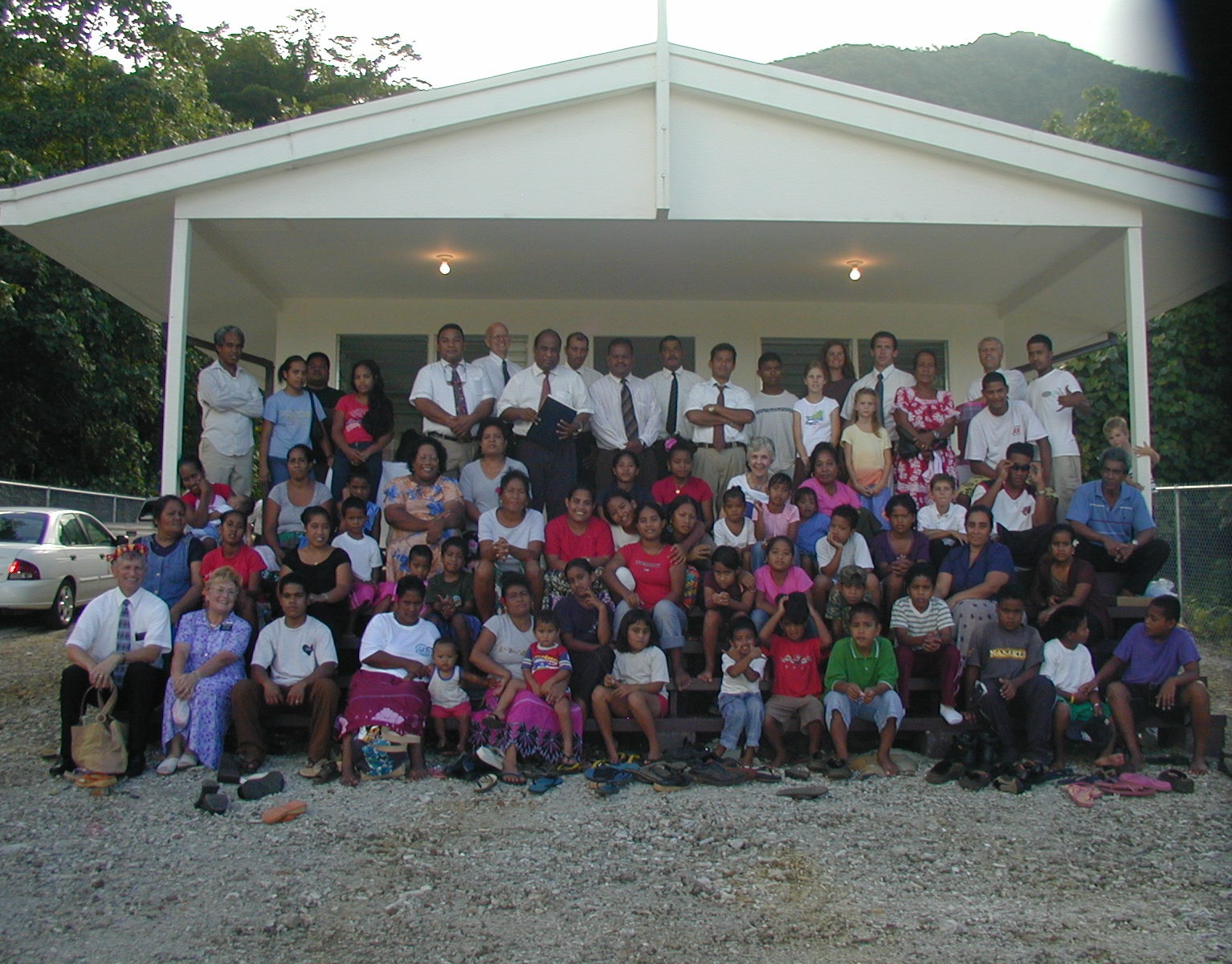 Dedication of the Uh Branch, July 2005. Courtesy of Phillip G. Pulsipher.
One small experience illustrates the sacrifice sometimes involved in the Church’s growth. In 2004 Walkner and Iosepa Joseph, both seventy-two years old, joined the Church in Uh (pronounced “oo”) after years of hearing the missionary discussions. They invited members of the Church to meet in their nahs, an open-air meeting place like a bowery. With approval from mission president Phillip Pulsipher, the Church donated money to convert the nahs into a chapel and build an outhouse with a septic tank and a flush toilet.[26]
Both Brother and Sister Joseph died within two weeks of the dedicatory services. “This chapel is a monument to a wonderful little couple who embraced the gospel,” wrote President Pulsipher. “Walkner and Iosepa were true pioneers in their little corner of the world.”[27]
Jingkle and Jackie Hemon
Jingkle and Jacqueline (Jackie) Hemon invited the missionaries to teach them, and at that time Jingkle was smoking two packs of cigarettes daily and drinking alcohol nightly. They got married and baptized the same day, on August 28, 2004. They married in Panasang. Jackie’s family are members of the Catholic Church, and her parents chose not to attend the wedding because Jingkle and Jackie were planning to get baptized afterward. Most of the family left after the wedding.
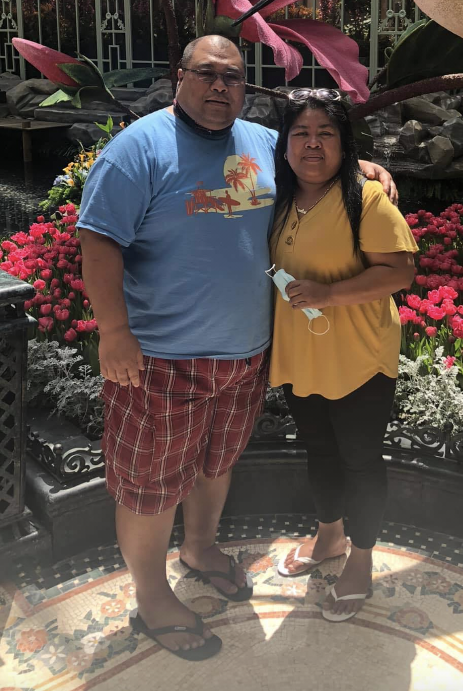 Jingkle and Jackie Hemon. Courtesy of Jackie Hemon
Ianser Edward was then serving as the district president, and he called Jingkle, as a new convert, to be the branch president. The Hemons went to the temple in July 2006, and two years later Ianser died and Jingkle was called to replace him:
I was called as the new youngest district president in October 2008. The mission president [Gary] Marshall came to Pohnpei after Ianser Edward passed away in September and spoke with all the priesthood leaders to interview who would be the next district president. When it was my turn, he asked me two questions: (1) What do I think can help the growth of the members in Pohnpei? I told him to strengthen home and visit teaching. I told him members need to really show that they care when they do their home and visiting teaching. (2) Who do I think can be the next district president? Of course, I didn’t say me. I gave him three names that I believed can be the next district president.[28]
Jingkle immediately faced a challenge but described his learning process:
I was called as a district president in October, and in November I had a minor heart attack. I got into the hospital for four days, and I was complaining to myself. I said “Why me? Why me? I’m still trying to learn as a district president. Why me?” Then that scripture in 1 Nephi 3:7 came to my mind. It says to go and do the things that Heavenly Father has commanded you to do. Then I stopped complaining, went to the mission president, and said, “Help me. I want to magnify my calling.” Then he gave me the handbook and said, “Learn that handbook. That’s your handbook that you’re going to learn.”[29]
Mission president Michael Dowdle described the pattern of mentoring President Hemon and receiving valuable feedback from leaders in Pohnpei: “I spent quite a bit of time with President Hemon, who always has a lot to talk over with me when we come to Pohnpei. I love spending time with him, training from the General Handbook of Instructions, and mentoring him. He is an earnest and willing mentee and is a very good leader in this district. He talked with me about some changes he would like to make in his district leadership as well.”[30] Such mentoring is vitally important to help new leaders navigate the complexities of Church patterns.
Jingkle summarized his service and the application for a stake in Pohnpei:
I served for almost eight years. In 2011, the district presidency with the assistance of the couple missionaries turned in an application for Pohnpei to become a stake. It was not approved by the First Presidency because we didn’t have enough full-tithe-paying priesthood holders. We worked on it by activating more priesthood holders and sending them to the Manila Phillippines Temple to get their endowments. One time we sent more than sixty individual members to the temple. A year later, we resubmitted an application for Pohnpei to become a stake. After several months, it was approved and organized to have Pohnpei become a stake in 2014. My family moved to BYU–Hawaii in March of 2013 for me to work on my bachelor’s degree. The Conrad Conrad family and my family were privileged and blessed to watch the organization of the Panasang Pohnpei Stake live at Brad Hanks’s residence in Laie, Hawaii.[31]
Eugene and Joseleen Conrad
 Eugene and Joseleen Conrad family. Courtesy of Eugene Conrad.
Eugene Conrad described the dynamics of his family and how they led to his conversion:
My whole family is Roman Catholic. One day as my sister was working for the national government, she got into an accident. She was driving and accidentally hit two children and killed them. So she was sent to prison, and I don’t know how, but the missionaries visited the prison and started teaching her until she started accepting the gospel. A miracle happened, and she got released from prison under the protection of our parents. She did not spend that much time there, only like three months, and then they released her. She started going to church every Sunday with the missionaries, and my dad and my mom were observing her. And she finally got a calling. She went and served her mission in Micronesia. She was serving a mission in Guam and Chuuk. Her name is Serloin Conrad.
And after her mission she went back home, and my parents got baptized, my brothers, my sisters. I have eleven siblings. Plus me, twelve. I was the only one in my family that is not a member. And I would see them do family home evenings, and I would just leave the house, and my dad would call me, “Come, join us!” I would say, “No, it’s okay. I’m gonna go outside.” So I kept doing this—going outside every time they do their family home evening on Mondays. But my dad knew that I was close, so he would open the windows so that I could hear them.[32]
Eugene met and married Joseleen, and the missionaries contacted them. But Eugene did not want to listen to them, so he moved to a mountaintop area in Kitti:
It’s way up in the mountains. Cars cannot even go there. And at that time, I know that no missionaries were serving in Kitti. So, we moved there, and one day while we were there, it was like two weeks after, it was noontime, and we were eating. Then we heard a knock on the door, so I told my wife to go check. She went over and came back. She said, “It’s the missionaries.”
I was just thinking, “Why? I know they are not serving here in Kitti, but are they allowed to come over here?” So I told my wife to let them in, and we start listening to them. It was Elder Rongu and Elder Johnson. Elder Rongu was from New Zealand. So we listened to them, and then they said they would come back again. They started coming back, and then they taught us about the Word of Wisdom and the law of chastity. Then we found out that we were not legally married. So I myself had a feeling. I just felt that we had to get married. I believed them. I know that that’s the truth. So we decided to get married.
So we told our families that we were going to get married. And they didn’t know that we were going to baptize at that time, that day. It was August 24, 2002. And then, when we went there, there were lots of families there. They knew that we were getting married. So, just after we got married, the missionaries told the people that we were going to get baptized. So, when her family found out that we were going to be baptized in the Church, they left. They took all the gifts that they brought for us. So, we just say that it’s okay, we were just going to get baptized, so we got baptized that day. Only my side of the family was there. Joseleen’s family left there. They were all Protestants.
And we got married, and then we were not really active at the time. I was still smoking, using drugs, and it seems that our life was getting worse, not getting any better. So, two years after, we almost got divorced like twice. Then one day, it was in January 2004, I bought some drinks. It was a New Year. I bought some drinks, marijuana, and betel nut, and I put it in my truck. And it was still daytime. I was just sitting in the back of my truck, and there’s a feeling that came over me that I had to stop everything. It was so strong, I never felt it in my whole life. So I just left everything in the car, and I went down to my mom’s house where we stayed, and I told my wife and my mom that I would, from that day on, I would quit smoking. I would go back to church. And my mom just laughed. All of them, they just laughed. So my older brother came and asked me, “What about the stuff in your car?” I said, “I don’t want it. Just bring my truck back. Drive my truck down here and then take those things I don’t want.” And he said, “Can I take them?” I said, “I don’t know. I don’t want it.”
So I started going back to church. On Sunday, I went to church, only by myself. My wife didn’t come, my mom didn’t come, my brother, sisters, but they were all members. So I went to church next Sunday. I kept going back to church. And I stopped using drugs or drinking kava. About three weeks after, my wife looked at me and said, “You really serious?” I say, “Yes. I’m going to go back to church, and that’s how it is.” So she stopped smoking, stopped eating betel nut and drinking kava. So she and my mom went with me to church. So we started going back to church, and after a month or two . . . I got a calling; it was the branch mission leader.[33]
Limited economic opportunities in Pohnpei have prompted many Pohnpeians to immigrate to the United States, including families like the Hemons and the Conrads. For example, there are substantial Micronesian Latter-day Saint congregations in Hawai’i, Washington, Oregon, Iowa, Utah, Arkansas, Missouri, and North Carolina.[34]
New Stake Organized
Mission leaders and indigenous leaders had worked for decades to qualify for a stake in Pohnpei. For example, missionaries in 2013 reported significant success in helping local seminary teachers strengthen youth and prepare them for missionary service.[35]
Such efforts led to the major milestone of a stake there. On March 16, 2014, Elders Scott D. Whiting and Marcus B. Nash of the Seventy formed the Panasang Pohnpei Stake with Lensper Kalio as president, Francisco Alwis Hadley as first counselor, and Nixson Redes as second counselor. A congregation of hundreds met in Pohnpei. The historic proceedings were broadcast to about ninety members and former missionaries in Herriman, Utah.
The Panasang Pohnpei Stake, which includes the Kitti, Mand and Uh branches and the Eirike, Palikir, Panasang, Sapwalap and Sekere wards, was created by Elders Scott D. Whiting and Marcus B. Nash of the Seventy. . . .
PANASANG POHNPEI STAKE: (March 16, 2014) President—Lensper Kalio, 50, fisherman; wife, S. Nelsiana Kalio. Counselors—Francisco Alwis Hadley, 53, bank security officer/
premises manager at Bank of FSM; wife, Melsihner Ramon Hadley. Nixson Redes, 45, self-employed; wife, Hermika Erlinso Redes.[36]
 Panasang Pohnpei Stake presidency. From right: Lensper Kalio, Francisco Alwis Hadley, Nixson Redes. Photograph by Ruby Chandler.
Sister Ruby Chandler, then serving as a missionary in Pohnpei, wrote the following blog post expressing her excitement about seeing the local members reach this important milestone:
We are a STAKE! What a miracle!! So many exciting things have happened on our Island in the past few weeks. Our little Island became a stake on March 16th, 2014. The outpouring of the Spirit was evident everywhere. Over 1,446 were in attendance. We now have a wonderful stake presidency, with a clerk, executive secretary, and high counselors. We have five wards, three branches, and three groups. What a blessing for this wonderful Island. A Patriarch will be announced soon to make the stake complete. We thank President Mecham for his tireless efforts to complete the necessary work to qualify us to become a stake. We had eighty-nine saints who met in Herriman, Utah (returned missionaries, Pohnpeians living in US, and a returned mission president), who enjoyed a direct wire feed, to be a part of this great event![37]
After this important development, political leaders in Pohnpei continued to promote warm relations with Church leaders there and in Utah. For example, on June 11, 2019, David W. Panuelo, president of the Federated States of Micronesia, met with Elder Gerrit W. Gong, a Latter-day Saint apostle. President Panuelo affirmed freedom of religion for all citizens and residents in the Federated States of Micronesia and later visited the state of Utah to meet with Micronesians and Church leaders there.[38]
Conclusion
Freedom of religion and cooperation among churches are important developments in the Federated States of Micronesia. In the nineteenth century, Protestant and Catholic missionaries initially brought the gospel message to Pohnpei. The seeds they planted took root in the hearts of Pohnpeians. Latter-day Saint missionaries arrived in the late 1970s to begin their own proselytizing efforts, and they were welcomed a bit reluctantly by other churches but then accepted more fully as members of a new religion. Latter-day Saint converts tried to find acceptance with their peers despite strong peer pressure to smoke or drink alcohol or sakau. As members became accustomed to a new lifestyle, they became the next generation of leaders and sought to strengthen individuals and families. Building on the foundation of those early pioneers in Pohnpei, members today rejoice in having a stake on the island and now a temple in Guam and a future one planned in Kiribati. And, like their seafaring ancestors of old, they continue to navigate the waves of life in search of new opportunities to better their economic prospects.
Notes
[1] “Pohnpei—History and Cultural Relations,” Countries and Their Cultures, http://
[2] Fitzgerald, Whisper of the Mother, 15.
[3] “The teachings in Doctrine and Covenants 89 include abstinence from tobacco, strong drinks (alcohol), and hot drinks (tea and coffee). Prophets have also taught members to avoid substances that are harmful, illegal, or addictive or that impair judgment.” General Handbook: Serving in the Church of Jesus Christ of Latter-day Saints, 38.7.14, ChurchofJesusChrist.org. The World Health Organization classifies betel nut as a carcinogen and suggests liver damage may be a side effect of kava use. See “How Dangerous Is Betel Nut?,” Healthline, September 17, 2018, https://
[4] Hanlon, Upon a Stone Altar, 167.
[5] Francis X. Hezel, interview by Fred E. Woods and R. Devan Jensen, July 8, 2020, copy in author’s possession.
[6] Francis X. Hezel, “The Church in Micronesia.”
[7] Evans, “Political Development in Micronesia,” 89.
[8] Poyer, Falgout, and Carucci, Typhoon of War, 31.
[9] Poyer, Falgout, and Carucci, Typhoon of War, 94, 102, 182.
[10] Encyclopaedia Brittanica, s.v. “Trust Territory of the Pacific Islands,” https://
[11] Cannon, Beachheads in Micronesia, 36–41.
[12] Maderson Ramon, interview, Church History Library, The Church of Jesus Christ of Latter-day Saints, Salt Lake City, Utah (hereafter CHL).
[13] Elias (Dusty) Elias and Nellie (Patsy) Elias McNamara, interview, CHL.
[14] Journal of Chris Harrison, March 21, 1977, Micronesia Guam Mission website, http://
[15] Journal of Chris Harrison, March 17, 1977.
[16] Bella Joel, interview by Ricky Joel, February 2007, in author’s possession.
[17] Ricky Joel to R. Devan Jensen, email correspondence, May 23, 2007.
[18] Melsihna Ramon Folau to R. Devan Jensen, email correspondence, December 28, 2020.
[19] Lee Warnick, “Book of Mormon in 80th Language,” Church News, January 9, 1988, https://
[20] Journal of Chris Harrison, November 26, 2003.
[21] See Barker, review of Winds of Change.
[22] This information is summarized from a manuscript history titled “Mand History,” located in the Kolonia, Pohnpei, missionary apartment, copy in author’s possession.
[23] For Walter Simram’s story, see Ram and Goodwill, “Netting the Stories of Pioneers from Micronesia,” in Underwood, Pioneers in the Pacific, 57–67.
[24] Elsihpa Ioanis, interview by Ricky Joel, March 15, 2007, in author’s possession.
[25] Ioanis, interview.
[26] “A Place to Meet for a Growing Branch,” Church News, January 14, 2006, Z14.
[27] Phillip G. Pulsipher to R. Devan Jensen, email correspondence, March 1, 2007.
[28] Jingkle Hemon to R. Devan Jensen, email correspondence, August 19, 2022.
[29] Jingkle Hemon and Jackie Hemon, interview, CHL.
[30] Michael Dowdle, missionary journal, January 12, 2010.
[31] Jingkle Hemon to R. Devan Jensen.
[32] Eugene Conrad and Joseleen Conrad, interview, CHL.
[33] Conrad and Conrad, interview.
[34] Benjamin T. Beasley, “Recent Convert Helps Teach Other Micronesians in Their Language,” Church News, January 23, 2017, https://
[35] Matt Martinich, “Recent Missionary and Church Growth Successes in Pohnpei, Micronesia,” July 20, 2013, https://
[36] “New Stake Presidents Called,” Deseret News, April 28, 2014.
[37] Ruby Chandler, “We Are a Stake! What a Miracle!!” Pohnpei Experience (blog), March 31, 2014, http://
[38] “President Panuelo Emphasizes the FSM’s Respect for Freedom of Religion in Courtesy Meeting with Elder Gerrit Gong” (press release, June 13, 2019), https://
