
 menu icon in the top, right corner of the screen.
 icon above to close this box.
 icon at the bottom of the screen below the browser—if you don't see it, swipe up to unhide it.
Pioneers of Palau
Clinton D. Christensen and Vonda A. Skousen
Clinton D. Christensen and Vonda A. Skousen, "Pioneers of Palau," in Battlefields to Temple Grounds: Latter-Day Saints in Guam and Micronesia, ed. R. Devan Jensen and Rosalind Meno Ram (Provo, UT: Religious Studies Center, Brigham Young University; Salt Lake City: Deseret Book), 185–208.
 Photo of Palau. Courtesy of Orval Skousen.
The small, beautiful island nation of Palau was occupied by the Spanish in the late 1800s and did not have a written language until the early 1900s, when occupying Germans wrote down sounds of the language as they heard them. After World War I, the Japanese occupied Palau until the end of World War II, when the United States became its protectorate. After the departure of the Japanese, only four thousand Palauans remained on the islands. In 1994 Palau became an independent country with a seat in the United Nations. By the year 2021 there were about twenty-one thousand Palauans residing in the country and several thousand scattered throughout the United States and Guam.
Marina Oei
The history of The Church of Jesus Christ of Latter-day Saints in Palau began far away from Micronesia in the Netherlands. In February 1977 Marina Oei was pregnant and struggling. Her washing machine had broken. It was too expensive to repair, and she and her husband worried about the baby coming and additional laundry. They were also preparing to move their large family from the Netherlands to Palau that summer. One night while the exhausted Marina was sleeping, she “heard someone calling my name, I saw in front of my bed a personage in white standing; he told me, ‘Don’t worry; if you have any problem, ask God to help you.’ I woke up my husband and told him about my dream.” She reported that her prayers were soon answered in a miraculous way when their washing machine began to work even without the broken part.[1]
 Marina and Ronnie Oei. Courtesy of Orval Skousen.
Marina and Ronnie Oei were originally from New Guinea and of Indonesian ancestry but had raised most of their family in the Netherlands. A little while after her first dream, Marina received another important message in the night.
I saw two men ring our doorbell. As I opened the door, I saw two young men standing wearing blue suits and white shirts with a name tag. I heard a voice say, “Do not close your door, but let them in and listen to what they have to say to you.”
The next day, I and my husband went to visit his niece. When we came home my son Richard said someone called and asked, “Is this the Oei family?” My son said, “Yes, but my parents aren’t home.” So the person told my son that they would come the next day at 11 a.m. My son said the person spoke English, so I prepared a meal for them and waited that Saturday. When someone rang our doorbell, I opened the door and saw two young men; one of them looked like the one I saw in my dream. I invited them in; they had a dream that they must come and help us pray. The two prayed with us, then they went home.[2]
Until their departure for Palau in August 1977, the Oeis studied the restored gospel with the missionaries. After arriving in Palau, Marina had her baby. When the doctor at the hospital asked her religious affiliation, she said, “Mormon,” though she had not yet been baptized. The Church had no branches or missionaries on the island, so Marina wrote to Guam asking for missionaries to be sent to them.
The Church responded in July 1978 by sending President Heber M. Butler, counselor in the Honolulu Hawaii Mission presidency and supervisor of the Church in Micronesia.[3] Joining him were two missionaries. They had come to begin missionary work in Palau and to visit with James Moikeha, a Hawaiian, who was the only member of the Church on the islands. He worked as manager of the Continental Hotel.
On July 8, 1978, on a hill on the island of Arakabesan, where the major islands of Palau could be seen, several rocks were set around a pole. There President Butler dedicated Palau for missionary work.[4] Also attending the dedication services were James Moikeha and Elders Ron Brown and Stanton Akana. Soon four islands were opened to proselytizing: Koror, Arakabesan, Malagal, and Airai.[5]
One of the missionaries’ first items of business was to meet with the Oei family. The missionaries resumed teaching them, and on September 15, 1978, ten of the eleven members of Ronnie and Marina Oei’s family were baptized in the ocean. The Church of Jesus Christ of Latter-day Saints had officially begun to be established in Palau.[6]
Miriam and Tadao “Tommy” Sakuma
 Tadao and Miriam Sakuma. Courtesy of Orval Skousen.
When Elders Ron Brown (from Utah) and Stanton Akana (from Hawai‘i) first arrived in Palau, they stayed in the Continental Hotel and had neither bikes nor a truck. After a short time, they received a vehicle from mission headquarters and moved to the district center of Koror. They were not liked around the island; people often ignored them or threw stones at them.
The first Palauans who accepted the restored gospel were Miriam and Tadao Sakuma. Miriam and her family lived in Meyuns before the Second World War. When war came, they moved to Ngeremeskang in Ngeremlengui and used caves as war shelters. During the war, the US soldiers were either working as physicians or demolition groups in Koror. The islanders were afraid of the Americans and thought they were giant white people who would come and squeeze them into pieces. Miriam would run to the bush and hide until they were out of sight. Tadao “Tommy” lived in Ngaraard, and his family stayed there until all the Japanese soldiers left Palau to return to Japan.
Miriam and Tommy were married in February 1969. When the Sakumas came to Meyuns, there were only four other families living near them. Their first home was a tent, and then they made a Quonset hut into their home.
One day in 1978, Tommy Sakuma was standing near his home as two young men in white shirts rode by on yellow bicycles. Not knowing their names, he called, “Hey, Mormons.” They continued riding, so he called again, “Hey, Mormons.” At that they stopped and returned to him. He asked if they could answer some questions, and after a little conversation they set up an appointment to tell him more about the Church. The discussions were held at the home of Miriam’s parents.
The missionaries used flip charts and beautiful pictures as visual aids. Miriam did not sit with them at the first appointment, but it was impossible not to overhear what was going on. She had been raised in the Protestant church. Her mother had worked for German missionaries before the war and had made sure the children attended the church sermons and Sunday School. At subsequent meetings with the missionaries, Miriam joined the discussions with her parents. She understood some of the gospel they talked about because she had studied the Bible all her life.
When the missionaries started to talk about Joseph Smith, Miriam was really surprised and interested, and she could see that Tommy was fascinated too. While he had always been very supportive of the children’s participation in her religion, he had not shown any interest himself. But now Tommy seemed to be in a big rush to know more about the restored Church of Jesus Christ. Soon he was truly converted and knew the Church was true. Miriam was happy they had found the restored gospel.
Tommy and Miriam Sakuma were baptized in the ocean in December 1978. The baptismal services were held where Belau National Hospital now stands. The Sakumas have been a very important family in the development of the Church in Palau. Miriam’s parents later joined the Church too. As new members, Tommy and Miriam dedicated themselves and their pickup truck to getting the members from Meyuns to Koror for all the meetings. Years later the Sakumas were able to travel to the Manila Philippines Temple to receive their temple blessings and be sealed on November 19, 1995.[7] Brother Sakuma also served as branch president Koror from 2001 to 2004.[8]
Church Organization
By the end of 1978, the Palau group of the Hawaii Honolulu Mission was organized with missionary Ron Brown as group leader. A young Yapese man named Tony Yauwasou joined the Church in November 1978, and he and members of the Oei family, including Thaem, Leonard, and Richard, received the Aaronic Priesthood.[9]
When the Church reached its sesquicentennial year in 1980, the Palau group had grown into a branch. In January the Church members fasted for land for a chapel. Then on January 17, 1980, the Saints were excited to welcome the first General Authority to Palau. Elder Adney Y. Komatsu of the Seventy journeyed from Hawai‘i to visit Church members in the islands of Micronesia.[10] Two months later, on March 1, a family from Airai was baptized: Robert and Francis Ngirblekuu and their son Timidik. Missionary work continued on the islands, and on April 1, 1980, the Palau Branch became part of the newly established Micronesia Guam Mission.
Conversion of Ben Roberto
Ben Roberto was in his late thirties in 1979. Professionally, he’d spent twenty years as an ironworker in the United States, but he was not content with his life. He’d been married and then divorced. He had also made some choices that could have landed him in jail for years, but surprisingly the judge couldn’t find his paperwork, so he was let go. Roberto needed some major changes in his life, and that is when he started hearing a voice telling him to go back to Palau.[11]
He gave everything away—his journeyman card, his car, his tools, and so forth—and went back to Palau. Even his mother did not recognize him at first. She asked him to cut off his long beard. Roberto met the missionaries in 1980, and his life changed. He cut off his long hair, put on a white shirt, and was baptized on December 19, 1980. Everyone, especially his family, was sure he would be back to drinking and his old ways in a month. No one expected him to become a full-time missionary in 1985.
At age forty-two, Roberto woke up one day and looked outside. It was as if the trees and grass all said, “You are to go on a mission,” he recalled. He knew he was too old to serve a mission, but he finally asked the branch president, who said, “No! Ben, you are too old, you need to settle down and find a wife.” But then the president prayed with Brother Roberto. When they were through, he said, “Okay, Ben, you are to go on a mission.”
 Martina and Ben Roberto. Courtesy of Orval Skousen.
But that day Joseph B. Keeler, the Micronesia Guam Mission president at the time, had unexpectedly arrived in Palau and appeared at the branch president’s home. Ben Roberto explained his desire to serve a mission. President Keeler’s response was the same as the branch president’s first response had been: “No, no! Ben, you are too old!” Ben accepted the mission president’s answer.
President Keeler left for his hotel, but halfway there, he turned around, having received new revelation. He came back to Brother Roberto and said, “You are to go on a mission. There is a group of three missionaries. You are to be the fourth one.”
President Keeler set Brother Roberto apart and told him to go pack up his clothes and join the missionaries in Palau. Ben quit his job that day and moved in with the missionaries. He and his companion baptized thirty-six people in one year. He also taught a young man named Rebluud Kesolei, who would later serve a mission in Palau and become a branch president in Koror.[12]
Through serving a mission, Ben Roberto also hoped to resolve his desire to find a wife. He taught and baptized Martina Sibeklii. After concluding his sixteen-month mission, Roberto returned to normal life, but he continued his friendship with Sister Sibeklii. They married on November 1, 1986, and they were sealed in the Manila Philippines Temple on October 19, 1987. Roberto served as a branch president and then as the second district president in Palau from March 3, 1991, to August 25, 1997.[13]
Creation of the Palau District
As the Church in Palau grew in the 1980s, it reached the point where a district needed to be organized. On March 25, 1989, the fourth district in Micronesia was created, covering the area of Palau. The new district had three hundred members in four branches. Branches were located in Airai, Meyuns, Topside, and Koror Central.
The new district president was Walter Mariur, with Ben Roberto as his counselor and Deo DeLeon as the district clerk. Walter Mariur had been a member for only two years when he became district president. He had joined the Church in 1987, and his wife, Bernadita, had followed a year later. President Mariur was ordained to the office of elder on May 8, 1988, by Kent M. Harmon, first counselor of the Micronesia Guam Mission presidency.
President Mariur shared his feelings about the Lord’s priesthood in the Palau Branch history book:[14]
Some people ask me to explain the priesthood to their Priest and Pastors. I tell them you have to study the six lessons. I cannot explain the priesthood because you are not ready to receive it. If you want the priesthood that I have, you need to come join The Church of Jesus Christ of Latter-day Saints.
I believe this Church because we have the direct authority of the priesthood. No other church on the world has this direct authority. Follow the line of authority to connect the Three Witnesses to Peter, James, and John to Jesus Christ when they were here on the earth. Jesus Christ sent Peter, James, and John and the Apostles to operate the Church when they were here on the earth. Then the world was in the dark age, because the power of the priesthood was taken away because the evil was in control of the world with his power.
Today there are two powers here upon the face of the earth: the Church of Jesus Christ operates with the power of authority—and the church of the dark to try to find their way to have the same power and priesthood. I myself, Walter Mariur, priesthood leader of the Church of Jesus Christ of Palau, am really careful to use my priesthood in the right way. I really praise God for my line of authority so I’m able to share my testimony with this letter to you, in the name of Jesus Christ, amen.[15]
President Mariur also understood the importance of helping others and serving in the priesthood. One senior missionary couple remembered “one evening going to the home of Sebue Skibang at Meyuns. Walter Mariur was inspired for us to visit with him. We found [Sebue] very ill and barely able to rise from the floor where he laid. There was a beautiful, serene spirit present as we talked with him, and before we left we gave him a priesthood blessing.”[16]
There was also power in having members in Palau share the gospel with their friends and with other people interested in learning more. Richard and Lenore Oyler, a senior missionary couple, said in 1988, “The Mariurs and Pedros contributed immeasurably to our labors with investigators. Without them our relations with those who took time to listen to our message would not be heard. Bernadita Mariur often bore her testimony to those we were about to teach. The power she conveyed as she told of her conversion left us in tears as well as making those listening—believers.”[17]
Babier Er a Mormon
As early as 1985, Ben Roberto was involved in helping the Church with translation work. He was remembered by the missionaries as “a master teacher, employing ‘parables’ of Palauan traditions that local members could relate to. We sat in awe as he instructed in the melodic Palauan language, then would translate for us at frequent intervals. He knew the gospel well and taught by the spirit.”[18]
As a young man in the branch, Harvey Olsingch remembered Ben Roberto working in 1986 with a committee in the branch president’s office to translate the Book of Mormon into Palauan. Some other members of the translation committee included Sisters Josie DeLeon, Miriam Sakuma, Erminia Kmederang, and Baustina Uehara.[19] After receiving final review and approval in Salt Lake City, the Book of Mormon selections in Palauan were published in 1988 as Babier Er a Mormon.[20] In 1989, to benefit Guam and the Mariana Islands, the Book of Mormon selections were also published in CHamoru.[21] The members on Palau relished the opportunity to study from the Book of Mormon in their own language. Having these selections in Palauan aided missionaries and members and was a factor in the growth of the Church when the district was formed in 1989 and membership reached three hundred.[22] Growth continued in the first years of the 1990s, reaching four hundred members.[23]
High Tides and Low Tides: A Chinese Branch
Though it is a small island nation, Palau has been involved in several agricultural projects, including one developed by the United Nations. This project brought Liu Donglong and his wife, Li Mei, to Palau from their native China in 1989. Senior missionaries Ken and Peggy Styles lived in the same apartment complex as Liu and Li Mei. Soon they became friends, and the Styleses shared the restored gospel. The discussion about the plan of salvation answered Liu’s questions about his existence. His testimony grew as he learned what he described as “the real meaning of this life,” the principle of “eternal marriage,” and how he could “cherish life at this time.” He was baptized in the ocean in August 1990. Li Mei followed a month later.
The Styleses taught writing and English classes, with twenty to twenty-four people attending at a time. Many of the students were from a large group from mainland China that came to Palau to build a hospital.[24] In the course of a year, over fifty Chinese people, mostly from this group, were baptized into the Church.[25]
On June 16, 1991, Liu Donglong became branch president of the newly organized Koror Central (Chinese) Branch. Most of the members were from Taiwan and China. The Church News ran an article about the organization of the branch and mentioned that five Chinese members had received the Melchizedek Priesthood at the branch’s creation.[26] To meet the language need to teach in Chinese, Elder Jami Elison was transferred from the mission in Taiwan to Palau.[27] Meetings saw attendance of sixty to seventy members.[28] The Chinese hymnbook was used, and meetings were conducted in Chinese. Monthly family home evenings for the Chinese branch were fun affairs with the members cooking favorite dishes and Elder Elison sharing Church videos with Chinese subtitles.
Interest in the restored gospel was high. However, many of the Chinese members were transient, having come as subcontractors for the hospital project. They arrived in Palau believing it was a doorway to the United States, but once their work on the hospital was finished, their work visas would expire. Others had been misled by dishonest men in China who told them that they were coming to work at a clothing factory in Palau. These Chinese members stayed for three months on a tourist visa and then were required to leave.[29] As one person said, “The first two things the Chinese wanted were to taste a hamburger and learn about religion, and many got both.”[30] Both Liu Donglong and Harvey Olsingch remembered a large group of Chinese workers, about eight to ten people, who had studied the gospel and received a testimony but whose visas had expired, requiring them to return to China. However, the night before the group was to depart by plane for China, mission president Lewis V. Nord authorized a quick baptism. Liu remembered leading the way to the ocean in the dark with his flashlight. The group were all baptized in the sea and confirmed on the beach. The men were ordained to the Aaronic Priesthood, and then they returned to China. Two additional men who joined during their time in Palau were ordained to the Melchizedek Priesthood before leaving for China.[31]
Because of his work with the United Nations, Liu Donglong would have the opportunity to go to the United States with his family. He left Palau at the end of 1991 to begin graduate school in agriculture. En route to school, the Liu family visited Ken and Peggy Styles at their home in Las Vegas and received their temple ordinances and sealing in the Las Vegas Nevada Temple. They have continued to serve in the Church for the last thirty years wherever they have lived. As a footnote to the experience, Ken and Peggy Styles later served in China as volunteer English teachers for BYU, and on occasion they were able to see some of their Chinese friends whom they had met in Palau.
For the Chinese Saints in Palau, the years 1990 and 1991 were the high tide for the branch. Eventually, most of the members would move on to their next destination and the Koror Central Branch would be merged with the Topside Branch on September 1, 1992.[32] What had been four branches when the district was organized in 1989 diminished further a few years later with the Airai and Topside Branches merging in 1991 and the Koror Central Branch merging with the Meyuns Branch in 1992. Membership would stay in the 300s for the remainder of the 1990s.[33]
Meetinghouses
Since land is a scarce commodity on the islands, the Church has depended on lease agreements to obtain buildings to rent or land on which to build a meetinghouse. It is very difficult for the Church to purchase land because families carefully guard their ownership and prefer to lease instead of sell. Over the years, several meeting places have served the Saints in Palau.
In 1982 the elders moved to an empty house owned by Mechelbang Martin Fritz, and the house was used by missionaries for several years. In 1989 the Church began construction on the chapel in Meyuns. The Meyuns chapel was dedicated on May 20, 1990, and to add to the celebration that day, local members Valentine Bedal and his wife, Dirratang, were married there by mission president Lewis Nord. The Relief Society prepared a lovely variety of foods for the event. The new chapel in Meyuns had a perfect view of the ocean, looking across to Koror and the causeways connecting Meyuns and Malakal. People from all over the island recognized where the Latter-day Saints met.
Just a month later, a typhoon hit the island. District president Walter Mariur visited each member in the Topside Branch to make sure everyone was safe and to find out if they needed anything. Many neighbors of the Meyuns Branch stayed in the chapel until the storm passed. Over the years, the meetinghouses in Palau have been used as places of shelter during typhoons because their construction meets exceptional building standards.
In April 1992 the first baptisms were performed in the Meyuns baptismal font. Missionaries prepared the font by filling garbage cans and buckets with water from the catchment system, lifting them to the font, and pouring the water in. They worked for hours before the font was full. They did this labor of love for the wonderful people who were baptized that Easter Sunday.
Over time the challenge of expiring leases affected the Church. On June 7, 1999, all the furnishings for the Meyuns chapel were removed, the building closed, and the keys turned over to the owners. The lease for the land the chapel was built on had expired, and the owners would not renew it. With the chapel closed, there was no font available for baptisms, but the ocean was always accessible. The site of this chapel was beautiful and had increased awareness of the Church in the community for the past decade.[34] A few months later the Meyuns chapel was completely torn down, and the lumber was donated to the Walter Mariur family.
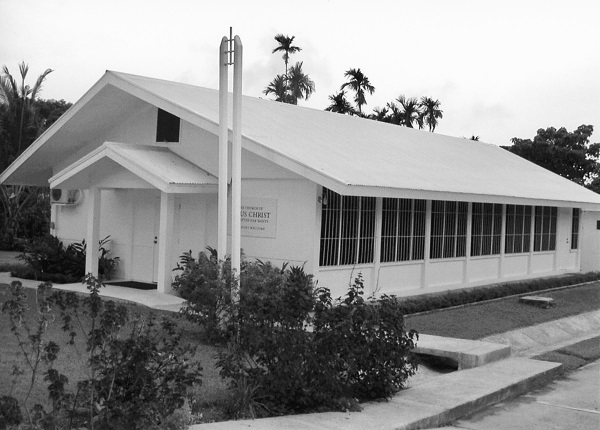 Koror Branch Meetinghouse. Courtesy of Orval Skousen.
As the new millennium began, plans were underway for the building of the Koror meetinghouse. During the 1990s there had been four branches on various islands of Palau, and by the decade’s conclusion there was one branch on Koror. Instead of having small branches on several islands, the Church was transitioning to having one centrally located meetinghouse in Koror. The building was completed in 2002. Members faithfully came every Saturday morning to mow and trim the grounds. In the evenings others cleaned inside and set up chairs.
Since 2002 the members have needed to walk along the connecting causeways from the other islands to Koror and the meetinghouse. Orval and Vonda Skousen, senior missionaries who served in 2003, lamented that they were directed to not pick up the members walking to church. They were advised that the members needed to be independent and come to church on their own, notwithstanding the distance and time it would take to get to Koror.[35] Activity suffered with only one meetinghouse in a central location, but Rebluud Kesolei, the branch president at the time, clarified that while it was not easy to get to church, those who made the effort and sacrificed would be blessed.[36]
Mission president Michael Dowdle shared an experience he had with President Kesolei:
July 16–18, 2009. Palau is one of my favorite places in the mission. It consists of just one branch, which is an independent branch supervised by the mission. The branch president is a single returned missionary about age thirty-five. He has just been elected this year to the Palauan House of Representatives. He has plans to someday run for president of Palau. He is a graduate of BYU–Hawaii and is a very sharp fellow. His name is Rebluud Kesolei. He and I have become quite close over this past year. Last December, we had a training here in Guam for all the district residents, and he was invited (since he is the leader of the Church on the island). . . .
After the zone conference, we attended the baptism of a “dear friend” of the branch president, named Joanny Renguul. She and President Kesolei have been dating, and she has been taking the missionary lessons from the senior couple on Palau. . . . After she was baptized, and was changing, President Kesolei asked to speak with me privately. He told me that he and Joanny wish to be married, and that, although he has always wanted to be married in the temple, he asked my counsel on getting married and then going to the temple. I told him that they should be married now and not wait and that they could go to the temple in a year. He was very relieved. She joined us in his office, and they asked that I perform the marriage! We will return to Palau sometime between now and the end of August for the wedding. Although the Church ceremony will be simple, there will be many people there, including dignitaries from the Republic of Palau. We will also be invited to attend the feasts and customary wedding celebrations that the families will put on. I am excited to see them married and to experience the Palauan customary celebrations. . . .
September 5, 2009. Rebluud Kesolei’s wedding was Saturday night. In attendance were the president and vice president of Palau, ministers from the cabinet of the president, members of the Palauan congress, tribal leaders of the villages, and even one of the two queens of Palau. The little chapel there (it holds about 130 people or so) was completely full to bursting. There were so many people that they couldn’t all fit inside. The ceremony went well, and Rebluud and his wife (her name is Joanny Renguul) looked very happy as I married them by the authority of the priesthood. The president of Palau then offered a toast, and we all raised our glasses of sparkling apple juice! It was awesome. The president has invited Rebluud, as one of only five people, to accompany him to New York later this month as he has been invited to address the United Nations. Rebluud is talking with him about stopping in Salt Lake to tour Temple Square and Welfare Square (the president’s slogan is “self-reliance”).[37]
Honoring and Sustaining the Law: Latter-day Saints and Government
For more than a century, Palau has faced the challenge of outside countries, including Spain, Germany, Japan, and the United States, exerting control and influence. In 1994 Palau became its own independent nation, no longer part of the US-administered Trust Territory of the Pacific Islands. With the change, Palau entered a fifteen-year Compact of Free Association with the United States that provided money and defense for the country.[38] Palau still benefits from its close ties to the United States and from outside investment by several Asian countries. This relationship with the United States would also impact the Church because it continued to allow Palauans greater access to employment and immigration opportunities in the United States.
While the early 1990s brought growth in membership and a new district, over the next few years membership would ebb, leading to the dissolution of the Palau District on August 25, 1997. In the two decades that followed, the Church in Palau winnowed down to one branch.
Despite the Church’s fluctuating size in Palau, members of The Church of Jesus Christ of Latter-day Saints played supportive roles and contributed to the Palauan government. Before the establishment of the independent country of Palau in 1994, Richard Cobb, a Latter-day Saint from Arizona, worked for one year, from 1990 to 1991, as legal counsel to the country’s president, Ngiratkel Etpison. Richard also served as the president of the Topside Branch. Jenna Cobb was also an attorney and did research work for the Palau Supreme Court. She taught seminary to a small group at the high school that included future local Church leaders Harvey Olsingch and Rebluud Kesolei.
As a young married couple who were both attorneys and worked with the government, the Cobbs brought additional visibility to the Church. A budding, independent democracy was still in the making in Palau, which had its first president in 1980. However, the presidents of Palau before Etpison had each died in office by assassination or suicide. Richard had great respect for President Etpison, who was a straightforward, honest man and a faithful Seventh-day Adventist. The president was dealing with a serious problem with the Palau Congress, whose members wanted to spend earmarked money from the US Congress for other purposes. Tensions had escalated as the president was caught between placating his congress and not wanting to offend the US Congress. Ultimately, President Etpison refused to capitulate and would honor the terms set by appropriation from the United States.
The Cobbs were caught in the crossfire of this situation, almost literally. Richard recalled that one night “the front passenger window of my government-owned Toyota station wagon was shot out while my wife, our baby, and I slept inside our apartment. Hearing the sound, Jenna woke and asked me what was happening. I told her it was gunfire and that we were probably safest to stay in our apartment protected by the cinder block walls. No one tried to enter our apartment or shoot through the window. But it was a clear message that we might be harmed if we didn’t leave the island.”[39]
Gunshots were also fired at the president’s office that night, breaking the windows. This was a deliberate intimidation tactic. As a safety measure that night, the president’s security team moved the Cobbs to a resort on the island. The next morning the president came to their room. Cobb recalled that President Etpison “told us that democracy was a relatively new concept in Palau, and its success required standing up to those who sought to influence government policy through violence. He then told us that if we left, it would send a clear message that democracy could be thwarted. He said he knew we were thinking of leaving and asked us to stay. He said that our staying would send a message that the rule of law meant something.”[40]
Richard wanted to go, fearing for his pregnant wife and their little son. However, at the thought of leaving the island, Jenna stated emphatically, “No way. Didn’t you hear him? We are staying.” Jenna’s determination and resolute faith were solid. The Palauans watched the Cobbs, who went back to normal living, and the threats ended. The Cobbs stayed and completed their one-year assignment and even went with the president to official meetings in China and the Philippines.
President Etpison lost his reelection campaign in 1993. Upon finishing his one term as president, he graciously transitioned his power to the next president. Cobb described Etpison as the “George Washington and John Adams of Palau,” a reference to the first two presidents of the United States. Washington modeled for the Western world that power could be turned over peacefully. Adams was caught between the interests of his country and the threat of war with France, which he delicately avoided. Etpison had walked a difficult line while balancing the demands of the Palauan Congress in how to use “earmarked money from the US congress. This was like how John Adams learned to balance his country’s long-term interests and avoided war with a foreign power. Being president is never an easy job.”[41]
Palauan Saints also have devoted much energy to supporting their nation. Ben Roberto worked as a press release officer for the Senate, and then in the late 1990s he worked for the House of Delegates in Congress.[42] He also spent two terms, from 2002 to 2006, as governor of Angaur. His responsibilities as governor were to further develop and improve economic growth. He was remembered as being a very blunt person; his brusque nature offended some people, but others respected his straightforward and honest approach to life.
Latter-day Saint Rebluud Kesolei served as deputy chief of staff to Palau’s president Thomas Remengesau Jr. during his two terms, from 2013 to 2021. Kesolei traveled the world with the president’s entourage. While being hosted and greeted by dignitaries from other countries, it was President Remengesau who made sure that Kesolei received water or 7-Up at receptions and parties instead of alcohol.[43]
While on Palau in 2017, Kesolei suffered a brain hemorrhage and became unconscious. Providentially, a team of doctors from Taiwan were visiting the island. Dr. Lian Cheng-loong performed an emergency operation to relieve the pressure on Kesolei’s brain so that Kesolei could then travel to Taiwan. The fact that these doctors were on the island at the time of the crisis saved Kesolei’s life. After a month in Taiwan under observation, Kesolei was able to make a full recovery. He later said of the doctors, “They gave me a second chance of life” and more time to serve his church and government.[44] The president of Palau called Kesolei a “miracle child.” Kesolei attributed his rapid recovery to having been obedient to the Word of Wisdom during his life.[45]
Cultural Challenges
In nearly every place where the Church is established, members experience challenges in keeping the commandments and appropriately adapting and respecting cultural traditions. In recent decades the United States has exerted a lot of Western influence on the island of Palau. But as the Church took root in the 1980s, the Palauans still closely followed the traditions of their forebears, some of which conflicted with Church standards.
DeLoy and Geraldine Gardner were a senior missionary couple in the mid-1980s and recalled how the women of Palau in the villages would go around “bare-breasted,” as had been the practice for centuries. The missionaries taught modesty as defined by Western standards. “When [the sisters] came to church, of course, they always covered themselves,” but when they were back in the village, they returned to the village status quo. Being different can be difficult. The Gardners recalled visiting a district Relief Society president on one of the islands who had been through the temple. Unlike all the women who were not covered on the top, she was at least wearing her garment top, which made her more modest. Yet this created another complicated situation from the Gardners’ viewpoint: everyone in the community, even those who were not endowed or even members of the Church, could see the garment.
At a conference at BYU–Hawaii in 1997, Ben Roberto referenced such cultural challenges. He spoke of the tradition of ngasech, a childbirth ritual. A couple months after a woman gives birth to her first child, she confines herself and is given medicinal baths for five to ten days.[46] During this time she is bare-breasted and is later seen that way publicly. As the district president, Roberto was asked by young women what to do. Many parents wanted their daughters to do the ngasech childbirth ceremony. President Roberto counseled, “As a Church member you shouldn’t do that.” It is against Church rules. “You cannot go with your breast exposed in public.”[47] This discrepancy created conflicts within families. When in 2021 Rebluud Kesolei was asked about issues of modesty on the islands, he said these traditions have faded over time. The Latter-day Saints are modest, and owing to US influence, many Palauans dress like Americans and not in the traditional ways.
Other cultural differences include betel nut chewing and donating money to the community rather than to the Church for tithing. Betel nut is addictive and has kept many older Palauans from joining the Church. It is common for parents to send their children to church while saying, “We don’t want to join your Church because you don’t chew betel nut.”[48] Richard Cobb also mentioned that beer was the number-one import in the country.[49] The prevalence of this drink makes keeping the Word of Wisdom difficult.
Ben Roberto also reflected on the custom of islanders helping each other pay large bills or debts. Community help is a great blessing and, in many ways, very commendable. Yet, while extended family and friends demonstrate charity, some have let it become a roadblock to obeying the law of tithing. Roberto explained that if a person goes to the hospital or is building a house, he or she asks for help. He said, “We have customs where we get together and gather money to send someone to the hospital in the Philippines or Hawai‘i.” On the radio you’ll hear your name on payday on Friday. You’ll be invited to a party to help contribute money. President Roberto said that when he has taught members the principle of tithing, sometimes their reply has been, “I’m sorry. I cannot pay tithing because I have to go to this custom.”[50] For a community of Saints needing to learn and obey the law of tithing to be worthy of its blessings and the chance to go to the temple, this peer pressure of making community contributions can be difficult to navigate, especially because the Church also teaches that “charity never faileth” (1 Corinthians 13:8; Moroni 7:46).
Ben Roberto explained that earlier in his life he decided how he would handle tithing. When he found out that tithing was a commandment, he was determined to obey it. He would travel by boat from Anguar to meet with the branch president in Koror for tithing settlement. Roberto put his tithing in a certain spot in his wallet as soon as he cashed his paycheck and kept it there, separated from his other money. When he got to church, he paid his tithing. He expressed how easy Heavenly Father makes things for us and how He makes it worth it.[51] Perhaps with a temple now built in Guam, there will be further motivation for the Saints in Palau to follow the law of tithing so they can participate in temple blessings.
Seminary, Missionary Service, and Education
Jenna Cobb remembered teaching seminary to Rebluud Kesolei, Harvey Olsingch, Shirley Mariur, and two other young women in 1990. For the youth of the Church, seminary classes opened the door for further study of the gospel and solidified testimonies. For a long time, seminary was held in the high school. Evangeline Andrews, an active sister in the Church who had once been a seminary student herself, eventually became the teacher. She exemplified a new pattern for Latter-day Saints in Palau. She attended seminary, served in the Micronesia Guam Mission, and then received an education at Brigham Young University–Hawaii. For many years seminary was held after hours in the high school because Andrews was a teacher there. She taught English as a second language and later taught seminary. As youth decided to pursue a similar path in education, they have been prepared to strengthen their families and the Church.
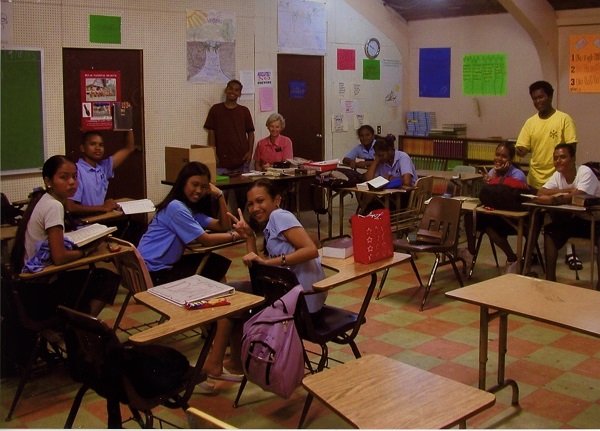 Seminary class in 2003. Courtesy of Orval Skousen.
When fourteen-year-old Rebluud Kesolei joined the Church in 1986, he firmly desired to serve a mission and be like the elders who taught him. He had been taught while Ben Roberto was a missionary, the first Palauan to serve on the island. Not surprisingly, Kesolei was called in 1992 to serve in the Micronesia Guam Mission and spent eighteen months assigned to Palau. He had the opportunity to teach all the members of his family and his friends the gospel. Later, as a branch president, he shared the gospel with his future wife, baptized her, and adopted her three children.
When nearing the conclusion of his mission, Kesolei realized that going to college was important to him. He applied to BYU–Hawaii and was accepted. He was interested in political science, and from 1994 to 1998 worked to earn his bachelor’s degree. As Kesolei prepared to graduate, there were many opportunities available for him to work in the United States, but he felt very strongly about returning to Palau. His commitment to Palau and to building the Church there had blossomed while he spent most of his mission on Palau. He was able to find work on his home island, and his work as deputy chief of staff to Palau’s president, Thomas Remengesau Jr., coincided with his educational pursuits in political science.
Not all the youth in Palau go to seminary, serve missions, or attend a university. The same could be said for any place in the world. There are many distractions. Yet scholarships are available to help Palauans to attend school at BYU–Hawaii. When young women and men forgo that educational opportunity and stay in Palau, there is an increased chance they will have children out of wedlock and fall away from the Church, although some eventually return to activity in the Church.
Palauan Emigration
In 2022 the population of Palau stood at eighteen thousand. The country’s status with the United States leads many Palauans to seek job opportunities there and in Guam. About three thousand Palauans work in Guam, and about four thousand work in the continental United States.[52] In 2016, when Rebluud Kesolei was deputy chief of staff, he traveled to Kansas in the United States with President Remengesau and visited Palauans serving in the US military.[53] The president praised them for participating in the military and working abroad because it helps them economically and some money is returned to families at home, benefiting Palau.
From a Latter-day Saint perspective, we are counseled to strengthen Zion wherever we are. However, while it would be ideal for the Church to be growing quickly to a stake in Palau, some key members have been called elsewhere. Harvey Olsingch is one example. While still a teenager in the early 1990s, he was invited to attend high school in Nevada and Arizona by former senior missionaries. He then served a mission in Micronesia and graduated from BYU–Hawaii. While in La‘ie, he met his future wife, who was from Wildomar, California. They married, and upon graduation Harvey went with his wife to settle in her hometown. In a 2021 interview, Harvey expressed how much he missed being in Palau and that he often prayed for an opportunity to return or to serve there. In the meantime, he is contributing to the Church in California. He has been a bishop, and from 2017 to 2023 he has been serving in the Lake Elsinore California Stake presidency.
Palauans who serve in the Church in other parts of the world are learning, developing, and making important contributions. However, having too many members leave Palau does have negatively affect the progress of the Church there.
In the early 1990s, all four stakes in Puerto Rico were returned to district status because so many members had moved to Florida. Like Palauans, Puerto Ricans can travel freely into the United States. Many of the most educated islanders, including future leaders, left Puerto Rico for better economic opportunities elsewhere. Such migration is a fact of the complex economics of this era.
For most of the twentieth century, the First Presidency encouraged members to build Zion in their home countries, though that is no longer a main emphasis. In 2006 Elder Russell M. Nelson of the Twelve spoke in general conference about the gathering of Israel, initially quoting Elder Bruce R. McConkie, who had told the Chilean Saints during a visit there, “Every nation is the gathering place for its own people.”[54] Elder Nelson then continued: “The place of gathering for Brazilian Saints is in Brazil; the place of gathering for Nigerian Saints is in Nigeria; the place of gathering for Korean Saints is in Korea; and so forth.”[55] This principle has also been taught regularly at BYU–Hawaii to the international students who attend there. In a 2018 BYU–Hawaii devotional, Elder David F. Evans, General Authority Seventy and Asia Area President, quoted Elder Nelson as above and then said, “Spiritual security will always depend upon how one lives, not where one lives. Saints in every land have equal claim upon the blessings of the Lord.” Some might say that if they return home, there will be no opportunity.”[56] Elder Evans then shared examples of the impact that graduates of BYU–Hawaii were making on their own countries after returning from their education. He shared examples from Mongolia, Cambodia, Indonesia, and Hong Kong about graduates who had good jobs and were serving in ways that were strengthening the Church and their homeland. Furthermore, those seeking additional education can also enroll in BYU Pathway Worldwide, which is blessing Latter-day Saints no matter their location and providing chances for better income and jobs in homelands.
Recent Developments in Palau
From 1978 to 2018, because there was no stake in Palau, branch presidencies there reported to mission leaders. Branches grew from one to four and consolidated back to one. But in 2018 a significant administrative change came to the Koror Branch when Palau became part of the Barriguda Guam Stake. Initially, this felt different because members were used to receiving visits from a mission president and having a personal relationship with him even though he is spread very thin and is replaced every three years.
According to Rebluud Kesolei, becoming part of a stake has helped the Koror Branch members feel that they are part of “something bigger.” The branch now reports to a stake presidency, who before the COVID-19 pandemic in 2020 would travel to the island for ward conferences. These stake leaders can serve as a presidency for up to a decade, creating strong leadership experience and bonds with members. Another benefit of being in a stake is having guidance from twelve traveling high councilors, who give administrative support and provide correlation throughout the wards and branches. Rebluud Kesolei was called to the high council and was the first in Palau to be ordained a high priest. Given the pandemic, in March 2020 in-person Church meetings were suspended for a time, but communications continued via Zoom technology using the internet. Stake high council meetings, stake conferences, and other interactions took place on Zoom. Kesolei explained that the direct reporting lines of the stake to the branch and the functioning high council have greatly benefited the Palauan members. In his view more gets done quickly now that the Koror Branch belongs to a stake.[57]
There was not a single case of the coronavirus in Palau in 2020, Kesolei recalled. But to be “good global citizens” (a phrase used by President Russell M. Nelson) the Saints in Palau stopped gathering to the Koror chapel for much of that year. This was a sacrifice, and it was difficult for members not to gather at the branch meetinghouse. There were also limited active Aaronic and Melchizedek Priesthood brethren on the islands. Authorized to hold Sunday School and sacrament meeting in their homes, the members focused on home-centered church. Branch president John O. Ngiraked, Rebluud Kesolei, and other priesthood holders would take the sacrament to homes with no priesthood holders. By the time Church meetings resumed in person, attendance in the Koror Branch had dwindled to thirty. By the fall of 2022, attendance was back up to the eighties with a total membership in Palau of 532. A future milestone for Palau will be the day that its membership is more fully active with enough priesthood and sister leaders so that a ward will be created from the Koror Branch.
The Saints in Palau are fortunate to have general conference sessions translated into their own language by local members Esmeralda Mariano and Harvey Olsingch. This work strengthens Olsingch’s testimony, he says, as he studies the words of the prophets and receives inspiration on which Palauan words best convey gospel truths. He has also been involved on the team that translated the temple ordinances into Palauan for use in the Yigo Guam Temple.[58]
The Yigo Guam Temple was dedicated on May 22, 2022. The Saints in Palau are grateful to have a temple in a nearby region. Married in 2009, Rebluud Kesolei and his wife, Joanny, looked forward to their sealing in the Yigo Guam Temple. Rebluud was able to attend the temple dedication, but his wife was not able to travel with him at that time. The Kesoleis know that the first temple in Micronesia will bring further blessings to their family personally and to the Saints in general. They are looking forward to being sealed during a future branch temple trip to Guam.[59] Making and keeping temple covenants will bring spiritual growth to the Saints on the islands of the sea and will ideally open the door to the next chapter of Church history in Palau.
Notes
[1] The Palau Branch history book is located in Koror, Palau (in private possession of Vonda Skousen). Excerpts were copied by Vonda Skousen in 2003.
[2] Palau Branch history book.
[3] Butler, “Faith-Promoting Experiences,” Church History Library, The Church of Jesus Christ of Latter-day Saints, Salt Lake City, Utah (hereafter CHL).
[4] Country dedications are done under the direction of the President of the Church, with assignments usually carried out by members of the Twelve and the Seventy. In Church history there are several instances of elders giving prayers of dedication when beginning missionary work in a new place. For example, the first missionaries to the Hawaiian Islands in 1850 gave such a prayer, though none of the elders were Apostles or Seventies. The prayer by Elder Butler was a similar circumstance. However, it was not a country dedicatory prayer directed by the Quorum of the Twelve.
[5] Palau Branch history book.
[6] Palau Branch annual historical reports, 1982, CHL.
[7] Palau Branch history book, January 23, 1990.
[8] Koror Palau District, Church Directory of Organizations and Leaders (online database). https://
[9] Palau Group historical report, Hawaii Honolulu Mission manuscript history, CHL.
[10] Palau Branch minutes, 1980, Hawaii Honolulu Mission manuscript history, Church History Library, Salt Lake City.
[11] “Our Stories: Original Pioneers from the Micronesia Guam Mission” (session consisting of William Swain, Walter Simram, Donald Calvo, Maria Calvo, Ben V. Roberto, and Ben Nago at the Pioneers in the Pacific Conference, Brigham Young University–Hawaii, Lā‘ie, Hawai‘i, October 9, 1997); transcript courtesy of BYU–Hawaii archives.
[12] “Our Stories: Original Pioneers from the Micronesia Guam Mission.”
[13] “Our Stories: Original Pioneers from the Micronesia Guam Mission”; Koror Palau District, Church Directory of Organizations and Leaders.
[14] Palau Branch history book.
[15] Walter Maurier, Palau Branch history book.
[16] Palau Branch history book, 1988.
[17] Palau Branch history book, 1988.
[18] Richard Lenore Oyler, Palau Branch history book, 1988.
[19] Harvey Olsingch, interview by Clinton D. Christensen, August 8, 2021, in private possession. The names of the Book of Mormon selection committee members were provided in an email by Rilang Roberto, August 9, 2021, in author’s possession.
[20] Wikipedia, s.v. “List of Book of Mormon Translations,” last modified August 19, 2021, https://
[21] Wikipedia, s.v. “List of Book of Mormon Translations.”
[22] Deseret News 1991–1992 Church Almanac, 330. Statistics are from December 31, 1989.
[23] Deseret News 1997–1998 Church Almanac, 528. Statistics are from December 31, 1991.
[24] Richard Cobb and Jenn Cobb, interview by Clinton D. Christensen, August 16, 2021, in author’s possession.
[25] Liu Donglong, interview by Clinton D. Christensen, August 8, 2021, in author’s possession.
[26] “Chinese Branch Created,” Church News, September 21, 1991, 12.
[27] Koror Palau District annual history report, 1991, CHL.
[28] Liu, interview.
[29] Lin J. Shan, letter to Ken and Peggy Styles, March 5, 1991, CHL.
[30] Cobb and Cobb, interview.
[31] Cobb and Cobb, interview.
[32] Koror Central Branch, Church Directory of Organization and Leaders.
[33] Koror Palau District annual history report, 1991–1992, CHL; Deseret News 2001–2002 Church Almanac, 580. Statistics are from December 31, 1999.
[34] Palau Branch history book.
[35] Vonda Skousen, interview by Clinton D. Christensen, August 12, 2021, in author’s possession.
[36] Rebluud Kesolei, interview by Clinton D. Christensen, August 21, 2021, in author’s possession.
[37] Michael L. Dowdle, missionary journal.
[38] “Palau Gains Independence on Saturday,” Deseret News, September 30, 1994.
[39] Richard Cobb, email to Clint Christensen, August 15, 2021, in author’s possession.
[40] Cobb to Clint Christensen, August 15, 2021.
[41] Cobb, interview.
[42] “Our Stories: Original Pioneers from the Micronesia Guam Mission.”
[43] Kesolei, interview.
[44] “ROC Doctors, Nurses Praised by Palau Official for Lifesaving Surgery,” Island Times, August 15, 2017, https://
[45] Kesolei, interview.
[46] See Anders Ryman, “Childbirth Ceremony: Palau, Micronesia,” Rites of Life, accessed August 22, 2021, http://
[47] “Our Stories: Original Pioneers from the Micronesia Guam Mission.”
[48] “Our Stories: Original Pioneers from the Micronesia Guam Mission.”
[49] Cobb interview.
[50] Cobb, interview.
[51] Palau Branch history book.
[52] Kesolei, interview.
[53] Season Osterfeld, “Visit Goes a Long Way: President of Republic of Palau Visits Junction City, Kansas, Fort Riley,” June 16, 2016, https://
[54] Bruce R. McConkie, in Conference Report, Mexico City Mexico Area Conference, 1972, 45.
[55] Russell M. Nelson, “The Gathering of Scattered Israel,” October 2006 general conference, https://
[56] David F. Evans, “That Our Strengths May Be Faithened,” BYU–Hawaii Devotional, September 25, 2018, https://
[57] Kesolei, interview.
[58] Olsingch interview.
[59] Email to author, September 1, 2022.
