
 menu icon in the top, right corner of the screen.
 icon above to close this box.
 icon at the bottom of the screen below the browser—if you don't see it, swipe up to unhide it.
"He Remembers Us"
History of the Church in Kiribati
Casey Paul Griffiths, Iotua Tune, and Eric Tonini
Casey Paul Griffiths, Iotua Tune, and Eric Tonini, "'He Remembers Us': History of the Church in Kiribati," in Battlefields to Temple Grounds: Latter-Day Saints in Guam and Micronesia, ed. R. Devan Jensen and Rosalind Meno Ram (Provo, UT: Religious Studies Center, Brigham Young University; Salt Lake City: Deseret Book), 43–70.
 Many citizens of Kiribati live on the island of Tarawa, which is forty miles long but less than half a mile wide at most points. Photograph by Casey Paul Griffiths.
If ocean is considered, the island nation of Kiribati is larger than the continental United States.[1] The Republic of Kiribati comprises thirty-two atolls and one raised coral island.[2] Geographically, the islands that make up Kiribati are scattered throughout the Central Pacific, roughly straddling the equator. In addition, the islands are near the international date line, which was moved by the government of Kiribati in 1995 so the entire population could share the same day.[3] Because of Kiribati’s closeness to the date line, its inhabitants are some of the first people in the world to see the sunrise each new day. The nation has an estimated population of 111,800 (July 2020), though over half of the population lives on the atoll of South Tarawa. Some of the islands contain only scattered inhabitants, while other areas have a population density that rivals Tokyo or Hong Kong.[4] The Church of Jesus Christ of Latter-day Saints is still relatively young in Kiribati, with the first missionaries arriving in 1975. However, Latter-day Saints have quickly become a powerful force for good in this island nation. From small beginnings in the 1970s, the Church has grown to include over twenty thousand members. Roughly one in six people in Kiribati are members of the Church.[5] In a country known for the earliest sunrise in the world, the Church is also rising and casting the gospel’s light on this wonderful and happy people.
Christianity Comes to Kiribati
Kiribati is the only country in the world that falls into all four hemispheres of the earth. Owing to its proximity to the equator, temperatures remain warm year-round. Archaeological evidence suggests that the islands of Kiribati have been inhabited for thousands of years. The people of Kiribati (referred to as I-Kiribati) are highly dependent on rainfall and wells for drinking and bathing water. Even though rain falls on a regular basis, the country is prone to droughts that can last several months.[6]
Christianity was introduced to Kiribati in the 1800s. The most well-known missionary from this time is Hiram Bingham, an American Protestant missionary who arrived in Kiribati in 1857 along with a group of Hawaiian pastors who assisted in the work. Bingham was in frail health when he arrived in the islands, but he was determined to learn the local language. He later wrote, “No miraculous gift of tongues is now conferred upon the ambassadors of Christ. Like other missionaries I have found no other way of obtaining my desire than to patiently set myself to work in picking up one word after another and one sentence after another.”[7] Bingham soon began work on a translation of the Bible in the language of the I-Kiribati, giving the language its first written form. Bingham collected two thousand words on his own and then began paying his young converts a dollar for each hundred words they could add to the list. By 1865, when Bingham was forced to leave the islands because of ill health, he had translated the Gospels of Matthew and John.[8]
During his absence, Bingham continued working on his translation of the New Testament, and he brought a complete translation with him when he returned to the islands in 1873. Because of his poor health, Bingham was able to live in the islands only sporadically, but he had completed a full translation of the Bible into the local language by 1890. Bingham was assisted in his translation in part by the priests of the Catholic Sacred Heart Mission in Kiribati, established in 1888.[9] He also received assistance from his wife, Clara, and a succession of Hawaiian assistants, most notably Moses Kaure; however, Bingham completed the majority of the translation himself. One historian noted, “The production of a written [I-Kiribati] language and the translation of the Bible were essentially one man’s labors.”[10] The work of Reverend Bingham sowed the seeds not only of Christianity but also of literacy among the I-Kiribati.
Bingham built the first Christian church in Kiribati at Koinawa on the island of Abaiang. Initially, Bingham enjoyed very little success. One local history noted, “A few people came, mainly out of curiosity. They did not realize how holy the place was and some of them, even the king of Abaiang himself, entered the meetinghouse whistling and did not take their hats off. Others just laid down and went to sleep while Bingham preached. Some talked, and even used bad language while Bingham was speaking.”[11] Reverend Bingham was eventually joined by Catholic missionaries, including Father Joseph Leray, who was appointed the first bishop over Kiribati. Soon after came missionaries from the London Missionary Society. These missionaries built schools throughout the island, and over several decades most of the inhabitants of Kiribati converted either to Catholicism or to a Protestant faith.
Friction between different faiths sometimes led to conflict, and some churches were attacked or burned down by opposing faiths. At times these conflicts were stoked by European missionaries who taught their followers to hate those who did not share their faith. In the twentieth century, the Kiribati government moved to help quell the conflict between the churches by creating a Bible Translation Committee intended to produce a Bible that would be used by all denominations. The government also organized a Language Board, aiming to create a standard version of the written I-Kiribati language, which had been taught in slightly different forms by the different faiths. By the 1970s nearly all of the I-Kiribati belonged to either the Roman Catholic Church or the Gilbert Islands Protestant Church.[12]
Education Opens the Door: AKAS and Liahona High School
Despite the dominance of Christianity among the people of Kiribati, The Church of Jesus Christ of Latter-day Saints was not established in the country until 1977. A long string of events beginning with World War II led to the Church being established on the islands. Kiribati gained some fame on the world stage when the bloody Battle of Tarawa was fought on the main atoll of the islands on November 20, 1943. A Japanese garrison of about 5,000 troops faced off against a large invasion force of United States Marines. Most of the fighting took place on the long, narrow island of Betio, the largest island of the Tarawa Atoll. The battle was one of the bloodiest of the Pacific War, and it resulted in the near annihilation of the Japanese force. Three days of hard fighting also left nearly 1,000 marines dead and another 2,000 wounded.[13] Wreckage from the battle and an American military cemetery remain on Betio, a poignant reminder of the three days that shattered the tranquil environment of Kiribati.
 A tank at Red Beach on Tarawa reminds of the battle fought here in November 1943. Photograph by Casey Paul Griffiths.
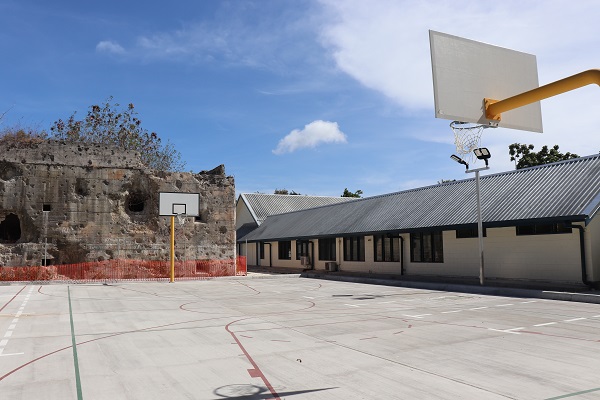 A modern Church building on Tarawa stands next to a Japanese bunker pockmarked by artillery damage from the 1943 invasion. Photograph by Casey Paul Griffiths.
Many of the I-Kiribati still carry with them memories of the exploding ordnance, soaring planes, and violent clashes on their island. One of the people who carried these memories was Waitea Abiuta, an educator on the main island of Tarawa. Abiuta is remembered by those who knew him as a short man with a lively and vibrant personality. He was a charismatic educator who received some education in Fiji before returning home and working as an educator in several different schools in Kiribati.[14] By the 1970s, Kiribati was still overseen by the United Kingdom, and only 5–7 percent of the elementary school–aged children were given the opportunity to attend school.[15] In an attempt to offer more opportunities, Abiuta decided to open his own school near the village of Eita on the main atoll of Tarawa. Available land came at a premium on Tarawa, so Abiuta chose to build his school on a parcel of land known as Tabuarorae (the sacred place). Tradition held that Tabuarorae was where the earliest people settled on Tarawa, led by a demigod named Auriaria. The spot became home to the earliest ancestral kings, of whom the most famous was Kokoi. In respect to these local traditions, Abiuta named his house of learning the Auriaria Kokoi Ataria School (AKAS), adding in the last name Ataria to honor his own father.[16]
The school was controversial even before it opened its doors. Because Tabuarorae was considered one of the most sacred places in Kiribati, many local villagers thought Abiuta was incurring divine disfavor by building the school there. A woman from the local village named Monika approached Abiuta and told him that several of the local people had experienced a dream in which they saw a fire in Tabuarorae with smoke ascending into the sky. Monika saw the dream as an omen of impending danger, and she urged Abiuta and his family to leave the area. Monika also discussed the dream with Abiuta’s father, who was a local pastor and a believer in dreams and visions. According to one account, Abiuta’s father told her the following:
Let’s carefully consider the dream. If a smoke is seen from the earth to the sky that is something. It is a vision of the power of God. Anything that relates to heaven is from God. So, if you will go back to the village now, tell your friends not to worry about us. We won’t leave this place. We will stay and complete the school. The meaning of the dream is this—one day the power of God will be bestowed in this area and by the nearby countries. . . . If something is seen in the sky, we [can] see it here from Kiribati. . . . Everyone sees it and that is related to the power of God. So, tell your friends not to worry about us. Be happy. It is a good vision. It’s a vision of something that will be established in this area, which will benefit the people of this country.[17]
 The AKAS School was originally housed in this structure. Courtesy of Moroni High School.
Not long after this incident, AKAS was registered with the government, and preparations were underway to open its doors. At the precise moment that the ribbon was being cut to open the school on July 21, 1969, the local news announced that the first American astronauts had landed on the moon. Abiuta took this as a good omen, declaring, “We are very grateful today to officially open this school on the day of victory. This is a day of victory for the United States for they are the first human nation to land on the moon. . . . As this is a day of victory for the United States, so this school will be backed by the United States in the near future.” He also told the crowd, “We don’t build the school for us, we build the school to prepare it for those who have the financial strength, who have the ability, who have the manpower, and who have the financial power to bring [it] up to the standard that we expect for this country. . . . We opened the campus for those who will come after us.”[18]
Abiuta had a vision for the school, but he did not know how it would be fulfilled. One of his students, Iotua Tune, later remarked, “The vision of this place I didn’t realize until I left. This is the nesting place. We came and learned how to fly here and then we flew away and [eventually] came back. . . . I think that things were made known unto this man [Abiuta]. He talked like a [Latter-day Saint]. He had a vision. And I think it really helped those [of] us that we should not think about going to another school.” Abiuta was fond of telling his students, “You are digging through your mountain now. Once you get to the other side there will be a blessing.”[19] Neither Abiuta nor his students grasped that this small school, built on sacred ground, would be the means of bringing the light of the restored gospel to Kiribati.
 Students at the original AKAS school. Courtesy of Moroni High School.
The First Students Arrive at Liahona High School
AKAS opened and was enjoying success, but Abiuta was concerned about the future of his students. Because of the limitations on secondary education, only a small number of students in Kiribati receive more than a grade-school education. In 1972 Abiuta began to send letters to high schools in different locations around the globe, including the United Kingdom, the United States, and other countries inside the Pacific Rim. Letters from Abiuta arrived at the Church schools in Samoa and Tonga and eventually reached the desk of Alton Wade, the Church Educational System (CES) administrator over the schools in the Pacific and president of BYU–Hawaii for eight years.[20] Wade later remembered, “When the first letter arrived, I didn’t pay much attention to it because my quick research revealed there were no known [I-Kiribati] members of the Church.” Several months later, Wade received a packet of letters from around thirty-five of the children at the school, pleading for the opportunity to obtain a secondary education at Liahona High School in Tonga. Wade took the request to the Commissioner of the Church Educational System, Neal A. Maxwell, who in turn took the request to the CES Board of Trustees, which included the First Presidency and the Quorum of the Twelve. According to Wade, the biggest concern during the discussion in the meeting was, “If they allowed some of the [I-Kiribati] students to go to Tonga, [and they] joined the Church and returned to the islands with no Church organization, what would happen to them?”[21]
In early March 1975, Alton Wade and Kenneth Beesley, another CES administrator, were sent on a fact-finding mission to Kiribati. Wade remembered, “As we flew over the group of sixteen islands it seemed as though the airstrip took up half the land-mass of the central island of Tarawa.” Upon arrival, the men flagged down a man driving a World War II jeep “held together by wire or whatever was available.” They showed the man a letter from AKAS and asked him to take them there. When they pulled up at the school, they saw that it consisted of four thatched huts and found a man sitting on a woven mat with his back toward them. “We quickly introduced ourselves and stated the purpose of our visit,” Wade recalled. “He rushed over to us, gave each a big embrace, and began to cry.”[22]
At the time, flights came in and out of Tarawa only every three days, so the two visitors had time to become acquainted with the school, its headmaster, and the students. “Two of the huts were classrooms with coral floors, nothing but mats to sit on and no teaching tools or materials of any kind except a few old hand-me-down textbooks and some paper and pencils,” Wade remembered. “There were no students present at the time we arrived because the boys went out fishing for the evening meal while the girls were gathering firewood and vegetables for the earthen oven,” he also observed. At the end of their three-day visit, the two administrators left the school after a formal send-off from the students, complete with handmade gifts and several songs of farewell.[23]
With the report from Wade and Beesley in hand, the Church board made the decision to approve twelve students to travel to Tonga to attend Liahona High School on a trial basis. George Puckett, the administrator of the Tonga schools, was instructed to take George Bates, the Liahona High School counselor, to Kiribati and select the twelve students to attend Liahona the following year. Both sides were aware of the opportunities for missionary work the new relationship created. Abiuta wrote to Alton Wade, “Thank you for accepting of our 12 students to your Liahona High School. Although it is very expensive still the parents sweat out to work hard for the benefit of their children. . . . Our parents wish some missionaries to come to the AKAS school and help [with] teaching and beside that they can lead people into the church as there is no branch of church of yours in our colony.”[24] CES leaders and Abiuta saw the exchange as mutually beneficial for the students and the Church. According to Kenneth Beesley, “[Abiuta] knew how to touch the sensitive points” and was conscious that the students might open the door for missionaries to enter the country.[25]
In February 1973, twelve students from Kiribati traveled to Tonga and enrolled at Liahona High School.[26] The students felt lost in the sea of a completely different culture, and many experienced homesickness. Much of the instruction at Liahona was in English, which the students from Kiribati learned to understand fairly quickly, but the religion classes at the school were given mostly in Tongan. Al Richardson, a teacher from Salt Lake City, set up a special seminary class for the students from Kiribati, centered around materials normally used for missionary work. By midyear all twelve of the students had requested to be baptized, had obtained written permission from their parents, and had been baptized by their teacher, Brother Richardson.[27] The students received fellowship from the Liahona Ward, an English-speaking unit of the Church in Tonga.[28]
 Baptism of I-Kiribati students in 1974. Courtesy of Riley M. Moffat.
Church leaders authorized a second group of students to travel from Kiribati and attend school at Liahona in 1974. Along with twelve more students, Ubanaba Ueara, a teacher at AKAS, traveled to Tonga. By now the students knew that everyone from the previous cohort had been baptized into the Church, but they received assurances from school leaders that baptism was not required to attend the school. Grant Howlett, then serving as an English teacher at Liahona, recalled intense discussions with the students about the Church, sometimes lasting hours. Some students joined the Church immediately, while others took several months, but by the end of the year all the second cohort, including the “old man” Ubanaba Ueara, had been baptized. Members of the Liahona Ward raised funds for Ubanaba to bring his wife and children to Tonga. The members of the Ueara family were the first investigators taught by converts from Kiribati. Ubanaba’s home soon became the hub for missionary work among the I-Kiribati in Tonga.[29]
The First Missionaries Return Home
With missionary success among these first two groups of students, Church leaders began thinking of ways to allow these young converts to return to their own people as missionaries. In April 1975, priesthood leaders called six members of the first cohort of Liahona students to return to Kiribati to serve as missionaries.[30] At the time, the law in Kiribati would not allow foreign missionaries to enter and teach in the country until their church had at least fifty resident adult members. The first Latter-day Saint missionaries from Kiribati—converts of less than two years—would need to return home and lead the mission without supervision. To prepare them, these missionaries first served six months in the Tonga mission to learn the basics of missionary service. During this time, the I-Kiribati missionaries taught several students and family members in Ubanaba Uera’s home. Following this six-month period of preparation, the six missionaries were transferred to the Fiji Suva Mission, under the direction of President Kenneth M. Palmer.[31]
The first Latter-day Saint missionaries in Kiribati, all members of the native population, arrived home on October 16, 1975. In company with them on the beach near the war-memorial cemetery on the island of Betio, President Palmer dedicated Kiribati for the preaching of the gospel. Betio, an islet that is part of the Tarawa Atoll, was the primary site of the bloody battle fought there in World War II. President Palmer later reflected that “this battle had fulfilled for Kiribati, and particularly Tarawa, what the Revolutionary War had done for America. . . . [It had] redeemed the land by the shedding of blood (Doctrine and Covenants 101:80).”[32] President Palmer’s prayer contained revelatory promises to the people of Kiribati:
 First I-Kiribati missionaries: Tekaibeti Taratake, Abakite Tuneti, Teema Bentitai, Taaiti Natanga, Bename Tawai, and Barate Timea, October 1975. Courtesy of Kiley M. Moffat.
We do earnestly pray that as people join the Church in this land, strong leaders may be raised up who will assume the administration of the Kingdom in this portion of Thy vineyard, and that among them there will be Branch Presidents, Bishops, High Counselors, Stake Presidents, and Missionaries. We seek that Thy Holy Spirit may move upon the government and leaders of these islands, that keys may be turned, and doors opened for the preaching of the gospel. . . . There are many scattered members of Thy chosen people of the House of Israel who will be receptive to the message of Thy servants, even as sheep know the voice of their shepherd.[33]
President Palmer spent a week with the missionaries and then departed, leaving them on their own.[34]
The missionaries centered their first efforts on AKAS. Not surprisingly, one of their first converts was Waitea Abiuta, who was set apart by President Palmer as the first branch president in Kiribati on January 24, 1976. The indigenous missionaries were assisted by expatriate missionaries from Fiji, who were allowed by the local government to serve on Kiribati for only one month before returning home.[35] The I-Kiribati missionaries experienced pushback as they returned to serve among their own people. Iotua Tune, one of the first missionaries, remembered, “As I look back, when we came, there were not very many members. There was a lot of persecution and mocking going on. At that time, the wearing of neckties and long pants was [problematic]. That was probably one of the hardest things I had to face.”[36] The wearing of American-style business attire created a sense of inequality between the missionaries and the people at times.
Despite the challenges, the missionaries enjoyed early success, especially among the AKAS students and their parents. Some families joined the Church only because they thought it would increase the chance of their children attending Liahona High School. But over time, a small and dedicated core of members began to coalesce around the school. In addition to Abiuta, three members of the school board, one of the teachers, and several of the parents of students joined the Church. Iotua Tune remembered, “The mission was great. We only had one branch at the time. We had a lot of baptisms. Every Sunday we baptized—a lot!”[37]
Success brought attention to the movement, and the missionaries soon found themselves facing opposition from other faiths. Leaders from other churches ordered their followers to avoid sending their children to the school, and enrollment at AKAS began to decline. Around the same time, Tuvalu (formerly known as the Ellice Islands) separated from Kiribati. Students from Tuvalu went home, further decreasing the school’s enrollment. AKAS was the hub of Church activity in Kiribati, and its closure would have been a devastating blow to the Latter-day Saint movement just as it was beginning to gain momentum. Just a few months after the first branch of the Church in Kiribati was formed in 1976, President Palmer and James W. Harris visited Kiribati and saw the need for the continued presence of a school, not just to ensure the continued growth of the Church there but also to meet the educational needs of the members in Kiribati.[38]
The suggestion for the Church to take over AKAS came at a time when the Church was gradually withdrawing from secular schooling around the globe. A report issued by CES Commissioner Neal A. Maxwell only a few years earlier stated that “religious education is to have primary emphasis in the future expansion of the Church Educational System.” The report further added that “the general policy for governing the Church Educational System rests on the assumption that non-religious education is usually provided by the state.” It did allow one caveat: “Where other educational systems are nonexistent, seriously deficient, or inaccessible to our members, the Church may elect to provide basic education for its members under carefully established criteria.”[39] According to Alton Wade, when the suggestion was raised that the Church take over the school, “the brethren in Salt Lake resisted that suggestion for a period of time, but it soon became clear that we really had no choice.”[40] In June of 1976, Grant and Patricia Howlett received a call to travel to Kiribati to direct the school.[41]
Moroni Community School
When Grant and Patricia Howlett arrived in Kiribati with their family, the branch and the school were facing serious challenges. Enrollment at the school had dropped to only seven students. One of the six missionaries had been badly injured in a motorcycle accident. Another missionary had quit proselyting and signed up for police training. The remaining four elders were split between a companionship on Tarawa and another companionship on the Marakei Atoll, where Abiuta hoped to open another branch of AKAS. Grant Howlett later recalled, “Only seven people attended the church services the first weeks we were there.”[42]
 Grant and Patricia Howlett family in Kiribati, about 1975. Courtesy of Riley M. Moffat.
The Howletts set to work but felt some uneasiness about the way the school was operated. In speaking with Abiuta about their concerns, they often received evasive answers from him about his work with the school and the students. After a few weeks of investigation and work with the local school board, Grant discovered evidence of improper conduct and serious mismanagement on the part of Abiuta. Abiuta’s support was instrumental in bringing the gospel to Kiribati, but his infractions could not be excused. With the support of the school board, Abiuta was suspended and removed from the campus. At the same time, his involvement with the Church ended. Grant was asked to take over as branch president, in addition to managing his responsibilities at the school.[43]
The controversy surrounding Abiuta caused a series of setbacks for the school. The government’s Ministry of Education, Training, and Culture declared that the school would have to be registered again, this time in Grant’s name. Grant worked with the government to negotiate the school’s re-registration but was forced to make compromises, including a provision that the school would close when Grant left the country. He and the local members became discouraged and were concerned that AKAS might not be able to maintain a permanent presence in the country. But the need for the school was evident. When the school resumed operations for the last term of 1976, enrollment increased to thirty-one students.[44]
Amid their efforts to keep the school alive, the Howletts were beset with a family crisis. Patricia gave birth to a baby girl on November 10, 1976. The baby was very ill from birth. Grant gave the little girl a blessing, promising her that she would live, though her condition continued to worsen. The baby fell into a coma due to dehydration. The Howletts struggled to find doctors on the island with the professional training to help the baby. The doctors finally determined that the baby was suffering from a blocked intestine. The Howletts recruited an eye doctor who was living on the island to perform a lifesaving surgery. His only qualification was that he had read up on how to perform the surgery using medical textbooks at hand and was “used to working on small things.” The surgery was successful, though the baby remained unconscious for three more weeks. After a total of six weeks in the hospital, the little girl was finally allowed to come home, though she was still below her birth weight.[45]
In January 1977, the new school year began with eighty-five students enrolled at AKAS. A seminary class also began at the school. Grant and his faculty did not know what the rest of the seminaries in the world were teaching, so they decided to start with the Old Testament. Through these religion classes, several students became interested in the gospel, allowing the missionaries to contact their families and begin teaching them. The school also began to find favor with the local government. A man named Tibwere helped the Howletts build a new home for their family. Tibwere closely observed the way the Howletts conducted themselves and began asking questions about the Church. Soon after, he and several of his family members were baptized. Tibwere’s son was an important official in the country’s Ministry of Education, which further opened the door for the school to establish a permanent presence.[46]
Around the same time, Grant received word that the Church was considering how to best help the needs of its growing membership in Kiribati. In February 1977, President Palmer came to the island, accompanied by Elder John H. Groberg. They brought with them a copy of the Church News announcing that approval was given for a church school in Kiribati and that Howlett had been appointed as the school administrator.[47] About a month later, Alton Wade and Paul Sorenson, another CES administrator, visited the island. Wade later recalled, “Brother Howlett reported that the school buildings, property, land lease, and materials and equipment were transferred from the governing AKAS board to the Church. . . . Brother Sorenson and I had the opportunity of speaking to the students. It was a great thrill for me, and I felt a special spirit amongst these young people.” Wade also noted that “the students range from twelve to twenty-three, and two of the students are married. They are certainly a warm and happy people.”[48]
After receiving permission from Church President Spencer W. Kimball, the Church Educational System officially took over AKAS and leased the school’s land for ninety-nine years. With the school coming under Church control, Wade felt it should receive a new name. While he and Sorenson sat on a coconut stump and gazed out at the ocean, they felt inspired to rename the school the Moroni Community School (later called Moroni High School). Wade reflected on the image of the angel Moroni sounding his trump, feeling that the school might serve a similar purpose, serving as a beacon shining to all the people of the islands of the sea.[49]
Receiving Official Recognition
As the president of the Tarawa Branch, Grant Howlett effectively became the leader of the Church in Kiribati. He was given the charge to obtain legal recognition for the Church from the government. By 1977 the Church had surpassed the fifty-member minimum required by the government to obtain official recognition. The induction of the school into the Church Educational System had bolstered the hopes of Church members to achieve official recognition, but many obstacles stood in the way. One of Howlett’s counselors in the branch presidency, Ntiua, advised him that it would take at least seven years before the Church received official recognition. Nevertheless, Howlett began writing letters and contacting government officials.[50]
 Moroni High School has become a central hub for the Church in Kiribati. Photograph by Casey Paul Griffiths.
Howlett soon received a letter back from the government stating that the Church’s application would receive no further action until allegations about the Church not extending the “rights of coloured races to fill the top ranks in the priesthood and administration of the Church” were answered.[51] This was an obvious reference to the Church policy of not allowing people of African descent to receive the priesthood or temple ordinances. The policy was changed the following year, in 1978, when after years of prayerful consideration President Spencer W. Kimball announced a new revelation extending priesthood and temple blessings to all worthy individuals, regardless of race.[52] However, in 1977 the accusations presented a serious barrier to official recognition of the Church in Kiribati. Howlett later admitted that he did not know the best way to answer the charges. He found a book on the subject, which he had purchased two years earlier during a visit to Utah, and began searching for the appropriate way to address the government’s concerns. He later recalled, “The book helped, but the Spirit of the Lord rested on me, and I drafted a letter.”[53]
In the letter, Howlett chose to address head-on the questions raised by the government. “At the root of this criticism is the belief that the Church practices and teaches racial discrimination, and this is false,” he wrote.
To the contrary, we teach that racial discrimination is a sin, for we teach that every person of any race is a spirit son or daughter of God and thus our brother and sister. This includes all races. Discrimination against any other person of any race is a sin against him, for he, like me, is a son of God who has the potential to “grow up” to be like God himself. Our purpose in life is to help each other reach this potential, and any unrighteous discrimination would be in direct conflict with our teachings. Clearly, this is a loftier concept of racial equality than is taught by any social movement on the earth.[54]
Howlett’s letter addressed many of the government’s concerns about the Church, and the re-registration process began again. Some obstacles remained. One British official told Howlett, President Palmer, and Elder Groberg that he was opposed to any religions beyond the Catholic Church and the Kiribati Protestant Church. “Two is enough—that gives people a choice,” he told the Latter-day Saint leaders. “Any more just brings fighting.”[55] Nevertheless, official recognition for the Church was granted on June 29, 1977. Grant Howlett was first informed of the approval right after he awakened from emergency surgery to remove a ruptured appendix. He later noted the remarkable way the door was opened for the Church in Kiribati: “The Church of God [another Christian denomination] has been in [Kiribati] for fifty years, and they are still not registered. Our missionaries had been in [Kiribati] less than two years.”[56]
 The Kiribati Service Centre located next to Moroni High School. Photograph by Casey Paul Griffiths.
The establishment of the Church was further assisted when most members of the government were voted out and a new group of government officials took office. Many leaders in the new government arrived in Tarawa looking for a school in which to enroll their children, and several of them chose the Moroni Community School, further raising the Church’s profile. School leaders also designed new uniforms with striking blue and gold colors, with a prominent logo showing the angel Moroni. The students’ blue uniforms became a common sight on Tarawa. The school itself dedicated two new buildings in March 1978. School officials also struck a deal to bring electricity to the school if the school agreed to provide most of the labor themselves. Students dug trenches across the school’s property while professionals ran the wires and cables into all of the buildings. Work was delayed slightly when another church complained that the school was using their transformer, but the dispute was resolved with help from the government. Howlett noted, “By this time, however, the government people had swung around from a position of opposition to our work to one of high respect and support, so the connection was soon made.”[57]
Grant and Patricia Howlett completed their mission in August 1978. By the time they departed, the Church was on stable footing in Kiribati. Grant Howlett noted, “Only seven people had attended the Church meetings the first weeks after we arrived, but we averaged 125 for the last month we were there. During those first weeks, some meetings had been begun without even having a prayer. But now two local men holding the Melchizedek Priesthood were prepared to conduct the meetings on their own until such time as the mission president could come to reorganize the branch. We had seen the Church go from a thing of ill repute to a church that commanded a great deal of respect.”[58] Early missionaries, Church officials, and expatriates, such as the Howletts, Alton Wade, and others, played an instrumental role in laying the foundations of the Church in Kiribati. They continue to play a role in the present day. But during the next few years, faithful converts among the I-Kiribati began to step forward and provide the leadership necessary for the Church to grow and flourish in their homeland.
Building and Expanding the Church and the School
Over the next few years, construction continued at a rapid pace at Moroni High School. In 1978 Richard and Adeline Pratt arrived to take over operations of the school from Grant and Patricia Howlett.[59] By 1980 almost the entire faculty of the school consisted of local Church members, aided by a handful of missionaries. The school records from this period highlight a myriad of challenges, internally and externally, facing the school and its staff. Kiribati became a sovereign state in 1979, and the transition to independence was difficult.[60] On June 1, 1980, the power suddenly went out at the school. The loss of electricity resulted from a strike, with local radicals burning down homes and gathering places and attacking government buildings. The electricity came back on seven days later, but the strike continued throughout the island.[61] In the same year, seven boys were expelled from the school for smoking in the dorms and school was dismissed for a short time in July because of a shortage of rice and flour. Despite all these challenges, fifty-three students graduated from the school, and dozens of students chose to join the Church.[62]
Roy and Michele (Mickey) Bauer
 Roy Bauer and Michele (Mickey) Bauer. Photograph by R. Devan Jensen.
Roy Bauer already had a master’s degree in animal nutrition before he began serving as a young missionary in the Cook and Fiji Islands in the Fiji Suva Mission in 1972. Later, in 1975, Roy married Mickey Parr. In October 1977, the head of the Church Educational System in the Pacific invited Roy to teach at the newly built Fiji LDS Technical College. The Bauers had one child at the time. They stayed in Fiji for five years. Then Jack Welton, head of Seminaries and Institutes in the Pacific, invited Roy to apply to be headmaster of the Moroni Community School in Eita, South Tarawa. Roy was hired in that position in January 1983. He worked as associate area director for Seminaries and Institutes in Micronesia and also became the branch president. The Bauers later served as mission president and companion in the Fiji Suva Mission from 1999 to 2002. They then served in the Church History Library in the Salt Lake City Headquarters Mission.
The school’s location, just a few meters from the open water on both sides, created unique maintenance challenges. A historical report from 1984 noted that the school was out of running water. The entire supply of running water for the school was dependent on rain, and occasionally no running water would be available, sometimes for months at a time. That same year, the seawall protecting the school on the ocean side of the island began to collapse. There was concern that the ground the school was built on might wash out to sea. Students spent two months repairing the seawall during low tide. They rushed to cement together rocks hauled to the site in time for them to dry before the tide came back in. In exchange for their services, the students received payment that went directly to their tuition.[63] Many students etched their names into the cement, leaving a witness still present decades later. Amid these challenges, the Church continued to use the school as an effective tool for spreading the gospel. School records from the time note that during the 1984 school year the percentage of non–Latter-day Saints dropped from 60 percent at the beginning of the school year to just 29 percent by the end of the year, owing to energetic missionary work.[64]
 Part of the seawall protecting Moroni High School from ocean erosion. Students who helped build the wall have written their names in the cement. Photograph by Casey Paul Griffiths.
While the students worked to shore up the school physically, Church members worked to strengthen the Church’s place in the local society. Baitika Toum, a stalwart member, eventually served as a six-time minister to the president of the Republic of Kiribati. Toum’s service in the government became vital to the continued growth of the Church in the islands. Toum later recalled, “When the Church first came, it faced a lot of difficulties. Most of the positions of people in the government with authority were either Protestant or Catholic. They were influenced by the Moderator and the Bishop of the Church. I was glad that the Lord used me in a political career to serve my country, my people, and also to help the Kingdom of God in Kiribati.”[65]
In the early 1980s, Church leaders wanted to expand Moroni High School to accommodate more students, but government officials refused their request. At the time, Baitika Toum was serving as a government minister, heading the Ministry of Education. Toum called a meeting of government officials to discuss the request. He began by asking, “What is the purpose of education?” The participants at the meeting replied, “We want to educate our people so that they can compete, so that they can improve the country and their welfare.” Toum responded, “Okay, are we going to develop the schools or are we going to limit them?” The ministers responded that they were eager to increase them. Toum then brought up the proposed expansion of Moroni High School. “The secretary at that time was a strong Protestant,” Toum recalled. “I knew he was once the Secretary for Education. He was the one who backed up things and put down Moroni, together with the assistance of the Catholic Priests and Catholic secretaries. So I told them, ‘Using my power as minister, I give the okay for Moroni Community School to be extended.’ I also told them that ‘any church in Kiribati who wanted to expand, let it expand, provided it can qualify for the requirements from the administration office.’”[66]
The Saints in Kiribati
As the Church continued to grow in Kiribati, individual stories of conversion multiplied as well. Through the years, Moroni High School has served as the primary engine of Church growth. Florence Muller Kabuuare was a student attending AKAS when she was baptized in 1977. She later admitted, “When I was baptized, I was not fully converted to the Church. I was just joining the Church to have my fees cut down.”[67] After graduation, Kabuuare traveled to Tonga to receive further education. She was impressed by how devoutly the local Saints in Tonga observed the Sabbath, and she began to study the gospel more diligently. She later said, “I couldn’t speak English at that time. I just say ‘yes’ or ‘no.’ And when I was there, too, I fasted and prayed. That’s where I gain[ed] a testimony—that through fasting and prayer I was able to speak in English. Not very well, but I could communicate, and also my grades [were] going up. . . . I started reading the Book of Mormon. Through seminary I started getting more [of] those feelings—like I know that the Book of Mormon is the word of God.”[68] From 1984 to 1986, Kabuuare served a mission in the Marshall Islands, Pohnpei, Guam, and her own home country. When she returned, she helped three of her sisters and her mother join the Church. Kabuuare was also able to travel with her mother to the temple, where her maternal grandparents, who were long deceased, were sealed together by proxy. Kabuuare was also sealed to her parents.[69]
Tereke Tabarea was baptized at Moroni High School in 1982. He served a mission to Tonga from 1987 to 1989 and then returned to Kiribati, where he worked building meetinghouses for the Church. He later remembered, “When I came back from [Tonga], I felt the need to show my family that I really believe there are living prophets.”[70] Tabarea later helped three of his sisters join the Church. When the temple in Suva, Fiji, was dedicated in 2001, Tabarea and his family sold many of their belongings to pay for airfare to the Fiji temple. Tabarea later said, “If you really want to go to the temple to be sealed, everything will be provided by Heavenly Father.”[71]
Tamaroa Tekeiaki grew up on Tabiteuea, a large atoll located to the south of Tarawa. Tekeiaki was living with his grandparents when a pair of missionaries stopped by their home. He was baptized in 1988 when he was just ten years old. Tekeiaki later said, “I was too young to understand a lot of the things that the missionaries told me, but I know it [was] because of the decision of my grandparents [that] I was able to be taught the gospel and then be baptized.”[72] The next year, when he was eleven, Tekeiaki left home to attend Moroni High School in Tarawa. There he enrolled in religion classes, and his testimony began to grow stronger. He remembered feeling the Spirit “because of the influence of [his] friends, teachers, and especially [his] seminary teachers. They encourage[d] [the students] to pray about the things that [they] learned in school and [the things] that the missionaries ha[d] taught.”[73]
Most of Tekeiaki’s relatives felt he was only pretending to believe so that he could attend the school. When Tekeiaki returned to his home island during a school break, relatives and friends took him aside to say, “It’s good that you attend the school there, but you know when you graduate you can go back to your own church.” Tekeiaki’s mother was deeply Protestant, but Tekeiaki felt strongly about his new faith. He recalled, “I think this is [true]; I have found the real truth in this church. So I just kind of ignore[d] what my relatives and friends encouraged me to do.”[74]
 Harry and Alice Wight family. Harry served as a headmaster of Moroni High School.
When Tekeiaki’s time at Moroni High School ended, he was filled with a strong desire to serve a mission. He worried about how his father and mother might respond to his desire to serve. His parents provided for their family by fishing and harvesting coconuts. They sacrificed for Tekeiaki to receive an education, and because he was their oldest child, they expected him to get a higher-paying job to help provide for his brothers and sisters. His parents at first firmly rejected his request to serve a mission, but Tekeiaki continued to pray. Eventually his father gave a lukewarm endorsement, saying, “Oh, it’s up to you.” Tekeiaki left home to serve for two years in the Australia Sydney South Mission. His mission was a time of growth and change. He wrote to his family regularly, sharing his testimony and inviting them to receive the missionaries in their home. He never heard back from his family.
Tekeiaki later recalled his anticipation when he completed his mission and arrived home: “I came home, and I [was] so excited. I want[ed] to see my family.” He found his family all well. A few days after his arrival, he was surprised when his mother and brother asked if they could accompany him to church. He later recalled, “I didn’t realize that my mom [had] become the Relief Society president! My family had been baptized, you know! . . . It was really so emotional to me at that time. I know that the Lord has blessed me as I have served Him well, and I have sacrificed a lot of things in my life. Now my family [is] being blessed.”[75]
The Church in Kiribati brought in converts from a wide variety of cultures. Jinendra Jinadasa was born in Ethiopia but moved to Kiribati when his parents were recruited to teach at a Protestant school in the islands. Both of his parents were science teachers and were highly sought after in the islands. The principal of Moroni High School, Harry Wight, offered both of Jinadasa’s parents teaching positions. When leaders from the other school found out that Jinadasa’s parents were being recruited by Moroni High School, they became upset and influenced several government officials to deport them from the country. As a result, Jinadasa and his family were sent to Fiji and remained there for several months while the matter was sorted out. Jinadasa and his sister returned to Kiribati while their parents were still working through legal issues and started school at Moroni without their mother and father.
When the Jinadasa family began to attend Church meetings, they struggled to understand the services because they were conducted in the local language rather than in English. Eventually Jinadasa’s father and sister were baptized, followed shortly thereafter by Jinadasa and his mother. Jinadasa remembered, “We studied on our own and got a testimony. . . . My father was still struggling with the Word of Wisdom; he was a heavy smoker. He had a lot of challenges, but gradually he was able to quit by a miracle. He got really active. He had a calling and was called to be a high councilor.”[76] Jinadasa graduated from Moroni High in 1993 and then traveled to BYU–Hawaii. He was then called to serve in the New York South Mission, covering Brooklyn, Queens, Staten Island, and Long Island. Looking back on his mission, Jinadasa recalled, “It was very challenging, very memorable, and, I think, the turning point in my life in a lot of ways. That’s where I gained a really strong testimony of the priesthood, also the importance of families.”[77]
Following his mission, Jinadasa returned to BYU–Hawaii, where he met his wife. They were sealed together in 1999 in the Laie Hawaii Temple. Jinadasa later remembered “the most wonderful feeling that [they] shared when [they] were in the sealing room.” He explained, “Neither of our families were there because we could not afford to get them there, but just being able to be in that room and knowing that we were going to be sealed for eternity was a very wonderful feeling.”[78] Jinadasa completed graduate school at Hawaii Pacific University and then returned to Kiribati with his family, where he worked as a computer teacher and specialist at Moroni High School. He found Kiribati to be an ideal place to raise a family. “One thing that’s very nice about the Kiribati culture is [that] families stay together,” he noted. “When children get married they stay with their families. Most people here are able to recall back many generations. Most of the time children are named after their grandparents. The names keep repeating, so it’s very easy to remember who was your grandfather [or] who was your grandmother.”[79]
The Church in Kiribati Comes of Age
Stories such as these multiplied as the Church grew throughout the 1980s and 1990s, increasing from just 510 members in 1980 to 5,076 by 1995.[80] In 1996 Elder L. Tom Perry became the first Apostle to visit Kiribati. He dedicated Moroni High School and then found a quiet, secluded place to dedicate Kiribati for the preaching of the gospel. Elder Perry, a former United States Marine who fought in the Pacific during World War II, chose a site on the island of Betio at Red Beach, where the United States Second Marine Division landed in 1943 at the beginning of the Battle of Tarawa. Accompanied by about twenty-five local Church leaders, Elder Perry acknowledged the hallowed history of the site in the dedicatory prayer: “We have selected this site for our prayer where death and destruction reigned a few decades ago, in contrast to our message of peace, hope and goodwill for all of thy children here on earth.” He continued, “Thou hast kept these islands isolated from the worldly things that bring contention among the people, where their understanding of the gospel truths that thou hast ordained for thy children here on earth will be simple and plain. Our hearts go out to thee in gratitude, dear Father, for the great truths of the everlasting gospel that have been established here on these islands.”[81]
Elder Perry spoke warmly of the Saints in Kiribati during his visit, describing his time on the island as a “choice experience.” “There is such a community feeling among the Saints on these islands,” he said. “It gives you such an uplift. When you meet with them, you can’t help but have tears in your eyes. I just fell in love with the people. To think we would have this kind of representation today as members of the Church on these islands is absolutely amazing.” Elder Perry created the first stake in Kiribati on Sunday, August 11, 1996.[82]
Around the time Elder Perry officially dedicated Kiribati, Alton Wade, now serving as an administrator at BYU, received a letter from Waitea Abiuta, the teacher who first reached out to Church educators decades earlier, starting the process leading to the establishment of the Church in Kiribati. Abiuta wrote,
I am very happy that the Church in Kiribati at this time is not a branch but a stake, and the school is rapidly improving. It is now the most beautiful than other church schools and even the government schools. Both of us and others should be proud of that, and I myself wish to give the greatest thanks to the Church in Utah and other [Latter-day Saint] churches in other countries in the world for their financial aid for all the school needs and equipment. . . . Now parents on Tarawa and other sister islands wish to send their sons and daughters for schooling in Moroni. I thank our Father in Heaven for presenting me the long life to live so that I may see all the great and rapid changes.[83]
Abiuta wrote fondly of his desire to “have a chance to see the holy city Utah—the Church city.”[84] He passed away a few years after sending the letter.[85]
In 2000 President Gordon B. Hinckley visited Kiribati as part of a trip to several nations in the region. Over 1,500 local Saints gathered at the Bonriki airport to hear President Hinckley speak. President Hinckley was formally greeted by Kataotika Tekee, minister of Environment and Social Development, who was sent by the president of Kiribati. Minister Tekee’s brother, Timea Tekee, was one of the first missionaries who had served in Kiribati. “I’ve never been to Kiribati before—not many people have,” President Hinckley joked. “But what a pleasure it is to look into your faces and to feel of your spirit—your great love for the Lord; your great love for the Prophet Joseph; your great love for the Church which you have joined in such large numbers.” President Hinckley used the presence of the school to emphasize the importance of education:
You are very fortunate here in this land out in the midst of the Pacific to have a high school which we have established for your blessing and good. I want to urge all of the young people—all of you young people—to take advantage of that school. Get all the education that you can. The Lord has told us that we have an obligation to educate ourselves in the things of the world and the things of His Church and Kingdom. This school will open up opportunities for you that you otherwise would not have. So, take advantage of it! If you have to sacrifice, do it, but go to school.[86]
Tereke Tabarea remembered vividly the prophet’s visit to his home country: “I also [had] an experience when the prophet Gordon B. Hinckley visited the island. When I saw him in my living eyes, I believe[d] he has been called from God.”[87] Levita Lamese, who at the time was serving as president of the Tarawa Kiribati Stake and principal of Moroni High School, remembered, “I was surprised to see many people crying and overwhelmed to be in the presence of the prophet of God. They just could not believe they were seeing the living prophet speaking to them face to face. Tears ran down their cheeks as they listened to the prophet’s message.”[88]
A Temple of God in Kiribati
In the early 2000s, Church growth in Kiribati continued at a rapid pace. Church membership reached 11,081 in 2004, a 490 percent increase from 2,259 members in 1990. By 2020, Church membership had grown to 20,946 members in eleven wards, twenty-six branches, and two stakes. One estimate places Church membership as high as one in six people in the larger population. In a country where there was no Church presence just fifty years ago, the Latter-day Saints in Kiribati now form a significant part of the population.[89] Lita Iabeta, a seminary coordinator in Tarawa who converted in the late 1980s, remarked, “I have seen a lot of growth. I have seen a lot of changes. One of the things I have seen is that the students I worked with when I was a principal and teacher, a lot of them are Church leaders, stake presidents, bishops, branch presidents, auxiliary leaders. I have seen a lot of my students go on missions. . . . We always invite former students who are returned missionaries to speak to our students. Our students saw their brothers and sisters serving and then decided to go on missions.”[90]
The relatively rapid growth of the Church in Kiribati means that new converts are often put into positions of responsibility soon after their baptism. Banririe Benati Nenebwati was called as a branch president just a few weeks after his baptism in 2006. In 2010 he was called as a counselor in a stake presidency, and then in 2015 he was called as president of the Tarawa Kiribati East Stake. “Stake president is a very big role for me,” he remarked. “I haven’t been a member for a long time. Two thousand six is not that far back, but I am proud that I have the opportunity to serve in the Church.”[91] Nenebwati presides over a stake with more than 4,000 members, working diligently with other Church leaders to help them minister to the membership throughout the islands. In addition to his responsibilities as stake president, Nenebwati also serves as the principal of Moroni High School.
In 2019 Iotua Tune, one of the first students to travel to Tonga in the 1970s, was called as an Area Seventy.[92] When Elder Tune joined the Church in Tonga, the first six missionaries from Kiribati were preparing to return to their homeland to preach the gospel. “When I started attending Church,” Elder Tune recalled, “Grant Howlett was a member of my bishopric. He invited me to his home to teach me the gospel. He taught me about the First Vision, and finally I was ready to be baptized.”[93] After graduating from Liahona High School, Elder Tune was filled with a desire to attend the temple. A couple from Tonga paid for his trip to the temple in New Zealand. Elder Tune recalled, “I stayed there for a month and attend[ed] the temple every day before I came back to Tonga. I was the first missionary [from Kiribati] to attend the temple.”[94]
 Iotua Tune was one of the first students to attend school in Tonga and then return as missionary to Kiribati. He was called to serve as an Area Seventy in 2019.
In 1979 Elder Tune returned to Kiribati to serve as a missionary. During his mission, Elder Tune stayed in the missionary apartment located on the Moroni High School campus. “My mother lived on the other side of the fence from me,” Elder Tune laughed. “She was only fifty meters away from where we were staying. She would wash my clothes.” He remembered the challenges of those early days: “We didn’t have a [Missionary Training Center]. It was helpful to go through the temple. At the time, missionaries were struggling. Quite a few of the early missionaries didn’t make [it]. A few of those who I started with didn’t finish. The temple helped me to make it.”[95]
After his mission, Elder Tune traveled to BYU–Hawaii, where he married Maii Toanimatang, a native of Tonga whom he had met during his schooling at Liahona. Elder Tune became the first student from Moroni High School to graduate from BYU–Hawaii. Afterward he traveled to BYU in Provo to gain further education and graduated in 1987. When he returned to Kiribati, he taught at Moroni High School, later serving as the principal and eventually as the CES coordinator for the entire country. Though Kiribati is mostly spoken of in the larger world because it is threatened by rising sea levels, Elder Tune expressed faith about the future of the Church in his country. In 2018 he remarked, “The temple will come when we are ready. If we do what we are asked to do, the temple will come.”[96]
 A rendering of the Tarawa Kiribati Temple. In May 2021 it was announced that the location of the temple will be across from the Kiribati House of Parliament. Courtesy of Church News.
Members in Kiribati rejoiced in October 2020 when President Russell M. Nelson announced plans to build a temple in their country. “Our hearts were full of joy and excitement up to a point that almost all who heard [the temple announcement] had tears and thankfulness of heart,” said Banririe Benati Nenebwati. “I know that the Lord is mindful of His people in the isles of the sea, and the revelation to erect His holy house in our country affirms that the will of the Lord, which has been prophesied in the holy scriptures, will soon be fulfilled once we literally see the temple being erected on our beautiful shores.”[97]
Elder Ian S. Ardern of the Seventy remarked of the announcement of the temple in Kiribati, “These members are amongst the most temple-isolated in the world, and that means for most they attend the temple just once in their lives. . . . To become regular temple attendees is a blessing many have prayed for over many years—so little wonder there was a silent ‘cheer of delight’ on hearing the announcement from President Nelson.”[98] The official site and design of the temple was announced on May 19, 2021. The stately, single-spire structure will be located at Ambo, South Tarawa, just across the street from the Kiribati House of Parliament.[99]
“He Remembers Us”
Today the school colors worn by Moroni High School students are a familiar sight, mingled in with the school colors from their counterparts at the Protestant and Catholic schools in Tarawa. Chapels dot the narrow strip of land that forms this central island in the nation of Kiribati. In the outer islands, small branches continue to grow as more and more people in this beautiful island nation discover the restored gospel. Soon an elegant temple will rise in the heart of the country, just meters away from its primary seat of government. Elder Tune, who has witnessed firsthand nearly the entire history of the Church in his country, reflected,
As I look back, I have seen the hand of the Lord. I have a testimony that this work is directed by Heavenly Father and that He has used us to fulfill what He planned for the people of the isles of the seas. I have seen the Church growing right from the beginning. I am so grateful for those who labored right from the beginning. . . . I remember in the Book of Mormon where the Lord says, “I remember those of the isles of the sea” [2 Nephi 10:8]. We live in days of calamities and tribulations, but I have great faith that we are here on this island, God placed us here, and He remembers us.[100]
Notes
[1] This study was made possible by a series of generous grants from the Religious Studies Center (RSC) and the Office of Research and Creative Activities (ORCA; now called the Research Administration Office) at Brigham Young University. Because of the generosity of these two institutions, the authors were able to travel to Kiribati in June 2018, collecting documents, oral histories, and other sources vital to the creation of this history. Without this help, this history may not have been possible. The authors also express sincere gratitude to the faculty and staff of Moroni High School, who provided housing and assistance with travel during our time in Kiribati. We extend our sincere thanks to Elder Iotua Tune, Banririe Benati Nenebwati, Lita Iabeta, and all the wonderful Saints of Kiribati who took the time to contribute to this chapter.
[2] The Republic of Kiribati was formerly known as the Gilbert Islands before it gained independence from the British Commonwealth in 1979. The name Kiribati is the rendering of the name Gilberts in the local language. The islands were originally named after the British sea captain Thomas Gilbert, who first visited the islands in 1788. Ridgell, Pacific Nations and Territories, 95.
[3] “Five Facts about the International Date Line,” CBC News, December 30, 2011, https://
[4] CIA, “Kiribati,” The World Factbook, https://
[5] “Kiribati: By the Numbers,” The Church of Jesus Christ of Latter-day Saints, https://
[6] Jacobs, “Beacon to the Isles of the Sea,” 277.
[7] Macdonald, Cinderellas of the Empire, 32–33.
[8] Macdonald, Cinderellas of the Empire, 33.
[9] Taoba, “Speaking and Writing,” 99–100.
[10] Macdonald, Cinderellas of the Empire, 33.
[11] Etekiera, “Te Aro,” 57.
[12] Etekiera, “Te Aro,” 59–64. As of 2015, just under 60 percent of the population of Kiribati declared themselves to be Roman Catholic, while just over 30 percent claimed to be members of the Kiribati Uniting Church (Protestant); see “Kiribati: By the Numbers.” The Gilbert Islands Protestant Church changed its name to the Kiribati Protestant Church in 1979 and then to the Kiribati Uniting Church (KUC) in 2014. The KUC integrates different Protestant denominations, including Congregationalists, Evangelicals, Anglicans, and Presbyterians; see “Kiribati Uniting Church,” World Council of Churches, https://
[13] Spector, Eagle Against the Sun, 259–67.
[14] Howlett and Howlett, “From Beginnings to an Open Door,” 4.
[15] Jacobs, “Beacon to the Isles of the Sea,” 278.
[16] Howlett and Howlett, “From Beginnings to an Open Door,” 5; Jacobs, “Beacon to the Isles of the Sea,” 278.
[17] Jacobs, “Beacon to the Isles of the Sea,” 279.
[18] Jacobs, “Beacon to the Isles of the Sea,” 279–80.
[19] Jacobs, “Beacon to the Isles of the Sea,” 279–80.
[20] Howlett and Howlett, “From Beginnings to an Open Door,” 5.
[21] Alton Wade, “Personal History,” unpublished manuscript, copy in authors’ possession, 8.
[22] Wade, “Personal History,” 8.
[23] Wade, “Personal History,” 10.
[24] Waitea Abiuta to Alton Wade, January 25, 1973, quoted in Wade, “Personal History,” 10.
[25] Kenneth H. Beesley, interview, Church History Library, The Church of Jesus Christ of Latter-day Saints, Salt Lake City, Utah, 14 (hereafter CHL).
[26] The first group of students from Kiribati to attend Liahona High School consisted of three female students: Karaititi Kaino, Teutu Rubo, and Marinoa Iotebatu. Nine male students from Kiribati joined them: Barate Timea, Tekaibeti Tatatake, Teema Bentitai, Abakite Tuneti, Titi Akau, Tebong Tebong, Bename Tawai, Itaia Riteri, and Taaiti Natanga (Kararaua); see Howlett and Howlett, “From Beginnings to an Open Door,” 7.
[27] Jacobs, “Beacon to the Isles of the Sea,” 282.
[28] Howlett and Howlett, “From Beginnings to an Open Door,” 7.
[29] Howlett and Howlett, “From Beginnings to an Open Door,” 8–9.
[30] Grant Howlett lists the first six native I-Kiribati missionaries as Barate Timea, Abakite Tuneti, Tekaibeti Taratake, Teema Bentitai, Bename Tawai, and Taaiti Natanga; see Howlett and Howlett, “From Beginnings to an Open Door,” 9.
[31] Jacobs, “Beacon to the Isles of the Sea,” 282.
[32] Howlett and Howlett, “From Beginnings to an Open Door,” 3, 10.
[33] Jacobs, “Beacon to the Isles of the Sea,” 283.
[34] Howlett and Howlett, “From Beginnings to an Open Door,” 10.
[35] Jacobs, “Beacon to the Isles of the Sea,” 283.
[36] Quoted in Jacobs, “Beacon to the Isles of the Sea,” 283.
[37] Jacobs, “Beacon to the Isles of the Sea,” 283.
[38] Wade, “Personal History,” 11.
[39] Report for 1971 from Commissioner of Education of The Church of Jesus Christ of Latter-day Saints, CHL, 1.
[40] Wade, “Personal History,” 11.
[41] Wade, “Personal History,” 11–12.
[42] Howlett and Howlett, “From Beginnings to an Open Door,” 12.
[43] Howlett and Howlett, “From Beginnings to an Open Door,” 12–13; Jacobs, “Beacon to the Isles of the Sea,” 284.
[44] Howlett and Howlett, “From Beginnings to an Open Door,” 13.
[45] Howlett and Howlett, “From Beginnings to an Open Door,” 14.
[46] Howlett and Howlett, “From Beginnings to an Open Door,” 15.
[47] Howlett and Howlett, “From Beginnings to an Open Door,” 15.
[48] Wade, “Personal History,” 12.
[49] Jacobs, “Beacon to the Isles of the Sea,” 264.
[50] Howlett and Howlett, “From Beginnings to an Open Door,” 16.
[51] Howlett and Howlett, “From Beginnings to an Open Door,” 16.
[52] “Race and the Priesthood,” The Church of Jesus Christ of Latter-day Saints, accessed July 20, 2021, https://
[53] Howlett and Howlett, “From Beginnings to an Open Door,” 16.
[54] Howlett and Howlett, “From Beginnings to an Open Door,” appendix.
[55] Howlett and Howlett, “From Beginnings to an Open Door,” 17.
[56] Howlett and Howlett, “From Beginnings to an Open Door,” 16.
[57] Howlett and Howlett, “From Beginnings to an Open Door,” 20.
[58] Howlett and Howlett, “From Beginnings to an Open Door,” 22.
[59] Wade, “Personal History,” 12.
[60] Kiribati: Aspects of History, 181.
[61] Moroni Community School History (1980), copy in authors’ possession.
[62] Moroni Community School History.
[63] Harry Wight, Moroni High School Historical Report (1984), copy in authors’ possession.
[64] Wight, Moroni High School Historical Report.
[65] Jacobs, “Beacon to the Isles of the Sea,” 285.
[66] Jacobs, “Beacon to the Isles of the Sea,” 286.
[67] Florence Muller Kabuuare, interview, CHL, 1.
[68] Kabuuare, interview, 2.
[69] Kabuuare, interview, 2.
[70] Tereke Tabarea Tebanie [Tereke Tabarea], interview, CHL, 1. The transcribed interview records the subject’s name as “Tereke Tabarea Tebanei.” While writing this study, the author reached out to the subject and found that his name is Tereke Tabarea.
[71] Tebani, interview, 2.
[72] Tamaroa Tekeaiki and Teaa Tekeaiki, interview, CHL,1–2.
[73] Tekeaikai and Tekeaikai, interview, 2.
[74] Tekeaikai and Tekeaikai, interview, 3.
[75] Tekeaikai and Tekeaikai, interview, 3.
[76] Jinendra Jinadasa, interview, CHL,1.
[77] Jinadasa, interview, 2.
[78] Jinadasa, interview, 4.
[79] Jinadasa, interview, 2, 6.
[80] Jacobs, “Beacon to the Isles of the Sea,” 266.
[81] Dell Van Orden, “Elder Perry Creates First Kiribati Stake, Dedicates Islands,” Church News,September 21, 1996, https://
[82] Van Orden, “Elder Perry Creates First Kiribati Stake.”
[83] Waitea Abiuta to Alton Wade, August 13, 1996, copy in authors’ possession.
[84] Abiuta to Wade.
[85] Notes from a conversation with Iotua Tune, June 3, 2018, copy in authors’ possession.
[86] “Pres. Hinckley Completes Tour in Pacific Rim,” Church News, February 12, 2000, https://
[87] Tebani, interview, 2.
[88] “President Hinckley Completes Tour.”
[89] Richard Hunter, “Kiribati: Facts and Statistics,” The Church of Jesus Christ of Latter-day Saints, https://
[90] Lita Iabeta, interview by Casey Paul Griffiths, June 3, 2018, notes in authors’ possession.
[91] Banririe Benati Nenebwati, interview by Casey Paul Griffiths, June 4, 2018, notes in authors’ possession.
[92] “Kiribati Latter-day Saint Called to Serve as Area Seventy,” Church Newsroom, October 5, 2019, https://
[93] Iotua Tune, interview by Casey Paul Griffiths, June 3, 2018, notes in authors’ possession.
[94] Tune, interview.
[95] Tune, interview.
[96] Tune, interview.
[97] “How Prophecy Is Being Realized ‘Upon the Isles of the Sea’ via Prolific Temple Building,” Church Newsroom, November 24, 2020, https://
[98] “How Prophecy Is Being Realized ‘Upon the Isles of the Sea.’”
[99] “New Temple Site Locations Announced for Two Temples to Be Built in Oceania,” Church Newsroom, May 19, 2021, https://
[100] Tune, interview.
