
 menu icon in the top, right corner of the screen.
 icon above to close this box.
 icon at the bottom of the screen below the browser—if you don't see it, swipe up to unhide it.
First Stakes in Guam and the Marshall Islands, 2000-2011
R. Devan Jensen
R. Devan Jensen, "First Stakes in Guam and the Marshall Islands, 2000-2011," in Battlefields to Temple Grounds: Latter-Day Saints in Guam and Micronesia, ed. R. Devan Jensen and Rosalind Meno Ram (Provo, UT: Religious Studies Center, Brigham Young University; Salt Lake City: Deseret Book), 249–62.
Latter-day Saint “stakes” are an important organizational achievement in a geographical area. Stakes typically include five or more wards and include a three-man stake presidency, a twelve-man high council, a patriarch, and male and female leaders who supervise the Primary, Relief Society, Sunday School, and youth organizations.[1] Scripturally speaking, stakes form an important gathering place for members “for a defense, and for a refuge” from the storms of the latter day (Doctrine and Covenants 115:6). With the decade beginning in the year 2000, the Micronesia Guam Mission weathered several storms both metaphorical and literal. Major milestones included the first stakes in Guam and the Marshall Islands and a new mission headquartered in Majuro.
Brent and Nelda Bangerter (2000–2003)
On September 21, 2000, Melba Louise Johnson, the wife of Micronesia Guam Mission president Morgan L. Johnson, became sick and died in the mission home early in the morning while President Johnson was visiting Chuuk.[2] President Johnson was released, and V. Brent Bangerter, a retired director of Instructional Media Services at the University of Utah, and his wife Nelda, a retired registered nurse, begin serving as mission leaders. They had been living in Majuro, where President Bangerter was serving as second counselor in the mission presidency.
 V. Brent and Nelda Bangerter were serving in Majuro when they were called to lead the Micronesia Guam Mission. Courtesy of V. Brent Bangerter.
In the year 2000, branch presidents in the Guam District performed thorough tithing settlement interviews and encouraged part-tithe payers to fully commit. These efforts resulted in more than enough full-tithe-paying members required to form a stake.[3]
On December 27 that year Morris Buchun, the Yap police chief, became the first indigenous district president from Yap. Members and missionaries rejoiced at these major steps toward a stake and more indigenous leadership.
President Bangerter shared details of an earthquake and three severe typhoons that damaged buildings throughout Micronesia and even the mission home. After the first, he contacted the Area Presidency for welfare assistance to help members with food.
March 4, 2002. Typhoon Mitag hit Yap. On the east side of the island, all houses along the coast were destroyed. The homes of two members were lost and that of President Defan of the Thol Branch was damaged. Crops were destroyed, and about 200 people are homeless due to the storm, most of them on the small outer islands from which reports were slow coming in. . .
April 27, 2002. 2:00 a.m. Our bed gave us an interesting ride when an earthquake hit, knocking power out across the island, jarring some of our things off from shelves. It also set off our intrusion alarm. Power was off for 14 hours, and according to news reports it registered 7.2 and was centered about 30 miles from us. It caused another meltdown of our freezers where we keep extra food for emergencies and when we have visitors. . . .
July 2–4, 2002. Tropical storm Chataan hovered around Chuuk for several days. At its peak, rainfall averaged 1 inch/
District President [Hermen] Walter spearheaded care of members and missionaries and offered Church assistance to the government. It was accepted, and the government requested canned meat and fish, flour, rice and milk, first-aid supplies, pain medication, and medication to prevent/
July 5, 2002. Chataan hit us full force just after midnight. We saw extensive damage to trees and vegetation. Many buildings and houses were damaged. Power lines down everywhere. Three large, reinforced cement power poles 100 feet tall and 18 inches in diameter were snapped off and fell onto Marine Drive. Cars were lifted up and flipped on top of other cars. What a mess. We are fine, but this is a trying time. Chataan was clocked at 120 m.p.h. before the gauges were broken and dumped 11 inches of rain.
July 10, 2002. The infrastructure on Guam will be disrupted for quite some time. We were informed that a shipment of 5,000 lbs. of food, clothing, med. supplies, and temporary shelter materials will leave SLC for Chuuk on Monday. The shipment will be divided into two parts: one for members, one for the community. But word from there is not good. There are more mudslides, and they fear a cholera outbreak soon. In the interest of safety, I made the decision to pull the missionaries out and bring them to Guam before the island is quarantined. . . .
December 8–31, 2002. Category 4 Super Typhoon Pongsona struck Guam with 184 m.p.h. winds and dropped 25.61 inches of rain. The large, comfortable mission home that had served us so well was flooded and irreparably damaged, forcing us to live out the remainder of our mission in a small house normally reserved for couple missionaries. In total, 1,751 houses were destroyed and 6,750 damaged, culinary water and power were lost, and roads were severely damaged. There were 193 people injured and one killed; none were missionaries or members. Damage at Guam International Airport forced its closing indefinitely. The eyewall stalled over Guam, causing severe damage throughout the island. We lost power and water service and suffered damage inside [the mission home] when the 1,000 lb. A/
Members in Guam were happy when an Area Seventy arrived to supervise the seminaries and institutes of religion throughout Micronesia. Elder Pita Foliaki Hopoate and Sister Lani W. (Alconcel) Hopoate worked in Guam from January 2003 to July 2009. Previously, Pita was the country director for the Church Educational System in Tonga, and Lani was a counselor at Liahona High School. They continued working for the Church Educational System in Micronesia with Pita as country director and Lani as a part-time secretary. Their work focused on the seminary and institute programs in the islands of Guam and Saipan; the Republic of the Marshall Islands; the Federated States of Micronesia, consisting of Kosrae, Pohnpei, Chuuk, and Yap; and the Republic of Palau. While living in Guam, Pita served as an Area Seventy of the Pacific Area and then the Asia North Area with the focus on growing the island districts to stakes.[5]
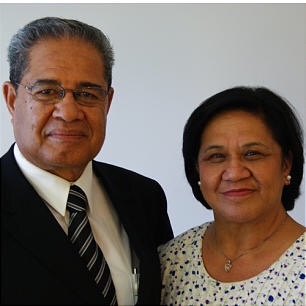 Pita Foliaki and Lani W. Hopoate. Courtesy of Pita Foliaki.
As President Bangerter was doing a final mission tour, he visited Kwajalein and Ebeye and reflected how member-missionary relations had improved during recent years:
As we walked around Kwaj, we remembered how lost we felt the first time we came and how we wandered around with a map in our hand looking for things. We remembered how lax the missionaries were and how the member/
Phillip and Margaret Pulsipher (2003–2006)
 Micronesia Guam District Presidents training seminar, December 2004. Front, left to right: Hermen Walter from Chuuk, Phillip G. Pulsipher, Buzz Passauer. Back, left to right: Samson Thomas from Ebeye, Ianser Edward from Pohnpei, William H. K. Davis from Guam, Craig Lilywhite and Aaron Bamlul from Yap, Rebluud Kesolei from Palau, Randolph Jonathan from Kosrae. Photograph by Del Benson.
Phillip G. and Margaret (Mickie) Kay Pulsipher began serving as mission leaders in July 2003. President Pulsipher had worked in information technology for Dow Chemical Company. They had lived in Michigan, Indiana, and Switzerland.
The Pulsiphers recorded appreciation for the personnel at the Micronesia Guam Mission Service Center, which provided essential administrative services for the mission: “Bill Davis was the Service Center manager for many years. Others who served before Elder Davis were Buzz Passauer, Jess Bacera, and Matt Primacio. They provided so many services for the Church and for the mission. They did the purchasing for the mission, managed the leases for our Church buildings, managed the vehicle fleet for the mission, arranged humanitarian efforts, and did much of the accounting for the mission.”[7]
President Pulsipher explained that gaining new buildings depended on the number of members attending regularly and paying tithing. Then he added, “We had two wonderful facilities managers: Arthur Mountford and LaMar Creamer. They took care of our buildings. The newest buildings were some of the finest buildings on our islands. A new district building was completed on Majuro. New buildings were started on Kosrae and Pohnpei.”[8] Such new buildings were wonderful places to worship and socialize, also attracting the attention of potential converts.
 Every child on the island of Lau in the Marshall Islands received a schoolbag customized by children in Lindon, Utah. Courtesy of Phillip G. Pulsipher.
 Mickie Pulsipher, Iosepa Joseph, Walkner Joseph, and Phillip G. Pulsipher. The Josephs donated land in Uh, Pohnpei, where the chapel stands. Courtesy of Phillip G. Pulsipher.
In December 2004 the Pulsiphers arranged for local leaders to fly to Guam for leadership training. This gathering provided a sense of unity and camaraderie among the far-flung district leadership
The tiny island of Lae in the Marshall Islands opened for missionaries. There were only about four hundred people on the whole island. There was no electricity. A boat from Ebeye was the only way for missionaries to get to Lae, and that boat did not travel often. They would come in from Lae only once a transfer. Missionaries would take food to Lae, and they often shared their food with the islanders. In turn, the islanders would give the missionaries fish. The Pulsiphers recorded a meaningful service project for the island of Lae:
Our daughter Kristin was looking for a project for her Primary in Lindon, Utah. She wanted to do something meaningful for our mission. After talking with Church leaders, we decided on providing schoolbags with school materials for the children on Lae. Kristin’s Primary went to work to raise the money for the supplies. Among other things the kids had lemonade stands. The sisters sewed the bags to hold the supplies. The children put their hands in paint and made hand impressions on the bags. It was first estimated there were 100 children. They had just about completed the bags when we received an updated estimate of 150 children. The Primary just went back to work to complete the additional 50 bags. As it came time to ship the bags, Kristin learned that it would take $400 to ship them ($400 they didn’t have). Kristin shared the latest challenge when she bore her testimony in sacrament meeting. After the meeting, members came up to shake her hand and pass to her money they had in the palm of their hand. The problem was solved.
The bags were shipped to Kwajalein. We chartered an airplane to take us to Lae. We held a meeting on Lae every six months to hold a conference. We took several Church leaders and of course the “Hands Across the World” schoolbags. We landed on a grass runway. The whole island came out to greet us when we landed. They were singing their native songs. They have beautiful voices. They had beautiful flower leis they put on us. They formed two lines, which we walked between as they escorted us to the center of the island close to their little school building. Every child on the island received a schoolbag. They were so excited. It was a resounding success for both the Primary and the children of Lae. It sent a wonderful message that the Church cares about the people of Lae.
The islanders made beautiful shell necklaces as a thank-you gift. The Primary workers each received a necklace.[9]
Gary and Ramona Marshall (2006–2008)
Gary L. and Ramona Dee Batt Marshall, from Idaho Falls, Idaho, began serving as mission president and companion in July 2006. President Marshall was a professor at BYU–Idaho and a project engineer at the Idaho National Laboratory. Sister Marshall was an elementary school teacher. A new mission in Micronesia formed just as their service began.
 Ramona and Gary Marshall. Courtesy of Gary L. Marshall.
In July 2006 the Marshall Islands and Kiribati became part of the newly formed Marshall Islands Majuro Mission. Nelson Lorell and Martha Elizabeth Hollinger Bleak were the new mission leaders.[10] President Bleak was a retired superintendent of schools, and Sister Bleak a former Relief Society president from Panaca, Nevada.[11] The creation of a new mission allowed more local supervision of members and missionaries and alleviated some challenges of long-distance supervision of missionary work and Church growth from Guam.
President and Sister Marshall focused attention on training leaders and members throughout Micronesia and seeking to achieve key indicators to form a stake in Guam. For example, “stakes outside the United States generally require 1,900 nominal members; 120 active, full-tithe-paying Melchizedek Priesthood holders; and at least five congregations that have sufficient numbers of active members to become wards.”[12] President Marshall wrote, “Ramona and I felt a special prompting to spend as much time as necessary to help and train the members and to strengthen the districts and branches. We also felt a strong prompting to help prepare Guam to become a stake. We enlisted the help of the missionaries in our efforts. Those desires guided our actions and helped us focus on what we thought was most important. We deeply appreciated all the efforts of the mission presidents and others who preceded us. We were very grateful for all the leaders who were serving in the districts and branches of the mission and in the Church administrative office in Guam.”[13]
President and Sister Marshall described a visit to missionaries on July 6, 2006, which offers a snapshot of living conditions for Micronesians in Guam: “We are learning that many of the islanders from Yap, Chuuk, Pohnpei, etc., have come to Guam over the years. Many of them live in pretty poor conditions—just tin shacks built in the forested areas. They just clear an area the government gives to them and build some kind of house.”[14]
Difficult job prospects, dismal living conditions, and food insecurity are typical for many Micronesians in Guam and Hawai‘i. “At present, fully one-third of FSM-born people live outside their island nation,” writes Pacific scholar Gonzaga Puas. “In North America, FSM citizens are able to find more abundant jobs, reduce their cost of living, and escape some of the negative stereotypes found on Guam and in Hawai‘i.”[15] Many Micronesians in Guam lived in impoverished conditions, struggling for survival.
The Marshalls described conditions in Chuuk:
We flew to Chuuk with Elder Groff, who is the other assistant. This is our first visit to Chuuk. You could only travel about two or three miles an hour on the road that went part way around the main island of Moen. The road was lined with garbage: pop cans, plastic sacks, wrappers. There is no garbage disposal system in the country. We left as soon as we could to visit some of the outer islands, to see our Church buildings and where the elders are living. . . . The first island was Fefan (I think). We walked for about 15 minutes to the church. It was a small, three-room building. The small buildings here have no pews, and the floors are tile. They just set up chairs for their Sunday meetings and use it as a cultural hall at other times. We visited the Church buildings on each of the islands we went to today. Each building has an outside basketball court made of cement that is used all the time by the young people of the community. At all the buildings there were people there to meet us, and they gave us leis and necklaces of flowers. Next to all the churches are missionary apartments.[16]
During 2007, new stakes were formed in Kiribati. Pacific Area President Spencer J. Condie divided the Tarawa Kiribati Stake into the Tarawa Kiribati West Stake and the Tarawa Kiribati East Stake. When the east stake was organized, all members of the stake presidency worked for the Church at Moroni High School, and the new president of the west stake worked for the Church, but neither counselor did.[17] This is an example of the close ties between Church employment and Church leadership service in Kiribati.
Michael and Gayla Dowdle (2008–11)
Michael L. and Gayla Dowdle begin serving as mission president and companion in July 2008. Two thrilling events during their service were the formation of the Majuro Marshall Islands Stake and the Barrigada Guam Stake.
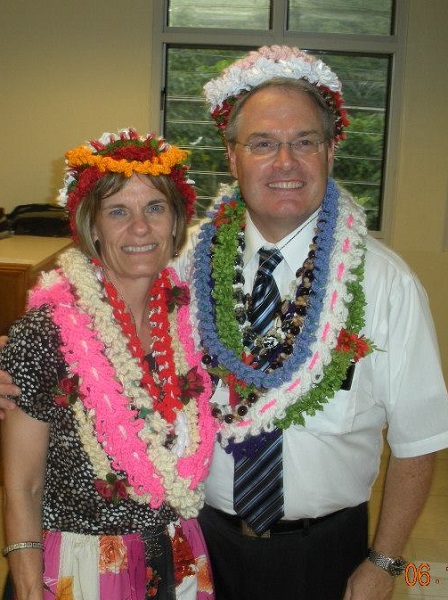 Gayla and Michael L. Dowdle presided over the mission when the Majuro Marshall Islands Stake and Barrigada Guam Stake were formed.
After years of patient preparation by members and missionaries, the Majuro Marshall Islands Stake was formed in June 2009. “With the creation of the new stake,” wrote demographers David Stewart and Matthew Martinich, “the Marshall Islands became the nation with the smallest population with a stake of the Church.”[18]
Joshua J. Perkey described the steps leading up to a stake:
For years Church members in the Marshall Islands have desired to have a stake there. On June 14, 2009, their desires were fulfilled. Elder David S. Baxter of the Seventy, who organized the stake, explains: “It is remarkable how the membership grew in the past couple of years. The stake was created because the development of the Church there made it inevitable. But it has been a long time in coming. Members had to overcome a number of challenges.”
Marshall Islands stake president Arlington Tibon . . . taught members while he served as district president that if they wanted a stake, they would have to work for it. He instructed district leaders to teach members from Malachi 3 and 3 Nephi 24 about the blessings of paying tithing. Leaders also encouraged youth and adults to study the Book of Mormon. They even held a successful event where the youth read the Book of Mormon for 12 hours straight.
President Tibon also set a goal to get members to understand “how important it is to be sealed in the temple,” explaining that receiving “the endowment helps them overcome a lot of things, makes them different, changes their lives.”
Under President Tibon’s leadership, members in the Marshall Islands visited two temples: one in Tonga and one in Hawaii. Each visit came after significant sacrifice. But, as Angela Tibon, President Tibon’s wife, says, those trips “have had a great impact on how committed members are to Heavenly Father and to the Church.”[19]
Meanwhile in Chuuk, missionaries were having success with converts, and a new building was dedicated in Romunum (see chapter 7 for details).
On December 12, 2010, Elder L. Tom Perry, an Apostle, and Elder Gary Stevenson, a General Authority Seventy and future Apostle, met in Guam to organize the Barrigada Guam Stake. Following are excerpts from President Dowdle’s missionary journal, shared here with his permission:
As we entered the Barrigada Chapel, we were greeted by the largest gathering that I had ever seen there. Every seat was filled, every chair occupied, and there was standing room only. It was clear that people had been gathering to attend this historic meeting for quite some time. Likewise, the congregation in Saipan, joining the meeting by video link, was overflowing. As the meeting began, the air was thick with anticipation. Following the opening song and invocation, President Stevenson rose to conduct the business of the conference. He disbanded the Guam District of the Church, releasing the district presidency and formed a new stake of Zion, to be called the Barrigada Guam Stake of The Church of Jesus Christ of Latter-day Saints! He then announced the calling of Arthur B. Clark as stake president, with Tamio S. Clark as first counselor and Jared W. Bodine as second counselor. As he announced President Clark’s name, there was a visible reaction in the congregation. I noted specifically that Buzz Passauer started crying, visibly shaken. They were sustained unanimously by the congregation. President Stevenson announced the remainder of the meeting up through his own talk. After a special musical number by the Guam Youth Choir (which was breathtaking), Arthur Clark rose to speak. He was emotional, which is unusual for him. He spoke of dreaming of this day for many years as a young boy growing up in Guam, but never seeing himself in this position. He spoke of all those who had worked so hard over so many years for this day, some who didn’t live to see it. He also spoke of the increased strength he has seen in the members of the Church in Guam and Saipan in the time that he has been district president, and the faith he had in the members here to firmly establish the stake and to see it grow. He said that in his mind, he saw a temple that could be built here in due time as the Church grew, and how it would serve so many members in Micronesia and nearby areas of the Church. His counselors bore strong testimonies as well.
When I spoke, I told the congregation of times that I had taken my children hiking back home, how as we climbed up into the mountains along the trails, we would stop from time to time to take in the vistas. The children would always ask me if we would ever get to our destination. They would even try to persuade me to stop along the way to set up our camp. I would tell them that we had some way to go, and that when we got there it would be worth our effort. It always was. I said what a great and historic day this was and that we were right to pause to celebrate this day, when a cherished dream long held by the members has been achieved. I also urged them not to be tempted to mistake today’s milestone as the mountaintop. We are called on not simply to establish stakes of Zion but to strengthen and enlarge them, continuously working to expand the Lord’s Kingdom in anticipation of His return, when we can enter His rest.
 Medallion given to Elder L. Tom Perry in Saipan. Courtesy of Lee Tom Perry.
President Stevenson spoke about how much Guam has grown in strength ever since he has been coming here. He spoke of it as a gathering spot for all of Micronesia, and he spoke about how the strength of this stake would now multiply itself into other stakes, as the Church is more firmly established in these islands. He encouraged them to continue to live the gospel and to be a light on a hill to the people of Guam and Saipan.
Elder Perry spoke about where the term stake comes from and what it takes to make a stake—what the Brethren look for before this can be done. He spoke of the growth of these islands since he was stationed in Saipan as a young man in WWII. He related the story of how he and some of his comrades, members and nonmembers, spent their off-duty time to build the first chapel in Micronesia, on Saipan, and how they met there once and then had to move on to other assignments in the war. He spoke of his unspoken desire to return to create the stake as the application was considered by the Quorum of the Twelve and of how he had received the assignment from President Packer, who himself had once served during the war on the island of Tinian. He expressed his gratitude for the opportunity to come and take part today. At one point, he called up to the stand Alex, President Clark’s seven-year-old son. He held him up on the podium and talked about how he would soon be baptized a member of the Church. Elder Perry’s talk was both inspiring and uplifting to all who attended the meeting.
Following the close of the meeting, members came forward to shake all of our hands, and we spent some time there before we could get Elders Perry and Stevenson and their wives safely away to have the new stake presidency set apart. Once the setting apart was completed, we left for a lunch at the mission home with the Perrys, Stevensons, and the Clarks. As I was leaving the building, Buzz Passauer hugged me and told me that this day was the fulfillment of a blessing that Buzz gave to a young, unmarried Arthur Clark years before in which Arthur was told that he would one day be the first stake president in Guam. I understood Buzz’s evident emotions as Arthur’s name was announced. . . .
We presented Elder Perry with a framed print of the photograph of the chapel in Saipan, together with another photo of the soldiers who had helped to build it. This had been discovered in the archives of one of the members in Saipan about a month before, and Del Benson, who is a photographer, had helped us to arrange to have it ready for Elder Perry’s visit. We also presented him with unframed copies of the same photos. He was moved to see it, had no idea that it still existed, and was very happy that we had presented him with it. . . . After lunch, we headed to the airport with the Perrys and Stevensons to fly to Saipan, where we arrived just before 6:00 p.m. We stayed at the Hyatt Regency Saipan that night.
On Monday morning, December 13th, we ate breakfast and then headed straight over to the US military museum in Saipan. Without him knowing, we had arranged for Elder Perry to visit the museum and to receive a private tour. He loved it, and we spent some time looking at all the exhibits there. Just before the tour, we had also arranged for him to receive a special medallion, given to all veterans of the battles on the island when they returned to the island. Elder Perry had been in the US Marines, and he was duly honored as a returning Marine veteran. As they draped the medallion around his neck, Elder Perry beamed a surprised smile. We spent the rest of the day seeing the sights on Saipan. We visited Bird Rock, Bonsai Cliff, and Suicide Cliff, the scenes of so many tragic deaths near the end of the battles on the island. We heard Elder Perry reminisce about his memories of his service. We went to the beach where he came ashore as a young marine, and he knelt to scoop up a small jar of sand as a token of remembrance—what he called his “Saipan Sand.”[20]
 Elder Gary E. Stevenson, Elder L. Tom Perry, and President Michael L. Dowdle in Saipan, December 13, 2010.
Conclusion
The creation of new stakes in Kiribati, the Marshall Islands, and Guam shows how the early branches of the 1980s sprouted up and grew into mature trees that could weather significant storms and help shelter members from life’s adversities. And the journal account of the Barrigada Guam Stake’s formation shows the deep love for members and missionaries of Micronesia held by Apostles like Elders Perry and Stevenson. Members in Micronesia discussing the feasibility of building a temple in their area.
Notes
[1] William G. Hartley, “Stake,” in Garr, Cannon, and Cowan, Encyclopedia of Latter-day Saint History, 1182.
[2] William H. K. Davis, email message to R. Devan Jensen, April 26, 2022.
[3] Historical Committee for the Guam District, Historical Record: Guam District, 1990–1999, 8.
[4] V. Brent Bangerter, email message to R. Devan Jensen, January 8, 2021.
[5] Pita Foliaki Hopoate, email message to R. Devan Jensen, May 12, 2022.
[6] Bangerter to Jensen, January 8, 2021.
[7] Phillip Pulsipher and Margaret (Mickie) Pulsipher, “Micronesia Guam Mission” (unpublished manuscript in author’s possession), 2020.
[8] Pulsipher and Pulsipher, “Micronesia Guam Mission.”
[9] Pulsipher and Pulsipher, “Micronesia Guam Mission.”
[10] Shaun D. Stahle, “New Missions,” Church News, July 15, 2006, https://
[11] “New Mission Presidents,” Church News, July 13, 2006, https://
[12] Matthew Martinich, “Recent Missionary Successes on Chuuk, Micronesia,” November 26, 2013, https://
[13] Gary L. Marshall and Ramona Dee Marshall, “Some History of the Micronesia-Guam Mission, July 2006–June 2008” (unpublished manuscript in author’s possession).
[14] Marshall and Marshall, “Some History of the Micronesia-Guam Mission.”
[15] Puas, Micronesians on the Move, 1.
[16] Marshall and Marshall, “Some History of the Micronesia-Guam Mission,” Monday, July 24, 2006.
[17] Stewart and Martinich, Reaching the Nations, 1:498.
[18] Stewart and Martinich, Reaching the Nations, 1:503.
[19] Joshua J. Perkey, “Sailing True in the Marshall Islands,” Ensign, April 2011, 37.
[20] Michael L. Dowdle, missionary journal (unpublished manuscript in author’s possession).
