
 menu icon in the top, right corner of the screen.
 icon above to close this box.
 icon at the bottom of the screen below the browser—if you don't see it, swipe up to unhide it.
Cultural Differences and Converts in Yap
R. Devan Jensen and Rosalind Meno Ram
Rosalind Meno Ram and R. Devan Jensen, "Cultural Differences and Converts in Yap," in Battlefields to Temple Grounds: Latter-Day Saints in Guam and Micronesia, ed. R. Devan Jensen and Rosalind Meno Ram (Provo, UT: Religious Studies Center, Brigham Young University; Salt Lake City: Deseret Book), 165–84.
Yap (formerly known as Guap) is an archipelago in the Western Caroline Islands that includes the islands of Gagil-Tamil, Maap, Ramung, Yap, and many outer islands. The people of Yap descend from brave adventurers and have strong cultural traditions. Before the time of Christ, sailors traveled via outrigger canoes from the Malay Peninsula, the Indonesian archipelago, New Guinea, and the Solomon Islands to the four main islands of Yap. During this precolonial period, Yap’s first inhabitants helped to shape the long history of trade and interaction with other peoples throughout the Western Pacific.
Those intrepid sailors navigated by the stars and ocean currents, traveling thousands of miles without using compasses. By sailing, the Yapese people were known to create mutual-exchange relationships with Palau on the southwest and the eastern atolls. They often engaged in gift giving and tributes of bamboo, turmeric, food, shell belts, beagiy (woven textiles made from banana fiber), and coconut rope. This interchange was conducted with utmost care and respect.[1] These settlers eventually built an interisland empire.
This chapter touches on the colonizing and Christianizing influences in Yap and then focuses on the stories of early Latter-day Saint missionaries and converts. Attention will also be given to the castes and culture of Yap as factors affecting members of the Church.
Colonizing and Christianizing Influences
The Yapese have navigated waves of colonialism and Christianity for many centuries, being claimed or overrun by various powers over the years. In succession, Spain, Germany, Japan, and the United States all governed Yap. From the seventeenth century until 1899, Spain occupied Yap and promoted Catholicism. Despite these waves of change, the islanders endured and adapted. Contact and interchange grew dramatically in the nineteenth century. The Yapese would sell shells and woven handicrafts to the colonizing powers in exchange for metal tools and knives.
Catholic historian Thomas M. Landy wrote about the languages and religions of Yap:
Culturally and linguistically, “Yap proper,” as the four high islands are sometimes called, is quite distinct not only from rest of Micronesia, but also from Yap state’s 13 other Outer Islands, which stretch across a 1,000 km arc mostly to the west of Yap proper. Outer Islanders speak Ulithian, Woleaian, and Chuukese languages, which bear no relation to the Yapese language. . . . About 82% of Yap state residents (73.8% of people from Yap proper, 96.2% of Outer Islanders) are Catholic. The remainder are distributed among about 20 Protestant churches . . . and other faiths.[2]
After the United States defeated Spain in the Spanish-American War of 1898, Spain sold Yap and other Pacific colonies to Germany. Yap soon became a major German naval communications center and an important international hub for cable telegraphs. Then, in September 1914, Japanese troops occupied Yap. The Versailles Treaty in 1919 recognized Japanese control of Yap as a mandated territory under League of Nations supervision.[3] The Japanese occupation was challenging for the Yapese people. From 1920 to 1940, the Japanese population in Yap went from 97 to 1,933.[4] The Japanese incorporated Japanese schooling as part of the “civilizing” process for all Yapese children, banned Yapese men from sleeping in the men’s house,[5] and outlawed all religious practices. Japanese industrial projects intensified with the onset of World War II, and the Yapese were used to build garrisons and fortifications, construct airstrips, and gather food for the Japanese soldiers.[6]
During World War II, both US and Japanese aircraft and ships bombed Yap. After the war, under a United Nations mandate, the United States held Yap and the rest of the Caroline Islands in a trusteeship called the Trust Territory of the Pacific Islands.
Anthropologist William Alkire stated that despite these colonial administrators, “in neither of these cases . . . did the Yapese interact extensively with the expatriates.” He further stated, “Status, success, and achievement in Yapese society continued to be measured in Yapese terms, and to the present-day Yap has a reputation as one of the more traditional and ‘conservative’ cultures of Micronesia.”[7] That reputation has translated into Yapese reluctance to join The Church of Jesus Christ of Latter-day Saints and embrace its more Western cultural values.
First Latter-day Saint Missionaries and Converts
 Charles and Odetta Keliikipi family with missionaries. Photograph by David Ige.
For many decades after becoming part of the Trust Territory of the Pacific Islands, the nations of Micronesia debated how best to carve out their independence from colonial powers. In 1976, as the Congress of Micronesia was leaning toward forming an independent nation, Elder John H. Groberg of the Seventy arrived in Honolulu on July 28 as Area Supervisor for the Hawaii–Pacific Isles Area. He invited William W. Cannon, president of the Hawaii Honolulu Mission, to send missionaries and establish branches of the Church throughout Micronesia, fearing that freedom of religion might end with the creation of independent governments. That fear eventually proved to be unfounded. In fact, in 1979 Yap, Chuuk, Pohnpei, and Kosrae combined their four island groups into a new independent nation, the Federated States of Micronesia, while maintaining close ties to the United States.[8] Those ties eased the transfer of missionaries and members throughout Micronesia.
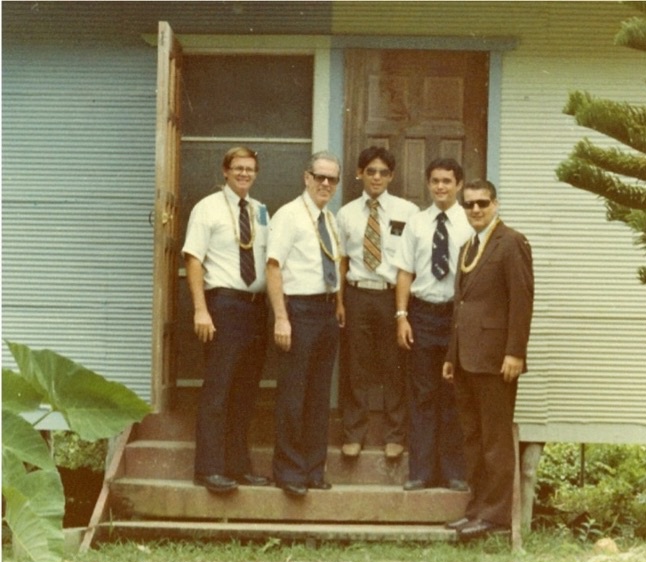 Hawaii-Pacific Area Supervisor John H. Groberg (right) on Yap with (left to right) area legal counsel Tom Kay, mission president William W. Cannon, and missionaries David Ige and Douglas Andrews, January 14, 1978.
In early 1977 Church members Charles and Odetta Keliikipi traveled to Yap, where Charles Keliikipi was chosen to organize a police department under a two-year contract. President Cannon asked Charles to organize a branch on Yap while he worked there. Then President Cannon sent missionaries David S. Ige and Douglas Andrews to open missionary work in Yap on November 14, 1977.
Stanton Akana and Ronald Brown were soon transferred to Yap. These Western missionaries expressed surprise to learn that Yapese men wore only a thu (like a loincloth) and women rarely wore shirts unless at church.[9] Use of betel nut[10] (considered by Church leaders in Micronesia to be against the spirit of the Word of Wisdom health code) and the practice of living together without being married have long been considered obstacles to the growth of the Church in Yap.[11] In addition, the caste system complicates gatherings and relationships between leaders and members, as discussed below.
Antonia Siso Isao, the first convert in Yap, was baptized on March 18, 1978. Soon afterward, several families joined the Church. The first meeting place for these new members was a Yapese hut. President Groberg, President Cannon, and area legal counsel Tom Kay worked to secure missionary quarters and land to lease so that a Church meetinghouse could be built.
President Cannon’s successor was Ferron Losee, who was called as the first president of the Micronesia Guam Mission when it was initially organized in April 1980. About that time, President Losee wrote that members in Yap were preparing to build a chapel. The chapel was completed on January 13, 1981, and the first service was held in it on January 18 (figure 8.3).
 Charles and Odetta Keliikipi, Vicenta and Clement (Jeff) Rehoboam, the Towai children, Elder Stanton Akana (back row, second from right), Elder Heber Butler (back row, right), and other members at an early chapel in Yap. Courtesy of Mark H. Butler.
 The Bing DeLeon family was baptized and contributed much to the early Church in Yap. John DeLeon, left, later served as a missionary in Pohnpei. Courtesy of Mark H. Butler.
William Alkire mentioned that Yapese interaction with expatriates was minimal and that Yap culture was seen as traditional and conservative when compared to the other cultures of Micronesia.[12] This may be construed as saying that Yapese people were reluctant to embrace Western cultural values, let alone Western religious beliefs. With this theory in mind, we analyzed mission reports from the Micronesia Guam Mission documents for 1982–96.[13] Most of these weekly and monthly entries were from couple missionaries who were diligent in writing the histories of the gatherings and events during the early days of the Church in Yap. Some of these elders were also called as branch presidents. In the 1990s the mission developed reports. These entries were typewritten using printed forms, with attachments containing supplemental information. In these accounts one can see growth and development among the members in Yap in three primary areas: finding, guiding, and developing Church members as leaders; the blending of Yapese and Western culture in Church activities; and encouraging temple preparation.
Developing Yapese Leaders
Missionary records show that in 1981 Richard Ken translated the discussions into Yapese. He was assisted by Elder Alexander J. Robinson. Records kept by Elder R. O. Davis (who served as branch president in Yap) in 1985 report Richard Ken as being inactive “but a very spiritual person.” President Davis interviewed Ken and challenged him to return to Church activity and prepare for temple marriage. The Davises helped strengthen the Kens in the gospel through activities such as family home evenings. Between 1986 and 1990, Richard Ken served in the branch presidency for Colonia Branch.
In the early 1980s, missionaries located less-active member Morris Buchun, the chief of police in Yap. In 1985 Ronald M. Kloepper, a member from the Sacramento, California, area, was visiting Yap. He mentioned how Buchun knew the gospel was true but had a few personal problems to overcome before he came back to church.[14] Buchun returned to activity in the Church and, in January 1990, became the president of the Colonia Branch. Then, at the branch conference on March 18, President Buzz Passauer, a counselor in the Micronesia Guam Mission, organized the Yap District. At that meeting Buchun was released as branch president and called to be the Yap District president.[15]
James Phillip Yorlang was a diligent priesthood holder for decades. Yorlang was called as the president of the Thol Branch in the mid-1980s. In 1985 he was also asked to teach adult seminary in Yapese, and the class saw good participation. A few years later, on September 2, 1990, President Yorlang was called to be the counselor in the district presidency.
Branches continued to develop in other communities. Jesus Boniface Soroniyan was called and set apart as president of the Thol Branch. Soon after, on September 16, 1990, the first sacrament meeting was held in Maap, with six people attending.
In February 1990, Stephen E. and Shirley F. Sherwood arrived in Yap from Stark City, Missouri. They too started documenting Church history in Yap. Elder Sherwood shared the following account, which in some ways is revealing of instances where a community of Saints was being cultivated based on trust and service one to another:
On August 1, 1990, President Yorlang called me to his home and wanted to show me something. We went into his yard and he uncovered what appeared to me to be a live projectile, a 90 MM or 5-in-one, which was used in artillery for horizontal ground use and also for anti-aircraft defense during World War II. These shells were fused to explode as they came in close proximity of the target and send metal fragments in all directions. I suggested that he keep his children away from it and also not to move or disturb it. He should call the Seabee detachment in Colonia and have them dispose of it. . . . A few days later, the Seabee personnel came. They observed it carefully and concluded that it was a live shell and staked it off and marked it with yellow tape which said “Caution—Explosives” but that they would radio Guam for a qualified technician. Elder Sherwood reported in September 4, 1990, the Navy sent an ammunition specialist to remove the live five-inch shell. They took the detonator from the end of the shell while still in the yard behind the pile of dirt which they had built up for protection. Then they evacuated all the people out of the village which was close by and then took the shell up near the You One Construction Company where they had dug a deep hole. They placed it into the hole and exploded it.[16]
That President Yorlang went first to the missionaries for assistance is evidence that trust and a sense of community were developing between the Yapese people and outsiders, including the missionaries. For the outsider who reads about this interaction between Yorlang and Sherwood, that the immediate question might be, “How is this experience relevant to trust?” This is a fair assessment and necessitates a discussion on context. After the Pacific War, the US military made efforts in places such as Guam to educate the public about live ordnance that may be found in people’s backyards. This education might not have been widespread in Yap. Not quite forty years later, Yorlang finds the ordnance. What is he to do? The object is foreign, so Yorlang asks a foreigner whom he trusts. He follows his instincts that what was in his backyard might be harmful for his family and neighbors. Also, Yorlang trusting his intuition to ask for help based on perhaps a resource (education and social capital resources) deprived situation and the need to act on the situation. Yorlang’s reaching out to Sherwood is about trusting that Sherwood might know more on what to do. The account demonstrates that he did use his knowledge and also his network (social capital) to take care of the live shell and its proper disposal.
 Early-morning seminary study with Odetta Keliikipi.
During this time, the members began to engage more and more in the organizations of the Church. Young men, young women, and young adults learned leadership skills in youth programs. Records for this early period have many accounts of youth leading out, speaking, organizing, and running activities. The young adults also held callings in the branches in areas such as seminary, young men, young women, primary, elders quorum, and Relief Society. An account of meetings from May 15 and June 26, 1994, describes the Relief Society sisters at a district level gathering: “As program and needs are discussed, it was decided this will be an ongoing meeting. The sisters feel the need to learn together, strengthen each other, and discuss ways in which they can help each other grow in their callings.” On July 26, 1994, President Yorlang instructed the men and women leaders on the importance of the priesthood involving women in the decision-making process regarding branch business. He also reminded members that the branch president has the responsibility of making final decisions.
The Caste System
Yap has a caste system with at least seven tiers and ranks within those tiers, which complicates social interactions between higher and lower castes of Yapese Saints in the district. How did this caste system come to be? Historically, villages competed for fishing and harvesting rights. Families competed for rank within each village. The caste ranking system was fluid until the arrival of German colonizers around the turn of the twentieth century. At that time, German occupiers enforced peace in Yap and froze the caste system in place, preserving the higher rankings of the villages of Ngolog, Teb, and Gachpar. Within the villages, Yapese clans (genung) tell their members about their ancestry and place of origin. Each clan has a chief and each village has a head chief who acts for all his clanmates, who are considered brothers and sisters. The village chief voices group consensus. Traditional villages also have councils of elders that maintain social control through laws.[17] Indeed, “they have been very reluctant to accept externally imposed innovations and persistently refer to the yalen or the ‘right’ Yapese way of life. For these reasons they have maintained a strong sense of cultural identity and unity against the outside world.”[18]
Along with Yapese way of organizing clans and villages, cultural material such as food and eating arrangements are central parts of Yapese culture. The Yapese caste system affects Church functions involving food preparation and eating norms. Food grown in Yap includes bananas, breadfruit, taro, and yams. Men generally work as fishermen, while women generally work as farmers in taro patches. The protein from the men’s work (thumag) and the starch from the women’s work (ggaan) complement each other in the Yapese meal. Imported foods are generally adapted within this classification system; for example, canned meats are considered thumag and rice is considered ggaan. Chewing betel nut and drinking alcohol are popular social activities there.
Yapese culture suggests who can appropriately eat together; for example, male nonserfs eat together. New members of eating classes must undergo an initiation ritual (dowach). Food is prepared separately for the men, the women and children, and the girls who are menstruating. Boys over the age of ten live and eat in the village’s young men’s house, and menstruating girls eat in a separate house. In the main house, older males eat separately from the women and younger children. Sometimes these cultural guidelines lead to separation and even isolation between Church members in the branches, and as a result the branches have grown very slowly.
Senior missionaries Phil and Ilene Whaley documented Church history on the island from November 1986 to February 1990. They described how the caste system affected social activities in Yap: “The problem of high caste, low caste still exists even in the Church. Efforts have been fruitful to some extent in breaking down to a degree. An attempt to have a joint branch party in December 1988 was somewhat a failure. Another attempt was made in December 1989 with good success. Members do not like the caste system but do not have the courage to break away from it even in Church activities.”[19]
The Whaleys also included in their report a description of the caste system in August 1986. Missionaries mentioned the seven levels of the system, and they observed that it was difficult at times to distinguish the levels:
It is difficult to tell one from another. One can fairly easily tell the high-caste from the last-caste villages. Soon one can kind of sort out by the way people act which class they belong to, but this is not always true. The [caste] system can sometimes create real problems, especially at the social [gatherings] where all castes are mingling together. Food prepared by the low caste cannot be eaten by the high caste. I have heard that they [the high caste] believe the low caste can cast a spell and might junk the food. If a high-caste child eats with a low-caste child, they will actually be barred from entering the homes of relatives of high caste. This problem has always caused a few problems. . . . Currently [circa 1986], the low-caste members can provide only fruits and things that need no preparation. If they [the low caste] prepare them, taro, tapioca, bake cakes, etc., the high caste cannot eat them. Both castes are able to eat food that is prepared by non-Yapese.[20]
As mentioned earlier, the branch president from Colonia was of the high caste, and the branch president of Thol was of the low caste. Other men of varying castes were also called to be leaders in the district. This was not an easy thing to navigate for these men and their families. Elder Whaley’s hope was eventually realized—local leaders learned to work through the challenges of the caste system. Catholic writer Thomas M. Landy notes that Yapese society may be on the cusp of more change in that “forces of modernity—political, economic, and cultural—are all part of Yapese life.”[21] What remains is how to balance traditional culture with modern influences.
Blending of Yapese and Western Culture in Church Activities
Records show how early missionaries and members were running Church functions as best as they knew how, often blending Yapese culture and Western traditions. They had family home evenings, raised gardens in garden boxes, and rendered service where needed. They established mother-daughter activities there; the first of these was a great success that led to more annual mother-daughter events. One year the young women wanted to work on sewing Yapese skirts as part of the buildup to the activity. The following year they planned to not only make the Yapese skirts but also model them, exemplifying the emergence and blending of Yapese and Western ways of doing things. Another example is the making of nunus (like hakus in Hawaiian culture) for the women of both branches of the Church to wear on their heads. Youth activities featured the regular competitive relays but also basket weaving, palm tree climbing, and coconut husking. There were also Western activities such as Pioneer Day events, skits, catching a greased pig, and making s’mores and pizzas. In Church meetings hymn singing was gradually introduced, at first in English and then eventually in the Yapese language. According to one account, on June 19, 1994, during the Colonia Branch Primary sacrament meeting, the children sang “I Am a Child of God” in Yapese, Tagalog, and English. Another account recorded the children participating in a Primary Easter activity with an egg hunt and Easter baskets. These entries in branch records demonstrate a sense of community in the 1990s and the emergence and blending of Yapese and Western ways as the Church in Yap began to mature.
Encouraging Temple Preparation
A theme of preparing to attend the temple can be found throughout the period of the mid-1980s to the mid-1990s. The first mention of temple readiness is in the account of Elder R. O. Davis, who served as the Colonia Branch president. In his account he interviewed individual members and couples, many of whom were inactive, such as Ken Richard, Phillip Yorlang, and Vicenta Rehoboam and her husband, Clement (Jeff) Rehoboam. Many islanders had a hard time conceiving the value of the temple ordinances and covenants. During these interviews, Elder Davis repeated the phrase “prepare for temple marriage.” It did not matter the age nor the status of the person: Elder Davis challenged all members to prepare for temple marriage. Of an interview with Jeff Rehoboam in 1985, for example, Elder Davis noted, “He said they really want to [attend the temple], but it costs too much money. I promised that he would have the funds to go if he would pay his tithes and offerings. The Spirit was so strong that we wept on each other’s shoulders.”[22]
On June 7, 1991, the mission records state that “President Morris and Sister Buchun along with their eight children were sealed in the Philippines Temple for time and all eternity. This was the first family from the Yap District to have this opportunity. It was a special day.” Later that month, on June 22, during the first-ever Yap District general priesthood meeting at the Colonia Branch, President Buchun and his son Choay talked about the temple. On July 9, 1992, mission president Gordon S. Thatcher spoke at a fireside on the importance of preparing to go to the temple.[23]
On October 29, 1994, leaders hosted an adult temple fireside meeting at the Colonia chapel. Presidents Buchun and Yorlang provided training on the importance of attending the temple. Thirty-one members were there, and they set a goal for a November 1995 temple trip. On December 30, 1994, the Buchuns hosted another fireside meeting. Presidents Buchun and Yorlang again provided training and motivation to form a Yap temple group for November 1995 (seventeen to twenty-two people). The couples were invited to save their money and put the temple at a higher priority. There were twenty in attendance. Although this temple trip did not happen by that date, in 2002 Yapese members traveled to temples in Japan, the Philippines, and Hawai‘i (discussed further below).
Goals for Member Self-Reliance in Yap
In 1987 mission president David J. Rollins and Sister Connie Rollins asked missionaries to strengthen the self-reliance of local leaders by not doing for the members what the members could do for themselves. Missionaries were no longer to serve as branch leaders, perform ordinances such as blessing the sacrament, or even play the keyboard for worship services when local members could perform the same tasks. Sister Rollins commented, “Problems we never dreamed of existed. Solutions came slowly, one at a time. Leadership was nonexistent in some areas. It was necessary to give them a chance to grow and develop. For example, missionaries finally taught music lessons on . . . Yap. Within a month, a ten-year-old boy was playing the little Casio organ for Church in one branch, and a fourteen-year-old girl was playing the piano in the other branch. This was progress.”[24]
By 1990, the tenth anniversary of the mission, there were approximately 150 members living on the island. There were two branches in Yap: in Colonia (the capital city) and Thol. From May 17 to 20, 1990, some Yapese Church members traveled to Tokyo, Japan, in the first of several temple excursions to receive their initiatory, endowment, and sealing ordinances. These excursions were not entirely blissful events because of occasional strong opposition from people of other faiths. Members reported that this stemmed from rumors about the acts of washing, anointing, and being clothed with temple garments. Even so, such temple trips became foundational spiritual experiences for the members—many of whom later became leaders in their congregations.
In 1995 local member Deo G. DeLeon reported on a “One-Day Mission” activity for the Yap District. Young men and women started by reciting 1 Nephi 3:7 from the Book of Mormon and singing “Called to Serve” and then received training on doing missionary work in companionships and carrying the Book of Mormon with them. After a day of proselytizing, the young people gathered for a testimony meeting. “My companion and I prayed to our Heavenly Father for the Spirit,” said Rebecca K. Buchun, “and with his help we were able to give out two copies of the Book of Mormon. It was a great experience. I would like to do it again someday by serving as a full-time missionary.”
“This day was the happiest day of my life, because my companion and I gave out 10 copies of the Book of Mormon,” said Yapese member missionary Ambrose Tuwun. “I now know how missionaries feel when they go out to do the Lord’s work.”[25]
Ambrose and Jessica Tuwun
After Ambrose Tuwun joined the Church, he served as a missionary in Chuuk and Saipan. He later attended BYU–Hawaii and moved to Utah for employment. His story shows his courageous conversion and the vital role of mentors in his life:
I was born in Yap (Wa’ab), Micronesia, in the municipality of Rumung. I am the first of many children of (Peter) Tuwun and Francesca Layan. My parents named me Ambrose Tuwun at birth, Ambrose being my English (Marikan) given name and Tuwun my Yapese given name. I was, and am still, known as Tuwun by my family. I grew up in the villages of Fal and Riy in an extended family dynamic where it took a village to raise a child. Being the oldest son, I was mostly raised by my grandparents. I was quite spoiled because they always looked out for me and favored me over my siblings and cousins. All four of my grandparents practiced the traditional belief system of the island. My dad also believes the traditional religion. I don’t know how, but my mom came to be a devout Catholic, and that is how I first learned about Jesus and God.
 Ambrose and Jessica Tuwun. Courtesy of Ambrose Tuwun.
My education began at Rumung Elementary School learning in Yapese. When I was in second grade, I wanted to attend Saint Mary’s School. This presented a big challenge for me, my grandparents, and my parents. Saint Mary’s was all the way in Colonia. I had to leave Fal by boat on a favorable tide and stay in Colonia for five days, then return the same way at the end of the school week. I stayed with different family members who were willing to take me in during the school year.
Being a Catholic school, Saint Mary’s offered catechism. I learned more about Catholic doctrine with classmates and decided to become Catholic at that time. When I was confirmed, the archbishop from Fiji came all the way to Yap for the ceremony. I remember a few of my classmates were also confirmed and we had a big party afterwards. I became an altar boy, and part of my responsibility was to help the priest on Tuesdays and Thursdays before school started.
By the time I started high school, my grandparents were aging and becoming more frail. My sense of entitlement was getting out of control, and my relationships with family members became strained. It was getting difficult to find family members willing to take me in during the school week. Eventually my parents and siblings left the village and moved to town. That is how I came to be living with my immediate family while attending Yap High School.
One day a pair of missionaries—Elders DeLeon & Oldroyd—came by our house. My dad was not a fan of them and tried to chase them away. I was sixteen or seventeen years old and felt sorry for them. I started to listen to them when they came by the house. Before I knew it, I was taking Latter-day Saint discussions and decided to get baptized to show my love for Jesus. My parents were against it, but I had the support of an uncle and cousin who had already joined The Church of Jesus Christ of Latter-day Saints, so that helped.
Because of my mom’s belief and my upbringing in the Catholic Church, I always wanted to stay close to Jesus and learn more about him. After I joined the LDS Church, I would stop at the chapel when school was out to attend seminary before going home. My uncle, Richard Ken, became the branch president of the Colonia Branch. At the time there were only about twenty of us members who attended church on Sunday. I wanted to go on a mission but faced many obstacles. A big one was chewing betel nut. Chewing is a huge part of the culture of Yap—everyone does it, and it is the Yapese way to have stained lips and teeth from chewing. I started chewing before I even started school, so giving up that habit was pretty hard! Chewed betel nut has a certain smell that, to this day, reminds me of home, family, and childhood.
When I was twenty-one, I was fortunate to be called to serve in the Micronesia Guam Mission. I was endowed in the Manila Philippines Temple and started my mission! I served on Chuuk for six months, learned Chuukese, and baptized just one person. Then I transferred to Saipan, where I served the rest of my mission.
On my mission, we didn’t have a lot of baptisms, but there was a lot of reactivation work to do. I saw lives change for the better when people returned to the gospel they once loved. My testimony grew, and I matured as a person. I grew to love the people I served, and I made friends along the way. Some of those longtime friends included mission companions, local families, and the Church leaders.
Del Benson and his family were very welcoming to the missionaries, and we spent a lot of time at their home. President Ray and Sister Joann Ward were very kind to me and were almost like parents when I was in the mission field. They encouraged me to further my education and they helped me apply to BYU–Hawaii. They made all the necessary arrangements for me to attend BYU–Hawaii, including extending my mission by three months so I could go directly from my mission to university. They understood how difficult it could be for a member of the Church to remain active amidst the cultural pressures in Micronesia.
The time I spent in Laie at BYU–Hawaii was a super awesome period in my life. I met some of the missionaries I served with and we became lifelong friends. Harvey Olsingch, James Martin, Erwin Mendoza, Ricky Joel, and Wade Lawrence continue to influence my life and strengthen my testimony today. Some of the staff and faculty also helped my testimony grow and encouraged me to stay true to the faith. This is particularly true of Rose Ram and her family, whom I remain close to today.
I also met and married my eternal companion at BYU–Hawaii. Jessica Miller and I were married at the Laie Hawaii Temple. Many of the people I mentioned earlier (including the Wards) attended our sealing. We have been married nearly twenty-three years and have three wonderful boys. Jessica’s family has been a blessing in my life, helping me stay on the path of righteousness and supporting our efforts to keep learning and growing.
The Church and its members still play a vital role in my life. I currently live in Provo, Utah, where I work at US Synthetic as a factory manager. My current supervisor, Nick Sloan, is helping me grow as an individual and a friend. Rob Galloway, the CEO, has also encouraged and supported my growth and development. Nick and Rob are examples of people who I admire and who inspire me to continue in the gospel.
As I try to live gospel principles, having a good support system around me is helping me stay strong and faithful. I am very grateful for my supporting cast. Because of them, my love for the Savior and Heavenly Father has continued to grow. Joining the Church seemed like a big risk at first, but I know that if I hadn’t, my life would not be as rich and fulfilling as it now is.
*Ambrose Tuwun, email message to Rosalind Meno Ram, May 8, 2022.
Typhoons and a Temple Trip
Typhoons frequently blow through the islands of Micronesia, wreaking havoc. In September 2000 the Church sent a twenty-foot humanitarian aid container to members in Yap that included “20+ wheelchairs, 20+ pairs of crutches, 2 ventilators, an electrically operated examination table, a baby incubator, a Pentium 2 computer, a gurney, many hospital beds, and many dozens of boxes containing pharmaceuticals and general medical supplies. Local doctors and island leaders were generous with their expressions of gratitude and accolades.”[26]
In 2001 mission president V. Brent Bangerter wrote, “Most islands have Selections of the Book of Mormon in their native language, and this year full translated copies of the Book of Mormon in Yapese and Marshallese went for final ecclesiastical review, showing again the blessings the Lord is pouring out on His children in the isles of the sea.” Early in 2002, “temple excursions went from Guam and Yap to Manila and from Ebeye to Laie. 44 adults and 41 children participated in temple ordinances.”[27] These temple excursions were a great joy to the members.
Unfortunately, on March 4, 2002, Typhoon Mitag hit Yap. Bangerter wrote that “on the east side of the island all houses along the coast were destroyed. The homes of two members were lost, and that of President Defan of the Thol Branch was damaged. Crops were destroyed, and about 200 people are homeless due to the storm, most of them on the small outer islands from which reports were slow coming in. Elder Decker is working directly with Elder Jackson, the Welfare Agent in the Area President’s office, to see what humanitarian aid the Church can provide.”[28]
Over the years, many members from Yap have sought better economic opportunities by immigrating to Guam, Hawai‘i, North America, and Asia. In 2006 mission president Gary Marshall reported on the conditions facing the Micronesian immigrants in Guam:
We saw some very poor people today. We are learning that many of the islanders from Yap, Chuuk, Pohnpei, etc., have come to Guam over the years. Many of them live in pretty poor conditions—just tin shacks built in the forested areas. They just clear an area the government gives to them and build some kind of house. The Chuukese and Yapese seem to be at the lowest end of the economic scale here. The missionaries find them the most receptive, although I worry about their ability to stay active and help build the kingdom. We are being careful to learn as much as possible right now.[29]
Member Missionary Successes
Mission president Michael Dowdle reported missionary progress in Yap in 2009:
September 1–7, 2009. . . . We have long awaited this time, when the missionaries in Yap felt confident enough, and had the spirit through obedience and diligence, where they could see some real success. That is what is happening there now. They have a total of 21 baptismal dates there! We were thrilled to see their happiness and the way that the Lord is blessing their efforts. One of the big reasons is also that the senior couple, the Warners, have been working their magic in Yap for the past six months. They truly are wonderful teachers. They will be leaving to go home at the first of October. We are heartbroken about it. But they have served a great mission, and have laid it all on the altar.
Another reason for the success in Yap is that the missionaries have become “sweetly bold.” The missionaries have been shy in extending baptismal commitments in Yap, for reasons that predate us. But the message is finally getting through to them, I think, and they are extending commitments early for both baptism and for overcoming challenges (like Word of Wisdom and attending church). Many of their dates have been extended during the first or second meeting with the investigators. But the largest part of what is happening in Yap is the members. There is a change in the feeling there, and it is affecting the members. They are no longer looking at themselves as this strange little band of outcasts. The feeling there is much more positive now, and the members are confident and happy.
I also had a good opportunity to sit in council with the branch president in the Colonia Branch in Yap. His name is Aaron Bamlul. . . . He is also very funny. He is turning into quite a good branch president and really wants to do the very best thing for his members there. As we talked for a little while, we covered things like working with the missionaries and member missionary work and fellowshipping. His heart is right; he has just never known what to do. I suggested that he and his wife should invite one of their family over for dinner, or perhaps a neighbor, and also invite the missionaries. He said, “I have never done that before.” I asked him, “Well, would they come over?” He told me that he thought that they would. He thought about it for a minute and said, “I am going to do this.” He thought another minute and said, “And I will do that same thing with our less-actives.” I almost kissed him. He is beginning to get the picture, I think. He is fairly new as a branch president, and I looked him right in the eye and told him that he was the next district president (the old one was released because his wife passed away), but that he needed to identify and help prepare a new branch president for the branch before we could re-form the district. He will be wonderful there. . . .
April 5–10, 2010. Since last I wrote, now almost two weeks ago, we had been in Guam for a couple of weeks, and were leaving later in the week for Yap, to provide the Area Training that our Area Presidency has outlined for all of our members to receive. We traveled to Yap on Thursday night, the 8th of April, and gave the Area Training on the 9th. It was a good training session, lasting three hours. It was the same training that we had provided in Palau in March, when Nate and Jamie were still with us. There was a good attendance there, perhaps 30–35 people all told. That is pretty strong for Yap. I felt that the members understood much of the content of the training, some of which was illustrated by President Monson’s stories from WWI and from a painting of a sea rescue that he had seen in the Victoria and Albert Museum in London. The people of our islands very much relate to the ocean, and the need to rescue, so I think that they related to what we were saying. We also taught them about using their branch councils more effectively for rescue efforts for their members.
The next day, Saturday the 10th, we attended a wonderful baptism of a man, Matthew Yarformal, his wife, and their little boy. This man, an outer islander Yapese, began investigating the Church after the elders found him at his house. I say “found him,” but they had help. His brother-in-law, Jim Hachegarich, is a recent convert, baptized last September, with his wife, Kathy. They live in a place in Yap called Gargey (pronounced “GeerGay”). This has become a hotbed of teaching and conversion in Yap and is a real bright spot in the mission right now.[30]
President Buchun’s Remarriage, Death, and Funeral
Morris Buchun’s wife died suddenly in February 2009, and he was released as district president. The calling remained open while President Dowdle searched for a new district president. In the meantime, Brother Buchun had a traditional marriage with Jennifer Faith Leyarthwaiu, a twenty-two-year-old woman from the branch. The Buchuns invited President Dowdle to perform a Church wedding to solemnize the marriage.[31] Brother Buchun passed away on March 19, 2011. Two weeks later, on April 4, Donna Wrembeck published a tribute in the Kaselehlie Press newspaper:
On Saturday 19th March 2011, Yap State lost its highest ranking police officer when Chief of Police Morris Buchun passed away after a long battle with illness. Chief Buchun served in the Yap State Police Department of Public Safety for nearly 36 years, being the longest serving member in the history of the Yap State Police. October 21, 1975, to July 7, 2009.
Chief Buchun’s body was taken from the family home on the afternoon of Tuesday 29 March to the Yap Mormon Church for a service with family, friends and those wishing to pay their respects. There was a large gathering at the church for a very dignified service very much like the man.
From the church, the funeral procession was given a full police escort. A police guard of honor escorted Chief Buchun to his final resting place. Police personnel gave a twenty-one-gun salute as a mark of distinguished respect of Chief Buchun. The State flag was presented to the family along with an official letter of appreciation for Chief Buchun’s dedication and service. Chief Buchun joined the service in October 21, 1975, as a Fireman 1, where he served for almost two years. On 30th January 1977, he became a Yap Island Police Officer 1. In December 18 of 1977 he was promoted to the rank of Patrol Officer 3 with a quick succession of promotion through the ranks where in July 15, 1979, he was promoted from Patrol Officer 3 to Lieutenant. In October 1981 Chief Buchun was reassigned to fire chief, where he held the position until August 7, 1997. He was promoted further within the ranks of public safety and was appointed to the senior rank of police captain. Chief Buchun was promoted to Chief on July 7, 2009. During his career within the department he was widely regarded as a friend, teacher, and leader to the many number of officers that had passed through the department and to those who are left behind.[32]
Changes in Guam, Pohnpei, and Yap
On December 10, 2010, Elder L. Tom Perry and his wife, Virginia Perry, arrived with Elder Gary Stevenson and his wife, Lesa Stevenson, to organize the Barrigada Guam Stake.[33] President Bamlul from Yap attended the meetings in which the stake was organized.
Because of member growth in Pohnpei, the Area Presidency was able to organize the Panasang Pohnpei Stake on March 16, 2014, the second stake in the Micronesia Guam Mission and the first stake in the Federated States of Micronesia.[34] Members in the Federated States of Micronesia cheered for the new stake.
In August 2018 the Yap District was discontinued and the branches in Yap were included in the Barrigada Guam Stake. Elder William H. Davis wrote, “I presided at the reorganization, and President Fredivic Nicerio, stake president, accompanied me. As a young missionary, President Nicerio served his mission on the island of Yap, and [he] spoke to the members in Yapese. It was very fitting to have the first stake president for the members in Yap to address them in their own language.”[35]
Micronesian Games in Yap
About the same time that the Yap branches joined the Barrigada Guam Stake in the summer of 2018, Yap served as host to the Micronesian Games. Senior missionaries helped coordinate Church involvement with the games. As an assistant executive secretary for the Asia North Area, Eric Hicks had wonderful experiences in Yap. He and Sister Hicks coordinated the Asia North Area’s involvement in the Micronesian Games held on Yap. The Hickses took Alex Boyé with them to Yap to perform for the closing ceremonies. Alex Boyé and the Hickses helped with the Micronesian Games and participated in service projects with the junior missionaries from the Micronesia Guam Mission.[36] Eric Hicks was grateful for those experiences with the Saints of Micronesia because he would soon serve as a mission president in Guam.
Pressing Forward in the Lord
Yap is a jewel within Micronesia. Its cultural traditions are what makes Yap what it is and are a strength to its people. Yet the gospel has touched the hearts and minds of Latter-day Saints in Yap and will continue to influence the people of this island state. Mission records demonstrate over and over how God loved and continues to love the people in Yap—Yapese, Filipinos, Sri Lankan, Chinese, or from the mainland United States.
This chapter shows what God can do if his children put their trust and faith in him. It is evident that Yapese members exerted enormous effort in helping God’s children. Through his leaders, he helped the less active grow in the gospel and become leaders. He helped these same leaders teach others how to lead. Through their Church affiliation, Yapese Saints were blessed to participate in wholesome activities marking an emerging blend of Yapese material culture and Western ways of having fun.
Nevertheless, there were challenges, especially with the caste system. The reports speak to how leaders of high or low caste worked through cultural differences and barriers. Through teamwork informed by gospel principles, they learned to work together in helping build God’s kingdom in Yap. They led and influenced others through their faith and service to God and his children. The effort to prepare the Yapese Saints to be temple goers was truly in its infancy. Yet the leaders at the time valued what temple attendance can do for members. That was evident in the experience and efforts of those that did attend the temple and their desire and efforts to encourage and help prepare others to attend as well. Despite hardships, many members in Yap have worked hard to receive temple endowments, and the faith of the Yapese Saints continues to grow.
Notes
[1] Jason C. Throop, Suffering and Sentiment, 19.
[2] Thomas M. Landy, “Cultural Traditions and Catholicism Guide Life on Yap, Micronesia,” Catholics and Culture (blog), last modified July 5, 2020, https://
[3] Wikipedia, s.v. “Yap,” last modified August 24, 2021, https://
[4] Office of the Governor, Yap State, 15.
[5] “One of the most important structures in Yap is the ‘faluw,’ or men’s house. Traditionally restricted to men, it is usually close to the shore or situated on top of a hill where it once served in past eras as a vantage point to watch for invaders.” Joyce McClure, “Coconut Husks, Bamboo and Palm Leaves: The Makings of a Traditional Yapese House,” https://
[6] Labby, Demystification of Yap, 5.
[7] Alkire, Peoples and Culture of Micronesia, 33.
[8] Lupant, “From the Trust Territory of Pacific to the Federated States of Micronesia.”
[9] Stanton Akana, interview, Church History Library, The Church of Jesus Christ of Latter-day Saints, Salt Lake City, Utah.
[10] “How Dangerous Is Betel Nut?,” Healthline, September 17, 2018, https://
[11] Ferron C. Losee to Heber Butler, March 16, 1980, and Daniel B. Crawford to William and Margerie Cannon, July 18, 1980, as cited in Cannon, Beachheads in Micronesia, 137, 139–40.
[12] Alkire, Peoples and Culture of Micronesia, 33.
[13] Phil Whaley and Ilene Whaley, report, Micronesia Guam Mission, box 15, folder 2, BYU–Hawaii Archives.
[14] R. O. Davis, report, Micronesia Guam Mission, box 15, folder 2, BYU–Hawaii Archives, April 25, 1985, [2].
[15] Stephen E. Sherwood and Shirley F. Sherwood, report, Micronesia Guam Mission, box 15, folder 2, BYU–Hawaii Archives, March 18, 1990.
[16] Sherwood and Sherwood, report, August 1, 1990.
[17] Petersen, Traditional Micronesian Societies, 142, 222–23.
[18] Lingerfelter, Yap, xi.
[19] Whaley and Whaley, report.
[20] Whaley and Whaley, report.
[21] Thomas M. Landy, “Cultural Traditions and Catholicism Guide Life on Yap, Micronesia,” Catholics & Cultures, April 15, 2019, https://
[22] R. O. Davis, report, April 25, 1985.
[23] Yap folder, Micronesia Guam Mission, box 15, folder 2, BYU–Hawaii Archives.
[24] Connie J. Rollins, email to R. Devan Jensen, May 3, 2020.
[25] Deo G. DeLeon, “Sharing the Gospel in Yap,” Liahona, February 1995, ChurchofJesusChrist.org.
[26] Bangerter, “Synoptic History of the Micronesia Guam Mission.”
[27] Bangerter, “Synoptic History of the Micronesia Guam Mission.”
[28] Bangerter, “Synoptic History of the Micronesia Guam Mission.”
[29] Marshall and Marshall, “Some History of the Micronesia-Guam Mission.”
[30] Michael Dowdle, missionary journal, April 5–18, 2010.
[31] Michael Dowdle, missionary journal, April 29–May 4, 2010.
[32] Donna Wrembeck, “Yap State Chief Morris Buchun Has His Final Salute from Officer,” Kaselehlie Press (newspaper of the Federated States of Micronesia), April 4, 2011.
[33] Trent Toone, “Church Members Still Cheering New Stake in Guam,” Deseret News, June 7, 2012.
[34] Stephen Mecham, email message to R. Devan Jensen, July 2, 2020.
[35] Bill Davis, email message to R. Devan Jensen, August 16, 2021.
[36] Christina Hicks, email message to R. Devan Jensen, January 15, 2021.
