
 menu icon in the top, right corner of the screen.
 icon above to close this box.
 icon at the bottom of the screen below the browser—if you don't see it, swipe up to unhide it.
Phillip H. McArthur, "The Church in the Marshall Islands: A Cultural History," in Battlefields to Temple Grounds: Latter-Day Saints in Guam and Micronesia, ed. R. Devan Jensen and Rosalind Meno Ram (Provo, UT: Religious Studies Center, Brigham Young University; Salt Lake City: Deseret Book), 71–106.
“Your old men shall dream dreams” (Joel 2:28)
In July 1983 the elderly Laibwijtok Lani, a ri-M̧ajeļ[1] Lajipjip, or grandson of an Iroojļapļap (highest chief), invited missionaries Tiitii Tuiletufuga and Phillip McArthur to sit beside him on mats in his small plywood and corrugated tin-roofed home in the Arrak district of Mājro[2] (Majuro) Atoll. He had important news for them; he wished to be baptized. This came as a surprise to the elders because they had been teaching him for over six months at the request of his wife, Neibōj, a colorful individual who had joined The Church of Jesus Christ of Latter-day Saints several months before to become one of the first of only three converts on the far end of the atoll. Latter-day Saint missionaries had taken residence in the area only the previous year. After going through all the discussions many times and having been turned down on the baptismal challenge at least six times, the elders continued to visit Laibwijtok, not with much anticipation of a baptism but because they enjoyed his wisdom and insight, his carefully offered instructions in the nuances of Kajin M̧ajeļ,[3] and because they felt the need to continue to fellowship Neibōj, who lived rather isolated from the other members. Their weekly visits offered her comfort because, as was becoming clear, Laibwijtok was dying.
 Marshall Islands. Photograph by Greg Vaughan.
Just a week before this visit, all of Laibwijtok’s toes and a portion of his left foot had been amputated, the result of complications from diabetes and a rapidly festering infection. When the elders crawled into the house to sit next to him, he informed them that he had undergone a change of heart, not because of his impending death but from deeply spiritual experiences over the past two nights. He rehearsed how he had witnessed two successive visions in his dreams. On the first night, he dreamed that he stepped outside his house to see a throng of ri-M̧ajeļ dressed in white following the trail toward the lagoon. He followed them, and when he found a place where he could see past the crowd, he witnessed a man baptizing the islanders one after another. He asked someone next to him who it was, and they identified him as John the Baptist. Then he awoke. The next night, just before the elders arrived, he had the same dream again, but this time, when he asked who was baptizing the people, they told him that it was Moroni and that he had come to gather the people into the true fold of God. When Laibwijtok awoke, he knew for himself that the authority of John to perform this saving ordinance belonged to the restored Church of Jesus Christ. He then vowed that the Church would flourish in the islands.
Laibwijtok’s baptism was scheduled for that Saturday. Because Laibwijtok could not walk, Elder Tuiletufuga, a Samoan of great strength, carried him down into the waters of the lagoon. Then Elder Tuiletufuga interlocked arms with his companion and they cradled Laibwijtok. The senior missionary, Frank Bradbury, performed the ordinance, and at “amen” the elders sank down together to submerge Laibwijtok, all three buried in the waters of the lagoon. The next day he was taken to the hospital in Teļap (Delap), on the other end of the atoll. In the following days the gangrene spread, and most of his leg was amputated. The elders provided a priesthood blessing, mostly for comfort and to release him from mortality, and shortly after he passed. All those involved, missionaries and members alike, could not but reflect on how in the latter days “your old men shall dream dreams” (Joel 2:28).
 Left to right: Elder Phillip H. McArthur, Laibwijtok Lani, and Elder Frank Bradbury at Laibwijtok’s baptism, 1983. Courtesy of Phillip H. McArthur.
After Laibwijtok’s baptism and death, the missionary efforts did take off, especially in Laura Village (historically Mājro), where baptisms quadrupled over the next year. Such portending moments were numerous among the ri-M̧ajeļ Saints in the early years of the Church in the islands, before and after Laibwijtok, and long before the creation of the stakes (2009 and 2016) and the Marshall Islands Majuro Mission (2006). But embedded within this story’s affirmation and assurance, we find deeply informed cultural responses that mix with familiar Latter-day Saint narratives. What I offer here represents a cultural history of the Church in the Marshall Islands. I do this not to foreground the narratives of missionaries’ hardships and triumphs (which can all too often lapse into a self-affirming tale of the “white man’s burden”). Rather, my purpose is to read between the lines of the American accounts in light of the cultural and historical realities on the ground for the ri-M̧ajeļ Saints in order to explore how the islanders accommodate a Restoration tradition of faith within their own culture.
There is no need to question Laibwijtok’s agency and the potent reality of his experience, yet we should also recognize that he merged his own cultural frameworks to give meaning to his spiritual experience. On the surface, his story offers a pattern familiar to the conversion stories that go all the way back to the early foundations of the Restoration, as well as to those found in biblical and Book of Mormon scriptural accounts. These stories rehearse how visions often come in dreams and how priesthood blessings offer powerful performative acts that both heal and release life. But we should not dismiss how these familiar motifs also take on a degree of cultural saliency in the Marshall Islands context. For the ri-M̧ajeļ, prophetic dreams characterize the long-held practice of prophetic forecasting (kanaan) with some resonance to divination (bubu), and priesthood blessings intimate the practice of magic (kkōpāl) and possessing healing powers (mālkwōj). In one form, divination for the ri-M̧ajeļ involves the esoteric folding and reading of pandanus leaves as portents, forecasting of events, or detecting guilty individuals. But it also implicates anything (including dreams, augury, etc.) that reveals that which is hidden, both in the past and in the future. For the ri-M̧ajeļ, divination typifies a form of revelation. Dreams (ttōnak) can also provide prophetic portending that will be realized and confirmed in time (kūm̧ool). Laibwijtok’s dreams offered a diagnosis of doctrine and legitimate authority and also a prophetic statement about the future. Magic, on the other hand, involves ritual activities (e.g., imitative gestures and taking medicines) that can be used for malevolent or good purposes, such as the use of native medicines (kōbbōkakkak). Such magical practices offer causal explanations to explain certain effects. The positive use of medicines and incantations leads to healing. When Laibwijtok received the priesthood blessing, the missionaries did not have any anointing oil with them and explained that they could still pronounce a blessing. But he insisted on its use in combination with the priesthood declarations of authority and their injunctions. The missionaries quickly rounded up some consecrated oil. Why would he insist on the oil? In ri-M̧ajeļ practice, coconut oil ointments (kūrm̧ur) characterize part of the tool kit of a healer’s craft. This is not a dark magic but the anointing of sacralized (consecrated) oil to facilitate the healing or transformative practice. Laibwijtok trusted in priesthood authority, but the use of consecrated oil also made sense to him in the context of traditional medicines and healing practices. And, while many missionaries over the years have wanted to dismiss or have even preached against the magical sensibilities that the islanders bring to such blessings (despite the history of the Church’s own magical worldview since the origins of the Restoration), the overlay of culture and gospel traditions continues to enhance faith and inform a localized way of embracing the gospel.
Approaching the history of The Church of Jesus Christ of Latter-day Saints in the Marshall Islands necessitates attention to the responses and interpretations of the Church’s doctrines within indigenous frameworks of understanding and practice. On those occasions when the American missionaries and leaders disentangled their own culture from the core principles and practices of the Church, the integration of the gospel with indigenous culture proved inspiring and productive. On the other hand, when American Latter-day Saints have insisted on their own cultural frameworks as concomitant with gospel teachings and Church governance, there has been slippage, misunderstanding, confusion, and sometimes resistance within the ri-M̧ajeļ Latter-day Saints. The ri-M̧ajeļ resistance, however, has not come in the form of overt rebellion or public rejection but through veiled acquiescence, feigned deference, and just sheer patience to wait out certain missionaries and mission leadership. As the native district president, Lani Lane Lanny (the son of Laibwijtok), once declared when considering how some outsiders seek to impose their own culture with the gospel, “They [the missionaries and American leaders] come and go, but we are still here.” He then added, “We love them anyway.”[4]
Christians and Culture
The ri-M̧ajeļ belief system represents a complex hybridized worldview that long predates the arrival of the first Latter-day Saint missionaries sent to the islands from the Hawaii Honolulu Mission on February 3, 1977.[5] When Elders William Wardle and Steven Cooper stepped off the plane on that day to open the islands to the preaching of the restored gospel, they faced not only a suspicious and sometimes resistant Christianity but also an indigenous worldview that had accommodated itself to the Christian religion for over a century. The first Christian missionaries arrived at Epoon [Ebon] Atoll in 1857.[6] These were Protestant missionaries from the American Board of Commissioners for Foreign Missions. They came by invitation from Kaibuke, a Rālik chief who had been rescued by missionaries on Kosrae Island after he and his ri-M̧ajeļ crew took an accidental drift voyage to the island, where the local islanders intended to kill the castaways.[7] The Marshalls were among the last islands in Micronesia to receive missionaries because of their exaggerated reputation of attacking and destroying visiting ships.[8] The mission gradually branched out to several other atolls over a seven-year period. In the early mission, Hawaiian Protestants provided much of the missionary labor until ri-M̧ajeļ converts staffed the entire mission by 1883. The islanders quickly took to literacy when a Kajin M̧ajeļ orthography was created and the Bible was translated.[9]
The new ri-M̧ajeļ Christians rapidly accommodated selected indigenous beliefs and conceptualizations. Certainly, the Christian missionaries felt they needed to eradicate the polytheism practiced in the islands, but the application of the term Irooj, or “chief,” for Lord assimilated the new idea about God with a socially recognized and respected sacred figure. The concept of Irooj communicated more than just hierarchy, or that God stands sovereign above humankind; it resonated in another way because the chiefs of the past and present were perceived to possess elevated spiritual power derived from their ancestors and the gods. Christ, as the selfless God and granter of life, found a comfortable place within the indigenous cosmology by how he became equated with Jebro, the ri-M̧ajeļ god of fecundity and renewal praised for his kindness (jouj). Jebro’s mother, Lōn̄tan̄ūr, one of the primal matriarchal gods, rewarded him with the first high chief title because of his obedience. Not long after the introduction of Christ as Lord, the islanders integrated into the Christmas celebration their three-month preparation of dances (jepta, biit); surprise attacks of playful, happy banter (iabon̄); and feasting—all to culminate on Christmas Day. Fortuitously, the timing of the traditional celebration heralding the return of Jebro (the constellation of Pleiades) corresponds with the Christmas season. When Jebro returned to the heavens, he brought calm seas, rain, good fishing, and life to the earth. So the transition from Jebro to Christ offered a hybrid blending of the indigenous god with the concept of the new one.[10] Though some Latter-day Saint missionaries have resisted participation in the Christmas (kōrijmōj) celebrations (being unaware of the syncretism of the old and new religion, which is not unlike the blending of pagan ideas with the commercial underpinnings of Western Christian celebrations), most have embraced it over the years. So, like nearly all Christian congregations, the members of the Church enjoy a festive season centered in happy fellowship, sacred remembrance, and worship in the courtyards and cultural halls of Latter-day Saint chapels.
The Church in an Imperial Context
The arrival of The Church of Jesus Christ of Latter-day Saints to the Marshall Islands on February 3, 1977, is deeply enmeshed in the history of colonization that preceded it. The missionaries rode in on the coattails of American imperialism that both facilitated their entrance and provided the background for their initial teaching efforts. When Micronesia was assigned to the Hawaii Honolulu Mission in 1976 with President William Cannon presiding, it presented some real challenges: the significant distances from Honolulu, the diversity of cultures and languages, and the minimal resources to support the missionaries. For this reason, the first forays into the islands were made in Guam, a US territory with several Latter-day Saint military families and a recognizable infrastructure. Nonetheless, Elder John H. Groberg, who was assigned in 1976 as the resident supervisor to the Hawaii–Pacific Islands Area of the Church, wished to move forward quickly to open the other parts of the Micronesian islands. His urgency lay in his anxiety about the emerging political independence movements.[11] Concerned that with political liberation the new self-governing island nations would restrict religious liberties, he wished for the Church to get a foothold and presence in the islands before any transitions to independence. Elder Groberg anticipated that the end of the trusteeship that had protected Christian missionaries would lead to potential obstacles for missionary efforts including authorization to enter the countries. His anxiety was misplaced. After the nations of the Republic of the Marshall Islands, Republic of Palau, and the Federated States of Micronesia became independent, they each upheld religious liberties in their constitutions. Nonetheless, Groberg’s urgency hastened the sending of missionaries into Micronesia so that by the time President William Cannon was released as president (1980), having served five years, all the major island groups had at least one companionship serving.
When missionaries arrived in the late 1970s, the islands were just emerging from a period of postwar isolation, having been set aside as a trust territory of the United States and as a kind of “living museum” for “stone age” people. This perspective was manifest even by President William Cannon when he quoted Kenneth Brower’s commentary on modern Micronesia, including the Marshalls. Brower characterized the Micronesians as lacking any “knack for anything about the technological world” but added that “the Marshall Islands do seem to be producing 20th Century leaders much faster than one would expect in islands so remote and so recently emerged from the shell age.”[12] President Cannon seemed surprised by the leadership capacity from those he assumed to be a primitive people. If outsiders giving such assessments had understood the sophisticated ri-M̧ajeļ social polity, they may not have been so surprised by the islander acumen to overlay traditional leadership with the newly emerging state structures. President Cannon seemed to adopt Brower’s reading of Micronesia through a Western-American lens in terms of an implicit evolutionism (i.e., cultures become more socially and technologically complex as they become modern) with also a kind of unexpected admiration for Micronesians’ “genius, gift, and talent” for their “uncanny . . . art and . . . science” and “alliance on the sea,” which “no other people surpass.”[13] This admiration was not only an appreciation for the islanders’ ability to subsist from the sea resources but also a respect for their sleek, refined outrigger sailing canoes and navigational abilities that were registered in the complex stick charts created long before the arrival of European explorers. Such ambivalence—patronizing characterization of simplicity with a curious admiration—typified most Americans who entered Micronesia at the time. Fortunately, President Cannon’s inclination was more approving and generous toward the Micronesians; he saw them as “some of the most interesting and worthwhile people on the face of the earth.”[14] He subscribed to the goals of the trusteeship and viewed them as consistent with the missionary effort to ensure the “freedom, stability, and enlightenment of the people.”[15]
Since the time of President Cannon and the early missionaries, the attitude of American Latter-day Saints toward the ri-M̧ajeļ has been one of love for them as individuals and potential converts, while also seeing them as “simple” people. Much of the stereotyping that minimizes islander culture represents something the early missionaries inherited from the US military and government representation on the islands. The ri-M̧ajeļ initially thought of the US forces positively as liberators from Japanese occupation, but in time they came to see the foreign government as an imperial and colonial power. When the Church arrived, the islanders were regrouping after years of violence, abuse, exploitation, and dislocation, the results of both World War II and subsequent atomic bomb testing and occupation of Kuwajleen (Kwajalein) Atoll for a missile-tracking range.[16] Their indigenous lifeways and methods of subsistence had been undermined by an increasing dependence on imports (often of the lowest quality), urbanization, removal from traditional land and kinship settings, and modern obsessions with time and commodities. Culturally, the islands were in a lull as the islanders adjusted to the changes precipitated by these imperial incursions and began to assert themselves politically. Without the American presence and administrative controls, however, the Church’s easy entrance into the islands may have proved less seamless.
Postcolonial Independence Initiatives and the Church
In 1977, when the missionaries arrived, the postcolonial independence initiatives sweeping across the world were also taking root in Micronesia. First attempts at self-government involved a consolidated effort by all the major island groups in the region to unify into one large nation.[17] But competing interests, especially centered in potential reparations for the atomic bomb testing, encouraged the Marshall Islands’ leaders to break away from the Micronesian initiative to found their own country, the Republic of the Marshall Islands (RMI). Championed by Amata Kabua, the high chief and lead ri-M̧ajeļ delegate to the Congress of Micronesia, the Marshall Islands people went their own way and ratified their independent constitution in May 1979.[18] So, from the very inception of the RMI, the Church was immersed in the independence movement. Indeed, according to their early accounts, the missionaries quickly realized that the emergence of state power overlaid with traditional authority, and so they sought audience with none other than Amata Kabua at his house. He was away at the time of their visit, but they left a Meet the Mormons book and a card for him to review.[19] In 1979 Kabua became the first president elected in a parliamentary system in the new government. He would retain this position for five consecutive terms until his death in 1996.
Because the Church, itself politically neutral, encourages the Saints to be actively involved civically and in the political process, Church members in the Marshall Islands have affiliated with several of the different political parties that have come and gone over the years in the archipelago. Early in the republic, some attached themselves to Kabua and his party, which was deeply enmeshed in traditional chiefly authority. Others were drawn to the more “democratically” inspired groups that were mostly composed of people who lacked traditional rank but were well-educated and active participants in the nascent capitalistic economy. The Saints’ differing political affiliations were most evidently displayed in 1983 during the vote to end the Trust Territory of the Pacific arrangement for complete independence with a Compact of Free Association with the United States.[20] One political faction resisted the US government’s attachment of rider 177 to the independence vote; the rider would permit the US to settle all nuclear claims with a lump sum with the stipulation it could no longer be sued. Kabua and his party members, however, desiring to expedite complete self-government, accepted these terms. The debates, rallies, and press coverage sometimes became heated, and the conflict strained many kinship relations, placed pressure on chiefdoms, and polarized membership among some of the churches. The Latter-day Saint membership seemed to weather their differences and settled into an understanding that politics were not to be brought into their worship meetings or to undermine fellowship among the Saints.
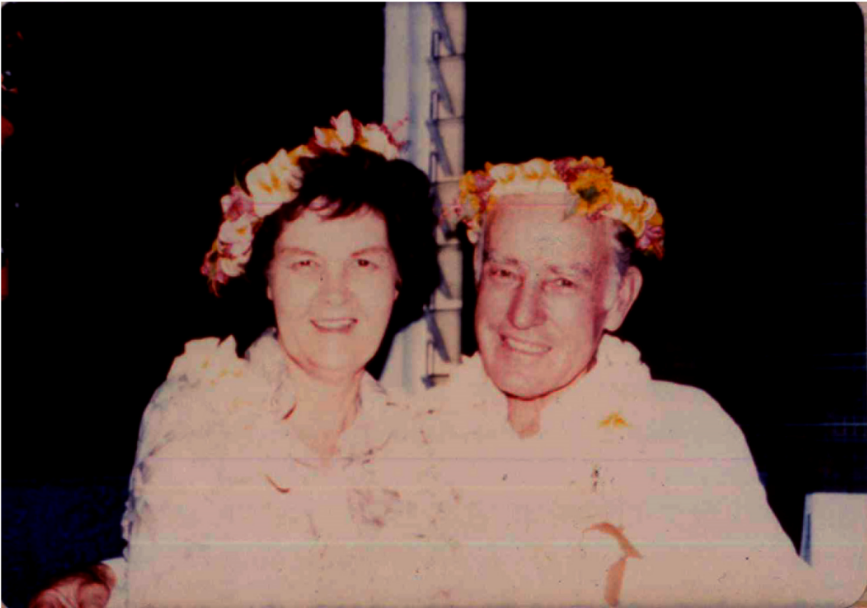 Ruth and Eldred Fewkes, 1977. Courtesy of Mark H. Butler.
First Member and Missionary Interactions
To open the Marshall Islands to the preaching of the restored gospel on February 3, 1977, Elders Wardle and Cooper had received three-month extensions to their missions to accept this assignment from President William Cannon.[21] The main challenge of their calling was their limited time in the islands. They were working in a culture in which people grant others trust over time for consistently behaving in reciprocal obligations; the elders’ stay was just not long enough. They nonetheless made exceptional progress in a short amount of time, and friendships began to take shape that would enable the initial work in the Marshalls.[22] Much of their early networking and relationship building was facilitated by the Fewkes family, a committed Latter-day Saint family living temporarily on Mājro. Brother Fewkes was an engineer working in the islands with the government to develop and build the first copra-processing plant.[23] The missionaries were also greatly assisted by Methan Edwin (converted while in Hawai‘i) and Andrew Bilemon (not a member), both former Church College of Hawaii and BYU–Hawaii students. Their assistance led to the first native baptism of Misao Lokiejak on April 27, 1977,[24] not long after the missionaries’ arrival. Lokiejak had positive impressions of the Church after an initial introduction while he was attending a training program on Oahu.[25] Consequently, he was immediately interested when he met up with the elders in Mājro. Despite these promising initial contacts, time ran out for these two missionaries, without an opportunity for them to develop any real competence in the language.
 Misao and Merasko Lokiejak family with Victor Merrell (right), 1978. Courtesy of Mark H. Butler.
The communication barrier presented no trivial challenge because it quickly became obvious that any future success in the Marshalls would require deep immersion in the language. Learning the language would allow current and future missionaries to reach most of the population, who were principally monolingual and very literate in their own language. It would also become a sign of respect, showing that the missionaries took seriously the indigenous language and that they would not assert a kind of linguistic imperialism. Learning the language also facilitated the missionaries’ entrance into the cultural world of the islanders because all the islanders’ values, worldviews, sensibilities, and beliefs[26] are deeply embedded in their language. This understanding has permitted much more conversant and effective teaching.
A Friend in the Right Place
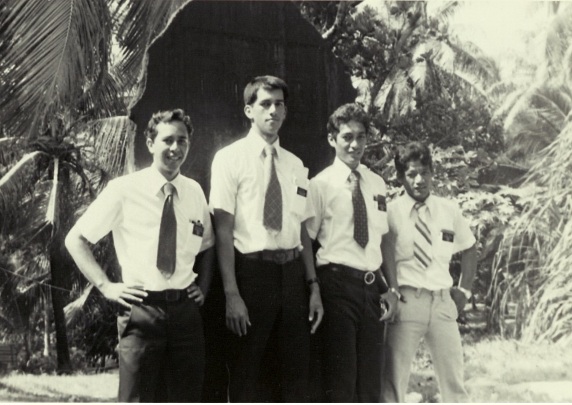
Missionaries Richard Conklin, Jim Brinton, Walter Wong, and Torlik Tima, 1977. Courtesy of Mark H. Butler.
The first missionary to become clearly fluent in Kajin M̧ajeļ was Elder James Brinton, who set it as his priority to learn the common language through his associations with the young.[27] Elder Brinton arrived in Mājro in June of 1977. Although he hailed from California, he brought with him some familiarity with islander ways, or at least an open disposition to their sensibilities, due in part to the influence of his Hawaiian maternal grandmother. This connection, coupled with his serious commitment to learn the language, likely well disposed the ri-M̧ajeļ to him, as he made several positive relations with many of them. Most notable of Brinton’s contacts and converts was LiMojwa, the “queen,” according to President William Cannon, “of one of the island chains.”[28] LiMojwa, described as eighty-three years old at the time, lived with her ninety-something commoner husband, Toeming. She, like many high-ranking individuals, was rather rotund. The missionary records noted her ample size and described her with a degree of curiosity.[29] Yet this observation is significant because her sturdy and portly dimensions would have stood as a sign to many of the islanders that she was well fed and waited upon as one of superior rank. As she and her husband confronted their mortality, she became interested in the plan of salvation and eternal marriage, principles not offered by the other well-entrenched Christian religions. As Brinton and his new companion, Elder Don Baldwin, learned the language, the lessons were facilitated by her bilingual granddaughter.
LiMojwa’s conversion, and eventually that of her husband and granddaughter, significantly facilitated the missionary effort in Mājro.[30] LiMojwa’s deep affection for Brinton was clear because she made him a priority. Even when she was conducting other business in her chiefly office, she would break off to give him her immediate attention when he visited. Undoubtedly, the other islanders noted her approval because the missionaries then enjoyed “access to any house on the island.”[31] While this may be an overstatement, even the islanders who disagreed with the Church and had other religious commitments would have, out of respect to LiMojwa, treated the missionaries with hospitality and good graces. A signal that the Church had truly arrived and had been given legitimacy came toward the end of Brinton’s mission when LiMojwa invited him along with his companion, Ferrant Sunada, to sit with her on the front row among other royal figures at the ceremonial signing of the new constitution of the Republic of the Marshall Islands on May 1, 1979.[32]
This account of missionaries making inroads with high-ranking individuals, and thus opening opportunities to the populace, characterizes a familiar story in the Pacific Islands generally. The missionaries intentionally pursued such contacts because success with commoner people in the islands could only go so far, and the new religion would never be seen as legitimate without the conversion of high-ranking individuals. This pattern by the Latter-day Saint missionaries replicates a similar strategy pursued by the early Protestant missionaries to the Marshall Islands; once the high-ranking individuals approved and in some cases adopted the new religion, at least in form, their subjects quickly followed.[33] LiMojwa’s baptism greatly facilitated the Church’s proselytizing effort, but the backstory of her role in society exemplifies a little more nuance than was understood and recorded by these early missionaries. The American missionaries and mission leadership, even those with some familiarity with island societies, read their successes with LiMojwa only through their own cultural lenses.
Chiefly Authority and Matrilineages
Clearly part of the discourse shared among the missionaries, mission leadership, and Latter-day Saint expatriates was the continued identification of LiMojwa as the “queen.” In references to other high-ranking figures with whom they sought to ingratiate themselves, they used the term king for male elites such as Kabua, the current high chief at the time. This terminological identification overlays ri-M̧ajeļ polity with Western conceptualizations of royalty. The term queen misapplies and obscures how rank and kinship work in ri-M̧ajeļ society. Marshall Islands kinship, like that in much of Micronesia, represents a flexible matrilineal system[34] wherein the primary ranks, titles, and land inheritances pass through women. In ri-M̧ajeļ society the term Iroojļapļap for the highest-ranking individuals is best translated as the “greatest or highest chief.” These leaders obtained their ranks through ascription or through the genealogies of their matriclans (jowi). I will discuss these clans shortly, but for now it needs to be understood that LiMojwa, the noteworthy woman and convert, would have been the Leroojļapļap, or highest-ranking female chief over a certain territory. In this society, rank is not determined by gender but by seniority among a set of generational siblings within a matriline. A variety of matrilineages (bwij) are then ranked within a matriclan, and the rankings among the several matriclans is also recognized.
Historically, residences in the Marshall Islands also tended toward matrilocality: after marriage (or common-law acknowledgment) a man went to reside on his wife’s lands to help raise the children, whose rights and inheritances are obtained through their mothers. Most usufruct rights to land are held by matrilineages, usually having been granted by high-ranking chiefs to their ancestors for noteworthy service. The pattern is notable because a man receives his authority and inheritance from his mother (descended from his maternal uncles through his matrilineal ancestors), not his father. A man’s titles and inheritance do not pass to his offspring but will follow to his sister’s sons, or his maternal nephews. This kinship pattern and its implications on land tenure and authority has played out in consequential ways in relation to the Church, including efforts to obtain land for Church buildings, ideas about family life and the home, how genealogies are kept and their significance to temple work, and the relationships Church members have with each other and outsiders, including with missionaries and Church dignitaries. The history of the Church in the Marshall Islands has had this social structural pattern as a backdrop to all its successes and failures, whether or not it is understood by the missionaries and visiting leaders.
LiMojwa, then, was not a queen in terms of the word’s Western usage; rather, she was a female high chief of the foremost ranking matrilineage in the uppermost-ranked matriclan. She possessed authority over a set of atolls within an island chain. The Marshall Islands archipelago form two island chains that run northwest to southeast. The eastern chain is referred to as Ratak (“sunrise”) and the western as Rālik (“sunset”). Despite significant contact between the two chains historically, each chain has its respective chiefly histories that recount how power fluctuated with the outcomes of interisland and interclan warfare until pacification.[35] Each island chain also possesses its own language dialect. Elder Brinton appears to have been getting his mind around the complexity of these histories when he identified the Kabua line as the chiefly matrilineage for the Rālik chain and LiMojwa for the Ratak chain.[36] Brinton’s understanding was in part accurate, although he missed how the great female chief had authority over the majority of the northern Ratak islands only and not all the eastern chain, while the Kabua chiefly authority was distributed across a range of royal figures within the chiefly lineage. But Brinton was right in his description of how the commoners (kajoor ro) pay obeisance to the chiefs through their submissive body gestures, formal speech, and tribute.[37] So LiMojwa, though possessing no political authority in the newly emerging nation state, was among the great chiefs who commanded respect and deference. That she is described in mission accounts as having “adopted” Brinton[38] also aligns with a very real kinship practice in the islands called kaajiriri, wherein children are offered to high-ranking family members, especially those without children of their own. This pattern can also be applied by high-ranking individuals to create relations of affection and to ensure a kind of reciprocity with others throughout their lives. Brinton would have been referred to as LiMojwa’s nejin (or son), and he would have been accorded all the respect granted to a female chief’s descendant. This alliance not only furthered the early missionary labors but also became a pattern experienced by many subsequent missionaries, though not with such a high-ranking individual as this female chief.
The Matrilineal Family and the Priesthood
Missionaries, mission leaders, and other visiting authorities have at times succeeded at working within the matrilineal structure, even when its machinations remained a bit foggy to them. At other times, misunderstandings have led to some serious missteps. But, over time, the ri-M̧ajeļ members have adapted the cultural patterns of the Church to fit their kinship and political structure. When the missionaries began teaching in the islands, they were confused (and many still are) about how family life worked according to the matrilineal practice. Both the composition of the home and the expected behaviors of people in their various roles often proved confusing to the Americans. The ri-M̧ajeļ family, as noted, may reside in a matrilocal arrangement (living on the wife’s or mother’s land). The father, who represents a kind of guest and who has his primary rights back with his sisters and their matrilineal lands, does not exert authority over the household composed of his wife’s matrilineal kin.
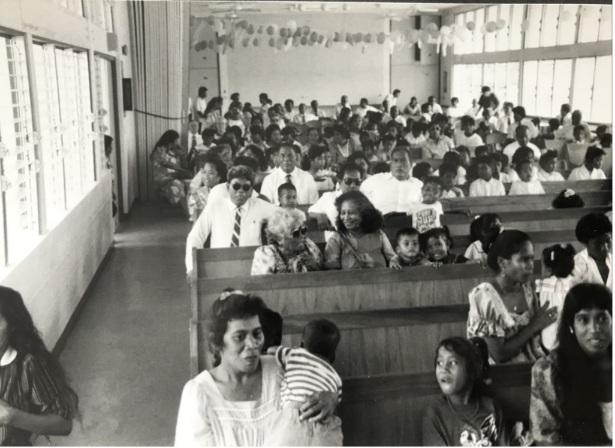 Latter-day Saint congregation, Delap Chapel, Mājro, 1993. Courtesy of Phillip H. McArthur.
Consequently, in such a traditional arrangement, fathers tend to act less as socializers of their children and more as friends and advocates. (In the urban centers of Mājro and Epjā [Ebeye] this pattern continues to adjust as people seek any place they can locate to reside in the overly populated communities and within the new economy.) Some members of the Church have characterized these fathers as passive or unwilling to assume the role to preside, when they are actually forming warm and affectionate bonds with their children while deferring to the wife’s mother and siblings. This family structure has created much puzzlement for some missionaries, as indicated by Brinton’s recollection recorded by President Cannon: “The principal problem with expanding the church in Majuro was that it had priesthood authority in what was a matriarchal society.”[39] This perspective is telling and has informed much of the continued perplexity and often unnecessary frustration among missionaries and mission leaders. For one, Brinton (and most others who follow with the same quick designation) misunderstood the matrilineal system by identifying it as “matriarchal.”
The ri-M̧ajeļ matrilineal society is not one ruled by females but one in which women may or may not be in authority—it depends on their position in the birth order of the senior matriline. And even when women do hold authority, they will defer to their brothers or sons to speak on their behalf (mmaan maron̄ron̄) in most public and ceremonial settings, although the men will not speak without first conferring with their mothers or sisters. But more problematic than the lack of understanding about the matrilineal society has been the perception by some missionaries that the significant influence of women and how it plays within the household is an impediment to priesthood authority. The patriarchal assumptions implicit in this view have missed two important points. First, the ri-M̧ajeļ do not have a problem with the idea of sacred authority passing through men or with priesthood holders’ responsibility to take charge in public venues. Second, the principles of the priesthood and its administration, as articulated in Doctrine and Covenants 121:41, resonate with how ri-M̧ajeļ men should serve with gentleness, meekness, and love unfeigned. Such a system puts a check on unrighteous dominion.[40] Certainly, over time, the islander Saints have adapted to the visual displays of priesthood authority (such as men presiding at worship services), but they, like so many Saints even in Western systems, have always recognized how it is women who mobilize people and call the shots in the actual practice of ministering to families and individuals. The islanders see the respective male and female responsibilities not as ranked privilege or subservience but as complementary domains of influence. In many ways they have truly lived by the statement in the “The Family: A Proclamation to the World” that “fathers and mothers are obligated to help one another as equal partners.”[41]
Indigenous Missionaries and the Complexities of Kinship
Relationships on the ground can be difficult to navigate in this high-context culture where the people, even if they don’t know each other personally, know where others fit within genealogies, kinship groupings, and social hierarchy. This difficulty became manifest in the early days of the mission when Torlick Tima, a ri-M̧ajeļ missionary, was first assigned to Epjā on Kuwajleen (Kwajalein) Atoll, where many of his matrilineal relatives resided. Elder Tima, who had converted in Colorado, had received his mission call to the Hawaii Honolulu Mission while a student at BYU–Hawaii. He was first assigned to Chuuk (Truk) in central Micronesia as one of the early missionaries to enter that archipelago.[42] Not long after, the mission president sent him to Kuwajleen in the Marshalls with the intent that Elder Tima, being a native speaker, could help launch the work among the ri-M̧ajeļ in Epjā Islet, where the islanders resided.
On August 27, 1977, Elders Don Baldwin and Torlick Tima arrived in Kuwajleen. They were aided by Brother and Sister Wise and a Sister Cox,[43] Americans living on Kuwajleen (the missionaries are not permitted to proselytize on the base and can visit only as guests to member families). Sometime close to the end of August of that year, Epjā islet was dedicated for missionary work. Elder Baldwin recounts the squalid conditions of Epjā but also a powerful spiritual outpouring as this small group gathered on the edges of a military base.[44] It did not take long for challenges to arise in Epjā, however, not the least of which was finding living accommodations for the missionaries. There were also “some special problems”[45] because Tima’s sister, cousins, aunts, and brother also lived on Epjā. Baldwin could not have understood the subtext to this complication with his limited knowledge of ri-M̧ajeļ society. This exemplified more than simply an issue of a missionary serving among relatives, for in this matrilineal society his sister represented someone to whom he would be required to demonstrate significant deference. Also, those identified by Baldwin as his “aunts” would likely have been Tima’s classificatory mothers in the matriline. In ri-M̧ajeļ kinship, a person’s mother’s sisters are also considered “mothers,” and the same relationship that adheres between mothers and sons would also be expected in these relationships as well. And if his brother was older, which we can suspect, then by virtue of the principle of title by age, Tima would have also needed to defer to him.
At first Elder Tima’s family welcomed him, but soon his sister began to question his role and commitment to the Church with some antagonism. Not all was negative, however. One incident that affected both the islanders and Tima’s sister positively included the miraculous healing of her infant son, who was covered with “dark blotches and scabs, . . . listless,” having apparently contracted an illness that had taken the lives of other infants on the island.[46] Tima asked his sister if he could provide the baby a priesthood blessing. Reluctant at first, she acquiesced, probably out of fear and despair for her son. The day after the blessing, the child began to improve remarkably, the discoloration began to fade, and the infant became active. This miracle was familiar to the Christian islanders, who mixed with such faith healings indigenous ideas about using anointing medicines (wūno). Afterward, many islanders asked for blessings from the missionaries as they tracked, although it likely did not lead to any significant increase in conversions and baptisms, perhaps owing to conflicts that arose.
This hierarchy of relationships created some real difficulties for Tima. As President Cannon worked to address the situation, Tima’s brother came to see the president in Honolulu to express his concerns about how the missionary’s presence in the islet created problems for the family. President Cannon assured Tima’s brother that he “would be considerate of the family and do nothing to stir up conflict.”[47] As Baldwin wrote in his journal, this all placed “particular strains on our relationship and on Elder Tima. It was a difficult time, especially for Tima.”[48] Although Baldwin could not have understood the full weight of the cultural relationships that engendered this challenge, he was obviously keenly aware of the pressures on Tima and its effect on the missionary work. This could be endured for only about two months, because on October 27, 1977, Elders Baldwin and Tima were transferred to Mājro and the missionary effort was closed on Epjā for a time.[49]
Navigating Church Governance and Priesthood Leadership
Just after a year from the time the first missionaries arrived in the Marshall Islands, the Majuro Branch was organized on May 11, 1978, with Misao Lokiejak (the first convert) as president.[50] There is some confusion in the records because President Cannon identified it as the “Laura Branch,” yet missionaries had not even been sent down to that side of the island by that time. In July 1982, a second branch was created at Rita and the Majuro Branch was renamed the Laura Branch,[51] but in actual practice this latter unit served as a satellite branch since a president was not called, and Lokiejak continued to preside and minister to the entire atoll. In these early branches the elders and senior missionaries sought to nurture the Saints in the fundamentals of the gospel and to train the new priesthood leaders in their responsibilities. If there was a struggle with the sense of priesthood leadership, it came early with the introduction of Church governance in the islands. In part, this derived from the islanders’ lack of familiarity with a lay leadership. This looked very different from other Christian churches in which ministers and pastors received ecclesiastical training at local centers or traveled to Hawai‘i and the US mainland to attend seminaries. But leaders in the restored church, who were “called” to serve in their positions, would one day be released. Titles and ranks in the traditional social structure are not something that one surrenders (unless deposed) after a certain time. These statuses last a lifetime. Similarly, even appointments of leaders in other Christian churches are not considered temporary and likely last a lifetime or until the preacher becomes incapacitated by illness or old age or moves away. To lose a traditional title meant that other high-ranking individuals had deposed them for some egregious behavior or mental incapacity, and other Christian leaders lost their positions only for serious improprieties or transgressions.
Thus, when the Church began calling indigenous people to lead in certain positions, to later be released, it caused a degree of consternation and thus speculation about what the former leader had done to merit his removal. The idea that members would serve in different callings for a while and then rotate characterized something foreign to the early islander Saints. Moreover, to be released gave the appearance of not only being removed from elevated status but also having lost connection with and approval from those of the outside powerful American church. This caused many early converts and leaders who had been released to pull away from the Church to avoid social stigma and rumor. And if there was an unhappy separation of a leader from a spouse because of the spouse’s philandering choices, the leader was unable to save face and, upon being released from the calling, more than likely chose to disassociate from the Church. This was the experience with one early leader who, after separating from the Church, became a pastor at a Protestant church but remained friendly with the Church members and missionaries and, word had it, continued to teach Latter-day Saint doctrine to his Protestant congregation.
There have been situations, however, when ri-M̧ajeļ cultural priorities came up against those of the priesthood leaders from the United States. For instance, a granddaughter in the royal matriline of LiMojwa, Turlang Jaik, who also converted to the Church, became an early leader within the Relief Society organization in Mājro. Turlang and her husband both received leadership callings while also proffering the symbolic roles of dignified royal members. Indeed, her husband, Ether Jaik, was called as the first elders quorum president in May of 1978.[52] Turlang also served as one of the early Relief Society presidents in the branch. In 1991 Lani Lane Lanny, the second indigenous district president,[53] called Turlang to serve as the district Relief Society president. As the senior woman in her royal matriline, Turlang embodied pronounced social authority as well as a palpable spiritual presence, owing to both her commitment to the precepts of the restored church and covenant keeping and the spiritual power ascribed to her as a female chief. By virtue of her rank, members and nonmembers were very deferential to her, paid her great respect through gesture and verbal praises, and avoided prohibitive (emo̧) behaviors in her presence. Once called and sustained as the district Relief Society president, she then needed to be set apart. The problem for President Lanny, a high-ranking person himself (but just not as high as Turlang, but also considered her “father” through a patriline), was the expectation to set her apart through the laying on of hands. To place one’s hands upon the female chief would be a serious social breech. The head of all chiefly figures is considered sacred, and the commoners will make gestures of subtle bowing (badikdik) to acknowledge it, and under no circumstances may they touch a royal’s head, the seat of their An, or spiritual power (mana in much of the Pacific). When confronted with this responsibility, President Lanny hesitated and could not bring himself to do it. The other ri-M̧ajeļ in the room (about ten) expectantly watched to see what he would do. The American senior missionary, who at the time served as the first counselor in the mission presidency assigned to train and advise the new ri-M̧ajeļ leadership, detected the reluctance on the part of this indigenous president. He sternly upbraided him and firmly instructed him to dismiss traditions that impeded the work of the priesthood. He offered a minilecture about serving either God or Mammon.[54]

President Lani Lane Lanny, 1992. Courtesy of Phillip H. McArthur.
Still, President Lanny resisted. For her part, Turlang, somewhat amused watching these men struggle through this scene, waited to be granted the authority and blessings in her new calling. The only other American in the room, whom President Lanny had called to the district council, suggested that because the mission president’s counselor also had the authority, he should set the sister apart, and the issue could be further discussed later. As an outsider, not constrained by the same obligations to the authority of the indigenous female chief, the mission counselor would be exempt from the prohibition. And so it was.
The American mission leader continued to pursue this event as a teaching moment in subsequent days. But President Lanny’s behavior led to something somewhat unexpected. While the American felt that deferring to local custom was an affront to priesthood authority, the members of the Church were relieved, and word started to spread. Even those outside the Church heard the story of the Latter-day Saint leader who respected the customs, and a positive attitude toward the Church resulted, leading to further proselytizing opportunities.[55] Over the years, such traditional prohibitions have lessened, and Church leadership perform ordinances and blessings on higher-ranking individuals, although they still accord them respect in social gatherings and traditional settings.
Traditional Land Tenure and the First Church Buildings
When the first missionaries arrived in Mājro, they had to scramble for both living accommodations and, eventually, a place to hold Sunday services. Methan Edwin and Andrew Bilemon, former students at BYU–Hawaii who were well-disposed toward the Church, helped the missionaries to secure reasonable but simple settings in which to live and hold services.[56] The first real edifice they secured for Sunday meetings was an old, deteriorating club or bar located on a small inlet on the lagoon across from the primary grocery store. This facility, though rudimentary and holding some stigma as a building of former ill repute, served for many years as the gathering place for the Majuro and Rita Branches. Eventually, the missionaries pushed out from the urban center of Uliga (on the Rita, or east, end of the island) to Long Island (Batkan, Jable, and Raidik districts) and to the far end of the island of Mājro Islet (which since World War II has been referred to as Laura, its military call sign). By the early 1980s, the congregations at the Rita and Laura ends of the island justified the building of chapels, and representatives from the Presiding Bishopric offices in Honolulu came out in February 1984 to negotiate lands for their construction. Because these representatives were familiar with some of the land tenure systems of Micronesia, they sought to work within the traditional patterns to secure lots on which to build the chapels. In the Marshall Islands, all land belongs to the chiefs. Extended families who have been assigned usufruct privileges or positioned as caretakers for the land tracts (wāto) also possess rights to the produce, resources, and monies made on the land through copra production, rents, or other uses. All benefits obtained from the land are distributed among the lineage members. The alab, or lineage head (either male or female), oversees the use of the land by the ri jerbal (laborers who are commoners, or kajoor ro) for housing and food production; the alab also manages any revenues accrued and tributes to the chiefs (ekkan). Such lands rarely consist of a nuclear family but are occupied by several matrilineally (and sometimes patrilineally) linked relatives.
Because lands cannot be purchased, the Church could create only long-term rental agreements with the chiefs and these families for land on which to build chapels. Such a contract needed the approval and signatures of the irooj (chief), alab (lineage head), and senior ri jerbal (laborer), and these were granted only after much discussion with these authorities’ respective family members, especially the senior women. Consequently, the negotiations were complicated and successful only after Elder Frank Bradbury (an experienced, unassuming senior missionary) and the Presiding Bishopric Office (PBO) representatives calmly worked out the details with all the relevant ranking individuals, aided by Lani Lane Lanny (the new branch president) and a missionary who assisted with translation. This intercultural achievement led to the building of the first chapels in the Marshall Islands, one in Uliga in the eastern urban center and one in Mājro islet (or Laura) on the west end of the atoll; the chapels were dedicated respectively on January 13 and 14, 1986.[57] Since these first two chapels were built, three others have been added, one in Rita (Djarrej), one in Long Island (Raidik), and one in Ajeltake. The Long Island chapel has been expanded to serve as the stake center. Without the positive relationships the members created with the irooj ro (chiefs) and alab ro (lineage heads) (many of whom were related to, or shared a matriclan or genealogy with the members), the missionaries, and the flexible land attorneys from the PBO, the building of these chapels would not have been realized. In addition to serving as hallowed buildings for worship and fellowship, these chapels, built to withstand typhoons, have served many times over the years as refuges for members and nonmembers alike who were seeking safety from the menacing storms. The reputation of these secure buildings is noted through the islands.
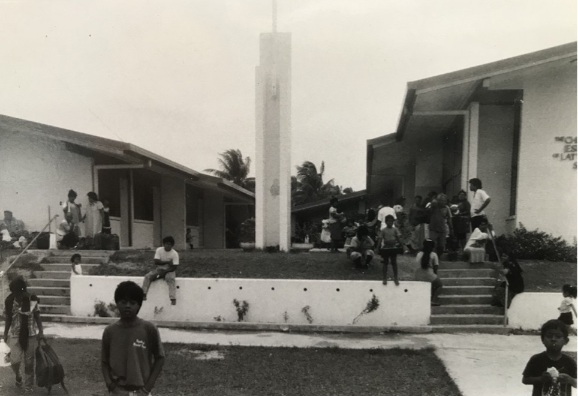 Delap Chapel, Majuro, 1992, first dedicated chapel in Marshall Islands. Courtesy of Phillip H. McArthur.
Linguistically Competent Missionaries
Along with the witness of the Spirit and a compelling gospel message that resonates with the ri-M̧ajeļ, the Church’s success has been enhanced by the ability to share that message in Kajin M̧ajeļ, both by linguistically competent missionaries and through the translation of the scriptures. Until recently, a language-training experience hasn’t been available at the missionary training centers; nonetheless, the generations of missionaries that have served in the Marshall Islands have achieved ample competence in the language, some more than others. Most missionaries have attained colloquial competence that enables them to deliver effective lessons or offer talks in Sunday services. Without formal training, each missionary has learned the language using a variety of resources—books, dictionaries, and audio resources[58]—created over the years by education institutions or outside specialists, and they have learned from experienced senior companions as well.
However, for the missionaries, the greatest language learning has come through the islanders themselves. The ri-M̧ajeļ, Church members and nonmembers alike, are very patient teachers who kindly correct a sincere learner and modify their speech to accommodate the beginner. They have looked past the grammatical missteps, poor pronunciation, and even inaccurate vocabulary use that could possibly offend when missionaries unknowingly employ vulgar or prohibited terms. Over time, the expectation for linguistic competence has become a tradition among the missionaries; it is a given that to be an effective teacher in the Marshall Islands, one must become as fluent as possible. The gift of tongues has been manifested often.[59] Missionaries tend to possess a limited vocabulary, circumscribed by the religious lexicon in which they are immersed. Yet with the help of the members, some missionaries have developed vocabularies that enable them to offer formal orations using the right metaphors and references. Many missionaries also come to understand the culture’s humor and even produce it, which is among the hardest thing to learn in a language because of all the complicated connotations. Some also correctly apply traditional proverbs for culturally situated teaching examples. And still a few others even learn to recite some traditional chants with their archaic linguistic forms. Such competent missionaries not only receive the accolades and respect of the islanders but also become the most effective teachers because they can situate gospel doctrines within the framework of a ri-M̧ajeļ worldview. These missionaries have also been helped by islanders who are competent in English and who kindly offer correctives to help the missionaries learn. These islander Saints have also proved indispensable for translating difficult doctrinal points and providing a vocabulary for the missionaries to use when the Kajin M̧ajeļ words employed by other Christians prove inadequate to capture nuanced gospel principles.
Translating the Scriptures
The majority of the ri-M̧ajeļ are profoundly literate in their own language and enjoy reading the scriptures and then engaging in sometimes animated discussions. Early Christian missionaries first translated the Bible into Kajin M̧ajeļ between 1870 and 1900.[60] Using the Rālik dialect (which to this day privileges it), they performed a herculean work to render the New Testament and most of the Old Testament in Kajin M̧ajeļ. Though translated through these missionaries’ own doctrinal lens, this work is noteworthy for its linguistic accuracy and has ultimately proved a blessing for the other Christian churches and Latter-day Saints alike. Since the first translation, other religious groups have provided alternative versions. In the early years of the mission, access to the original translation sometimes proved a challenge because churches that were not well disposed to Latter-day Saint beliefs, and that held the copyright over the text, sometimes created impediments for the missionaries to acquire copies.
For several decades the Protestant Bible was the only scripture the missionaries had to work with. In the early 1980s a Selections from the Book of Mormon volume (about forty to fifty pages) was translated, but two things about this translation quickly became clear: first, it was rendered in a more casual language and used the vocabulary and grammatical level of a late grade-schooler; and second, it proved limited in the doctrinal points it covered. Without the Book of Mormon, Church members could develop only so far in terms of doctrinal understanding and a fuller conversion. The running jest for many years was that the first generation of members were basically “Protestant Mormons” who had been converted to the stories and principles of the Restoration but were fundamentally making sense of most doctrines through a Protestant lens. Translations of handbooks, teaching manuals, and other pamphlets (e.g., the Joseph Smith story) preceded the translation of the Book of Mormon and additional Latter-day Saint scripture. The first complete translation of the Book of Mormon was accomplished in 2006 by William Swain, with the assistance of many other bilingual members. William, despite his German name, is ri-M̧ajeļ and is a long-term member of the Church.
William was born and raised on Ujae Atoll, a very remote and traditional atoll in the northern Rālik chain. He was an intellectually capable child, and his family sent him to the capital as a teen to attend high school. William developed an intricate understanding of the genealogies, narratives, protocols, and symbolic meanings of his culture. Just about the time the missionaries first arrived in the Marshall Islands, William graduated from high school and moved to Arizona to attend a junior college. While there, he was introduced to the gospel and accepted baptism. As soon as he was eligible to serve a mission, he received a call to South Chicago, where he continued to develop his English language skills and knowledge of the Church. Upon his release, he returned to the Marshall Islands, expecting to begin sharing the gospel and perhaps encouraging the Church to send missionaries. At his return in early 1983, however, he was surprised to find not only missionaries but also a Church membership that was beginning to thrive. After spending time with family and supporting the new Church members, he enrolled at BYU–Hawaii, where he eventually received a bachelor’s degree in political science. Upon graduation, he returned to the Marshall Islands and became a foundational figure in helping the Saints to develop doctrinal literacy; these efforts included developing the seminary program.
In his professional life, William was taken in by Amata Kabua, the high chief and first president of the independent Republic of the Marshall Islands. In Amata’s circles, William was assigned to the roles of an ambassador to Asia and an ambassador to the United Nations.[61] He eventually became an assistant to the president within the president’s cabinet (almost like a chief of staff). The late President/
But William’s greatest contribution has been his translation work, including the Book of Mormon (with all the footnotes and indexes), Doctrine and Covenants, and Pearl of Great Price (translation approval 2013; published in 2016). With the translation of the triple combination in place, gospel literacy, conversion, and testimony have come to notable fruition. The Saints have been more prepared for serving and teaching purposefully and for obtaining temple ordinances. In 1992, prior to these translations, William, with the assistance of Lani Lane Lanny, also completed the temple initiatory and endowment ceremonies and then arranged for local Saints (among them Lani Lane Lanny, Neito Lanny, Ether Jaik, Simon Milne, and Jormeto Moreang) to travel to Utah to record the endowment in Kajin M̧ajeļ; this recording has been used in the Laie Hawaii Temple since that time. And most recently, in 2018, William’s translation of the temple sealing was approved and used for the first time by a former missionary who now serves as a sealer in the Laie Hawaii Temple.
The Spiritual and Cultural Depth of the Temple Experience
The first ri-M̧ajeļ members to receive their endowments and be sealed in the temple were Misao Lokiejak and his wife, Morasco. In 1978 President William Cannon of the Hawaii Honolulu Mission arranged to send the Lokiejaks to attend the temple in order to help Misao in his new calling as the Marshall Islands’ first branch president. They attended the temple in La‘ie just before it closed for renovations.[63] After President and Sister Lokiejak’s trip, attendance to the temple by ri-M̧ajeļ members was limited and sporadic. Because of the prohibitive costs to travel the 2,300 miles to Hawai‘i, the islanders often felt that the blessings of the temple were outside their reach. Even in the 1970s and early 1980s, the cost of a plane ticket was $700 to $1,000 (much costlier today). At the time the average household income was $4,000 annually.[64] One ticket alone required a quarter of a family’s annual income. Such an encumbrance significantly restricted travel to the temple, especially if a couple intended to take their children, which could exhaust their resources for a year. But beginning around 1992, a temple fund created and underwritten by the mission president, Lewis V. Nord, with additional contributions from former missionaries, helped offset the expenses for the Marshall Islands Saints to travel to the temple in Hawai‘i. These Saints saved much of their own minimal earnings and then created fundraising activities (kabajet) as branches to contribute to their airfare, lodging, and meals for a four-day trip, each day filled with ordinances for the living and the dead. The endowments received and sealings performed have greatly strengthened the ri-M̧ajeļ Saints over the years, and participating in these ordinances was key to the members’ preparation to establish a stake in 2009. Intellectually enlightened, spiritually strengthened, and now set more firmly on the covenant path, Church leadership has flourished and the Saints have greatly enhanced their commitment. They have now received all the blessings of the restored gospel and seek to put all they know into practice.
The temple excursions[65] have proved to be powerful experiences that resonate deeply for the ri-M̧ajeļ Saints in terms of their own culture, familial relationships, and personal spirituality. The sacrifice the Saints have made to realize this one-time opportunity to attend the temple demonstrates their humility, deep gratitude, and open reception to all they can absorb. Many who have helped facilitate these temple group trips (among them former missionaries) note that the ri-M̧ajeļ have a strong ability to be attentive and focused during the ceremonies. These islanders possess a keen ability to be patient and listen intently. From an early age ri-M̧ajeļ children learn to sit patiently as they are instructed; they watch, listen, and observe, and then when it is their turn to do something, they seem to demonstrate astute competence without having tried it before. So it is with the temple—the members assiduously focus on the sacred ceremonies, the symbols, and the actions they are to perform. They take the experience seriously, and they are quick studies in all they are to say and do. Their collective support of each other is also noteworthy, as they willingly help each other without embarrassment.
 Sisters from the Laura Branch, temple excursion, 2018. Courtesy of Phillip H. McArthur.
The temple ceremonies do not come with any confusion or surprise to the ri-M̧ajeļ. They are comfortable with the initiatory process because the ritual gestures of washing and anointing articulate with traditional sacred practices of cleansing and investiture of titles. In other temple ceremonies, the repetitive language with slight variations echoes the patterns of their chants, and the unfolding of the cosmological story rings familiar to the creation stories and sacrifices of a benevolent God. The image of Eve as a noble ancestress who recognized and spoke the essential truth resonates with their matrilineal sensibilities, and the ceremonial clothing articulates with their appreciation for preparations to assume significant and often sacred roles. The body as the medium and template for sacred symbols and signs leaves an indelible impression for remembering, and the covenant making speaks to both their old ways of demonstrating commitment and their new beliefs about a personal consecrated relationship with God. For the ri-M̧ajeļ, temple sealings confirm their greatest traditional sense of the perpetuation of the human soul and their belief that both matrilineal and patrilineal familial relationships endure. Over the years the ri-M̧ajeļ Saints have shared many testimonies about manifestations of ancestors in the sealing rooms. For a people who consider appearances of deceased relatives to be the norm, such visitations in the sacred space of the temple come as no surprise and are viewed as intimate experiences that confirm the veil between the living and the dead as truly thin.
The Unfolding of Missions and the First Stake
The increase of missionaries to each of the countries significantly grew when the Micronesia Guam Mission was created on April 1, 1980, with Ferron C. Losee presiding.[66] President Losee had served as a counselor to William Cannon working in Micronesia before his call. As a former president of Dixie College in St. George, Utah, who had already worked in Micronesia, Losee was administratively sharp, perfectly prepared to preside over a group of far-flung young men and also open to managing diversity. By virtue of his position and title, the ri-M̧ajeļ Saints respected him. But it was more than this; they appreciated his warmth and patience and, in many ways, saw the characterization of a beneficent chief. Whenever he and Sister Losee visited the islands, they were welcomed as high-ranking dignitaries with leis, songs, dances, and feasting. The Losees graciously participated in these events, recognizing both their cultural value and ability to foster positive fellowship. Over the years, mission presidents have been more or less amenable to these cultural protocols, either endearing themselves to the Saints or disappointing them and, in some rare cases, creating mild offense. But because the Church and missionary force are now firmly rooted in the islands and the visits by mission leaders so frequent, the salience of these kinds of events have been significantly lessened. Even departing missionaries come and go without much acknowledgment, in marked contrast from the early years when only four to six missionaries served in a location and typically remained in one place, sometimes for more than a year, becoming intimately involved with the membership.
For twenty-six years, the Marshall Islands resided on the far eastern edge of the Micronesia Guam Mission, over eighteen hundred miles from the mission home and office in Barragada. The distance is actually greater because air travel from Guam to Mājro requires the “island hopper” route that meanders through Chuuk, Pohnpei, Kosrae, and Kuwajleen, taking over six and half hours of flight time alone. This all changed when on July 1, 2006, the Marshall Islands Majuro Mission was created, with Nelson Lorell Bleak presiding as its first president.[67] The Kiribati Islands to the south, with their own language and culture, were also included in the mission. Kiribati has been the floater archipelago moving between multiple missions over the decades. First, it was part of the Fiji Mission, and then when the Micronesia Guam Mission was formed, it became part of the new mission. It was later transferred back to Fiji owing to travel complications from Guam. When the Marshall Islands Majuro Mission was established, Kiribati was once again relocated to become part of it. With a mission home in Mājro, mission leaders have been able to expand the placement of missionaries and open several of the outer islands in the Marshall Islands as well, sometimes with great success such as in Lae and to a lesser degree in Aelōn̄ļapļap [Ailinglaplap], Jālooj [Jaluit], Mile [Mili], and Wōjjā [Wotje].
With a mission now located in the Marshall Islands, the Church has continued its steady growth, not just in numbers but in how the Saints have become ever more committed and accustomed to church governance. Among the current Saints are many recent converts as well as some who were part of the first branches in the 1970s and 1980s. Some of these members have grown up in the Church, participated in all its organizations, and become sealed in the temple; they bring a wealth of experience to support each generation of converts as they more effectively serve in positions of leadership. This experience proved a great blessing when, after forty-two years since the first converts, Elder David S. Baxter of the Seventy organized the Majuro Marshall Islands Stake on June 14, 2009. The new stake was composed of six branches that became wards (Delap, Jenrōk, Laura, Long Island [in Rairōk], Rita, and Uliga, with Ajeltake remaining a branch). The Church waited to organize the stake until enough priesthood leadership had developed and then looked to Arlington Jabat Tibon, the serving district president, who was called as the first stake president. Having joined the Church in the early 1980s as a boy, President Tibon brought both Church experience and a sound understanding of the culture and political environment. This first tenure for a stake president did not last long, however, when President Tibon was released in August 2010 so he could complete his bachelor’s degree at BYU–Hawaii.[68] He was replaced by Zedhkeia Zedhkeia after Jack Ading served as the acting president during the interim. President Zedhkeia, also an experienced member and priesthood holder, brought to the stake close associations with key cultural and political leaders.
 Arlington Tibon and Angela Tibon, 2019. Courtesy of Phillip H. McArthur.
The calling of President Zedhkeia represented a most eventful occasion when Elder David A. Bednar came to reorganize the stake presidency in January 2011. Elder Bednar’s visit to the Marshall Islands, accompanied by Elder Tad R. Callister of the Pacific Area Presidency, represented the first for an Apostle of the Church.[69] In what has now become a familiar refrain, Elder Bednar described the Marshall Islands Saints as “very warm and welcoming” with a “simple and abiding faith in the Savior. They are not diverted by things that do not matter, and they are generous and loving.”[70] The Apostle responded well to the humility and respect offered to someone of his rank and whom the islanders hold in highest esteem. And, certainly telling, he described their hospitality and lack of materialism, age-old qualities they now simply fold into their commitment to gospel living. The Mājro Saints reflect fondly on their time in the presence of someone with such spiritual depth and with a holy calling they sustain. President Zedhkeia served faithfully, longer than any indigenous leader in any presiding position, until his release in June 2019, when he was replaced by none other than Arlington Tibon on June 2, 2019.[71]
President Tibon had circled back, now able to complete what he had started. After completing his degree in Hawai‘i, President Tibon returned to the Marshall Islands to assume substantial employment in the business sector. His total education was also enhanced by having internalized deeply what he learned by attending the temple in La‘ie as often as he and his wife could. So Tibon will be remembered as the first and the third stake president of the Majuro Marshall Islands Stake.
Adoption Scandal and Aftereffects of Nuclear Bombs
The missionaries and Church in the Marshall Islands, although they have sometimes faced significant resistance from other churches and individuals, have never, since the formation of the independent government, been threatened with expulsion or restricted in proselytizing efforts. Entrance into some outer islands has been resisted by chiefs and the entrenched religions, but the restored church has gone forward relatively unimpeded. Only when some misguided and self-serving former missionaries became involved in a nefarious adoption scheme in the 1990s, disingenuously arranging for ri-M̧ajeļ children from intact families to be adopted out to American (mostly Latter-day Saint) families, has there been a serious gesture by the government to investigate the Church. Those involved sought to manipulate poor women, using traditional concepts of adoption (kaajiriri), to surrender their babies to be taken to the United States. These women thought they were simply expanding their links and opportunities for their family members to draw upon, and they assumed, as with the traditional form of adoption, they would continue to have intimate ties with their children. Fortunately, representatives from Church headquarters, with the aid of very capable local leaders, were able to persuade government officials that the individuals involved did not represent the Church. They were able to shut the scheme down for a time, but later a returned missionary began to bring pregnant ri-M̧ajeļ women to the USA. After these women gave birth, he would send them back to the islands and adopt out their newborn babies. He has since been prosecuted for human trafficking and received a prison sentence.[72] This has all proved an embarrassment to the Church and its members, and it has taken some effort to rebuild trust to further the purposes of the Restoration.
 Katner Tima, patriarch. Courtesy of Phillip H. McArthur.
A notable calling that demonstrates how the Marshall Island Saints have embraced the gospel and disentangled it from their often-negative experiences with American abuses was the calling of Katner Tima (a relative of Elder Tima) as the first stake patriarch. As a boy, Brother Tima had been a victim of the nuclear fallout from the Bravo blast on March 1, 1954. His home atoll, Ron̄lap [Rongelap], was one of those downwind from the blast and experienced the “gritty white snow” that descended on their islands, which proved to be nuclear fallout.[73] Unlike the islanders of the Ānewetak [Enewetak] and Pikinni [Bikini] Atolls who were forcibly relocated before the nuclear tests, and whose islands remain contaminated with some islets completely obliterated, those in the northern Ratak islands, including Ron̄lap Atoll, had no idea of the adverse effects awaiting them. Some commentators have claimed that this was no accident but an experiment to see the human responses to radiation.[74] Since the tests, these islanders have experienced debilitating radiation burns, several lethal cancers, stillbirths, deformations (“jellyfish babies”), and other serious health challenges. Most of these islanders have had to relocate away from their inheritance lands. In his tender years, Brother Tima experienced these terrors, but as a dislocated adult he became attracted to the message of peace contained in the restored gospel and joined the Church. Without rancor, resentment, or desire for revenge, he developed into one of the most humble and devout among the Saints, admired for his spiritual depth as well as historical clarity (Brother Tima passed away on May 11, 2020). His refusal to harbor anger and a willingness to forgive did not, however, mitigate his desire for his people to receive reparations. But his greater emphasis was on a spiritual restoration to accompany the healing of the land and bodies.
From Tracking Missiles to Forming a Stake in Zion
The challenges of displaced ri-M̧ajeļ owing to the atomic bomb testing represent only some of the unfortunate forced relocation of the islanders. On Kuwajleen, the site of the Ronald Reagan Missile Tracking Range, the islanders are restricted to Epjā Islet, unable to freely go to the main island, for many the place of their inheritance, without a work permit. The US Army and civilian support contractors occupy this larger islet. If the islanders do work on Kuwajleen, they travel by ferry in the morning, then must return the same way at evening. For those who reside there, Kuwajleen represents a protected area with Honolulu-like neighborhoods, American grocery stories, bowling alleys, swimming pools, and a golf course. In contrast, Epjā Islet, where the majority of the islanders reside, is popularly known as the “slum of the Pacific.” With a population of over fifteen thousand on only eighty acres, the treeless islet is entirely covered by compacted houses made of cinder block, plywood, and corrugated tin. It represents the most densely populated location in all the Pacific Islands, equivalent to forty thousand inhabitants per square kilometer [75] Problems with clean water, waste disposal, and the lack of any indigenous foods (available food is mostly limited to imported canned and junk foods) result in serious malnutrition, chronic cases of dysentery, tuberculosis, and occasional cholera outbreaks. Epjā records one of the highest rates of diabetes, hypertension, and mortality in the world.[76] Excluded from the benefits of Kuwajleen, the islanders are prisoners in their own land since they are restricted to Epjā and a few neighboring islets, unable to travel to the remainder of the atoll and its islets because of limitations imposed by the military for their missile experiments. Inactive warheads shot from Vandenberg Airforce Base in California use the Kuwajleen Lagoon as target practice five thousand miles away. Within this setting, the Church has taken shape in Kuwajleen. Some argue that the economic benefits received from rent payments from the US military offer a reasonable compensation. Indeed, the nation derives nearly 60 percent of its budget from Compact of Free Association payments.[77] If this was not in place, the nation’s economic challenges would be even more exacerbated. But the consequences on the health of the islanders and a sense of alienation in their own home are acute.
The Kwajalein Island Branch, made up entirely of US citizens serving in the military or civil servant personnel, was organized in 1978. The composition of this little branch has constantly changed as members are transferred in and out of the base. The American members of the Church have resided in the gated community on the main islet of Kuwajleen, where a servicemen’s group first organized among themselves and met for worship services before the creation of the branch. The islanders, however, were excluded from these gatherings because of US Army policy. Consequently, on Kuwajleen Atoll, the early Church was segregated, although some sister residents in Kuwajleen sought to establish a Primary on Epjā among the ri-M̧ajeļ.
After Elders Baldwin and Tima left Epjā in 1977, it wasn’t until May 16, 1989, that missionary work resumed—when Elders Kepiloni Foliaki and Michael Steele returned to Kuwajleen. Progress was steady, so much so that in June 1990 the Ebeye Branch was organized, even though the members had no building to meet for Sunday services. With the Ebeye and Kwajalein Branches in place, Elders Bruce Saunders and Joel Robinson initiated missionary work on the neighboring island of Lae on December 27, 1991, and promptly a branch was organized on August 10, 1992. The entry of the Church into Lae through an invitation by Bartok, the senior female in one of the atoll’s matrilines,[78] represents one of the unique pockets of the Church where, in a relatively obscure place, the gospel can take hold and then become a centering point for a very small population. A quarter of the population of this atoll attend the Latter-day Saint meetings. The success in Lae characterizes what can transpire in the outer islands. Removed from the problems of urbanization and dislocation, the complete antithesis of Epjā and Mājro, the Lae experiment presents a case where gospel living and village life can fuse in a complementary fashion. It demonstrates how the greatest impediment to the implementation of the Church and gospel often lies less in that of culture, and more in the challenges that come with modernity and all its distractions and values contrary to the teachings of Christ. In this minimal setting, the simple and pure teachings of the Master can be more abundantly realized.
The eclectic Kwajalein, Ebeye, and Lae Branches have continued to grow since the early 1990s to the point that in October 2016 Elder O. Vincent Haleck, President of the Pacific Area, organized the Kwajalein Marshall Islands Stake consisting of five units (three in Epjā, one in Kuwajleen, and one in Lae) with indigenous president Johannes J. Seremai presiding.[79] This now makes two stakes in the Marshall Islands. Because of the limited building spaces on Epjā, the creation of the chapels has always proved a real challenge. On November 7, 1998, after years of negotiation with the traditional and civil authorities, the storm shelter that the Church leased for use by the first branch was converted into a modern chapel. To realize this arrangement, the Church agreed to share the cost for a school addition constructed on the other end of the shelter.[80] This neighborly gesture was surely noted by the islanders and traditional leadership. Part of these negotiations were eased through the positive relations created when the Ebeye Branch Relief Society began an ongoing service project in 1992 to pick up litter to beautify this garbage-inundated island. Their continued efforts were noted by the Lerooj (high female chief) Emalain Kabua, who began to join them in these activities.[81] These women, who would not allow their difficult circumstances to define them, and who chose to live forward and seek ways to improve the living conditions of all the people, not just the members, also created lasting impressions on those in traditional authority. This ultimately helped facilitate the positioning of the Church in a place where building accommodations are severely restricted.
Saints in the Diaspora
Once the Compact of Free Association was in place, travel by the ri-M̧ajeļ to the United States rapidly increased, and today nearly thirty thousand ri-M̧ajeļ live in the diaspora.[82] Significant ri-M̧ajeļ communities and populations have grown in Costa Mesa, California, and in Oahu, Hawai‘i. Communities are also found in Utah, Washington, Oregon, Iowa, Oklahoma, and, most significantly, Springdale, Arkansas, which has an islander population estimated at fifteen thousand. After making their way to these locations and finding work, these Saints have invited their family members to join them, thus creating pockets of islander ri-M̧ajeļ communities. In most of these locations Kajin M̧ajeļ continues to be the common language spoken, but nearly all these populations are profoundly bilingual, most notably the generation of children who have been born in (or have come at a very young age to) the United States and been raised there. These communities have taken shape around key industries in these locations, where the islanders make up the bulk of the laborers. For instance, in Springdale, Arkansas, the majority of the ri-M̧ajeļ residents are employed by Tyson Foods in chicken factories.[83] Some of these immigrants are members of the Church, and they have proved critical in the creation of ri-M̧ajeļ units in areas where the population has grown substantially. Kajin M̧ajeļ branches can now be found in places such as Waipahu, Oahu, and Oregon, and there is a ward in Arkansas. Accommodating stake presidents have seen the need to create these units in order to sustain and minister to these congregations of Saints. In Hawai‘i, Washington, Oregon, Iowa, Oklahoma, and Arkansas, mission presidents have even begun to assign companionships to learn Kajin M̧ajeļ and serve in this communities.
These diasporic Saints, who often face significant discrimination and economic challenges, have flourished, although at times they have created a leadership drain on the stakes in the Marshall Islands as individuals and families move to the United States for employment opportunities and to support their extended kin. The movement back and forth between the states and the islands often replicates a very common historical practice of the Pacific Islanders, who value mobility across the ocean to seek opportunity and adventure and to link up with long-lost relations. Even with all the positive development of the Church in the islands, and with the Church’s emphasis on education, including learning English, members both in the islands and in the diaspora have remained loyal to their native language and continue to be nurtured by the good word of God through their own tongue. With their bilingual abilities, many of the members who are called on missions from these communities in the US mainland have received assignments to the islands and are able to hit the ground running without needing to learn the language.
Learning from the Marshall Islands Saints
The growth of the Church in the Marshall Islands and among the ri-M̧ajeļ has seen starts and stops, but overall it has moved forward consistently. Along with Kiribati, the Marshall Islands have the greatest rate of Church membership growth in Micronesia.[84] Baptisms have taken place steadily in the urban centers, and missionary work has had variable success in the outer islands. As in many places throughout the world, the challenge for the Church in the Marshall Islands has been the retention of new converts. Some members can be traced back to the earliest days of the Church in the islands, but the majority represent more recent converts. The ongoing migrations and travels between the United States and the islands have caused a continued drain on the pool of members who are doctrinally informed, endowed in the temple, experienced in Church government, and prepared to assume leadership positions. Nonetheless, the culture of the Saints has consistently taken shape as Church members enter a new era with a generation of those who have grown up in the Church combined with the always-refreshing converts who bring excitement and commitment to learn and live according to their covenants.
Even so, as the Church continues to emerge in the Marshall Islands, there is a dance between the past cultural and religious traditions and the teachings, order, procedures, and expectations of the restored church. Most often, the challenges are not doctrinal or administrative; rather, they come from the expectations of those who conflate their own culture, traditions, and worldviews with gospel principles and Church practice. Some nonindigenous missionaries and mission leaders have recognized customs in their own cultures that are not in harmony with gospel and Church principles, and they approach this conflict more like Ammon of the Book of Mormon, who, when among the people of Lamoni, sought to find common ground that could then be used as a point of departure to effectively teach and minister.[85] Most notable, however, has been the ability of the islander Saints themselves to identify the core principles of the gospel and know how to administrate and minister to each other within the organizational framework of the Church. The Saints also find ways to continue to draw on the complementary depth of their own culture and social relationships to live more fully in a consecrated way. At times, the intercultural work between the US Church leaders and the islanders has been complicated with significant misunderstandings and efforts to change one another. But when the Saints have been united by the Spirit and a love of God, and when they have been focused on the core tenets of the gospel, this intercultural work has been seamless. The valiant ri-M̧ajeļ Saints have recognized cultural practices that may need to be set aside while embracing traditions that can complement their own faith, as Elders Richard E. Scott (1998), M. Russell Ballard (2001), and Quentin L. Cook (2020)[86] have consistently encouraged. Some practices, in any culture, must be discarded so that Church members can be true followers and disciples of the Savior, but most cultural traditions can find a comfortable nexus within the Church if the Saints attend more to principle than to form.
The Marshall Islands Saints have come unto Christ in their own way, as have so many Saints in history and across cultures, and in doing so they have enriched the total body of the Latter-day Saints. Their charity, unassuming faith, and Christian service, qualities that ring true with their age-old culture, exemplify something that all Church members can most assuredly embrace and seek to emulate. They have made their traditions of faith work within the principles and practices of the Restoration, and they continue to refine themselves in this effort as consecrated Saints. One cannot help but recognize that, in the process, they are fulfilling Laibwijtok’s prophetic dreams. As Elder David A. Bednar declared after his visit to the Marshalls, “We [the Church] have much to learn from these modern pioneers who live and serve in areas where the Church is beginning to be established.”[87] Most who have served in the Marshalls feel deeply this truth expressed by the Apostle. While they have sought to teach and impart the gospel, they have in turn learned much about how to love without guile, serve humbly with quiet devotion, and follow Jesus Christ’s teachings in all their purity.
Notes
[1] In lieu of the Western designation Marshallese for the islanders, I will use the official reference and current spelling. The term literally means “People of the Marshalls.” The practice of using the terms, spellings, and pronunciations of the indigenous people permits the people to choose how they wish to be identified. I will to use Marshalls only when it is part of an accepted proper noun or title.
[2] I will use the official and current spellings for place-names recently adopted by the RMI government. First instances of place-names are followed by the former common spellings (in parentheses) used by Westerners and found on most maps. I will also use the common spellings when they are part of a proper name, such as a name of a stake or ward.
[3] This is the official reference and current spelling for the indigenous language spoken in the Marshall Islands. This term is now used to reference the language on the Church website, although with the unofficial variant spelling, “Kajin Majōl.” The name of the Church is “Kabun̄ eo An Jisōs Kraist im Armij Ro Rekwojarjar ilo Ran Ko Eliktata.”
[4] Lani Lane Lanny, personal statement, 1991, recorded by the author.
[5] Cannon, Beachheads in Micronesia, 52.
[6] Hezel, Strangers in Their Own Land, 45–93.
[7] Walsh and Heine, Etto N̄an Raan Kein, 135–36; author’s oral history recording.
[8] Hezel, First Taint of Civilization, 197.
[9] Hezel, First Taint of Civilization, 208; Walsh and Heine, Etto N̄an Raan Kein, 154–55.
[10] See Carucci, Nuclear Nativity, 68–70; McArthur, “Narrative, Cosmos, and Nation,” 55–80.
[11] Cannon, Beachheads in Micronesia,36–37.
[12] Cannon, Beachheads in Micronesia, 37. Cannon quotes Kenneth Bower, Micronesia: The Land, the People, the Sea (Baton Rouge: Louisiana State University Press, 1981).
[13] Cannon, Beachheads in Micronesia, 37.
[14] Cannon, Beachheads in Micronesia, 37.
[15] Cannon, Beachheads in Micronesia, 37. Per four “Major Goals” in Article 6 of the Trusteeship Agreement, the United States will 1. foster the development of political institutions as are suited to the trust territory; 2. promote economic advancement and self-sufficiency of the inhabitants of the trust territory; promote the social advancement of the inhabitants, and to this end shall protect the rights and fundamental freedoms of all elements of the population without discrimination; 4. promote the educational advancement of the inhabitants of the trust territory.
[16] Barker, Bravo for the Marshallese; Smith-Norris, Domination and Resistance.
[17] Ron Crocombe and Leonard Mason, Micronesian Politics, Suva, Fiji: Institute of Pacific Studies, University of the South Pacific, 1988; Walsh and Heine, Etto N̄an Raan Kein, 374–82.
[18] Walsh and Heine, Etto N̄an Raan Kein, 2012, 379–81.
[19] Cannon, Beachheads in Micronesia, pp. 60.
[20] Walsh and Heine, Etto N̄an Raan Kein, 2012, 333–66.
[21] Cannon, Beachheads in Micronesia, 51.
[22] Cannon, Beachheads in Micronesia, 48–49.
[23] Cannon, Beachheads in Micronesia, 48–49.
[24] Country Information: Marshall Islands, Church News, January 29, 2010, https://
[25] Cannon, Beachheads in Micronesia, 53.
[26] Compare McArthur, “Modernism and Pacific Ways of Knowing,” 7–25, in which alternative Micronesian epistemologies are explored and contrasted with those in Western culture.
[27] Cannon, Beachheads in Micronesia, 59.
[28] Cannon, Beachheads in Micronesia, 81.
[29] Cannon, Beachheads in Micronesia, 81.
[30] Cannon, Beachheads in Micronesia, 81.
[31] Cannon, Beachheads in Micronesia, 81.
[32] Cannon, Beachheads in Micronesia, 81.
[33] Hezel, First Taint of Civilization, 197–210.
[34] Petersen, Traditional Micronesian Societies; see also McArthur, “Narrative, Cosmos, and Nation,” and McArthur, “Ambivalent Fantasies.”
[35] Tobin, Stories from the Marshall Islands.
[36] James Brinton, as cited by Cannon, Beachheads in Micronesia, 82.
[37] Brinton, cited by Cannon, Beachheads in Micronesia, 82. Although Brinton acknowledges commoner obeisance, he does not elaborate as I have done here.
[38] Cannon, Beachheads in Micronesia, 81.
[39] Cannon, Beachheads in Micronesia, 82.
[40] Over the last several decades there has been a shift away from the matrilineal model, and men, within the nuclear family setting, have asserted more authority. In some unfortunate cases this has led to a variety of abuses within the household.
[41] “The Family: A Proclamation to the World,” ChurchofJesusChrist.org. The proclamation was read by President Gordon B. Hinckley as part of his message at the General Relief Society Meeting held September 23, 1995, in Salt Lake City, Utah.
[42] Cannon, Beachheads in Micronesia, 58.
[43] Cannon, Beachheads in Micronesia, 77.
[44] Cannon, Beachheads in Micronesia, 77.
[45] Cannon, Beachheads in Micronesia, 77.
[46] Baldwin’s account in Cannon, Beachheads in Micronesia, 77.
[47] Cannon, Beachheads in Micronesia, 81.
[48] Cannon, Beachheads in Micronesia, 77.
[49] Cannon, Beachheads in Micronesia, 81.
[50] Cannon, Beachheads in Micronesia, 91; “Country Information: The Marshall Islands.”
[51] “Country Information: The Marshall Islands.”
[52] Cannon, Beachheads in Micronesia, 92.
[53] The Majuro District was organized under the direction of President Joseph B. Keeler, second mission president of the Micronesia Guam Mission. A senior American missionary, Orlo Hall, was set a part as the first district president on December 30, 1986. “Country Information: The Marshall Islands.”
[54] William Swain also references this event in Rosalind Meno Ram and Sanoma Irons Goodwill, “Netting the Stories of Pioneers from Micronesia,” in Underwood, Pioneers in the Pacific, 57–67.
[55] Wikipedia, s.v. “The Church of Jesus Christ of Latter-day Saints in the Marshall Islands,” under the heading “Membership in the Marshall Islands,” last modified July 17, 2022, https://
[56] Cannon, Beachheads in Micronesia, 52–53.
[57] “Country Information: Marshall Islands.”
[58] Bender, Spoken Marshallese; Abo et al., Marshallese-English Dictionary; Rudiak-Gould, Practical Marshallese.
[59] Cannon, Beachheads in Micronesia, 82.
[60] Walsh and Heine, Etto n̄an Raan Kein, 151–55.
[61] Ram and Goodwill, “Netting the Stories of Pioneers from Micronesia,” 57–67.
[62] William Swain, personal communication to author, 1992.
[63] Cannon, Beachheads in Micronesia, 91.
[64] Today’s average household income is $27,000. This number needs to be understood as supporting the entire household, which includes all extended kin, not just a nuclear family.
[65] After the formation of the Marshall Islands Majuro Mission, the rate of attendance increased significantly. See Christensen, Stories of the Temple in Lā‘ie, Hawai‘i.
[66] Cannon, Beachheads in Micronesia, 142.
[67] “Country Information: The Marshall Islands.”
[68] The relationship between BYU–Hawaii and the Marshall Islands Government has been close and productive. Not only have former graduates such as William Swain returned to serve in prominent government roles, but the university has awarded several degrees to Marshall Islander professionals (administrators, principals, teachers) affiliated with the Ministry of Education in the Republic of the Marshall Islands government. Beginning in 1991, Keith Roberts, who was then a university consultant for institutional research and later served as assistant to the university president (1997–2000) and academic vice-president (2000–2008), helped facilitate a partnership with Miles Kawatachi (a former Department of Education administrator in Hawai‘i), who received a grant from the Asian Development Bank to create a program whereby midcareer administrative professionals from the ministry could complete bachelor’s degrees. Most of these administrators had associate’s degrees and several workshop credits from other universities. The BYU–Hawaii program was devised to bring the students to campus for at least one semester to complete a set of curricula and achieve residency hours, and then BYU–H faculty would periodically travel to the Marshall Islands to deliver additional courses. The first wave of students were administrators who completed degrees in political science with an emphasis in leadership, and the second wave, who included principals and teachers, completed degrees in education (Keith Roberts, oral history, collected by author, April 27, 2022). Several students responded to the gospel-centered learning and were either baptized while on campus or waited until they returned to the islands to share the gospel with family and then join the Church together. Even those who did not become members of the church have remained staunch alumni, and on many occasions have defended the Church in the national newspaper from the occasional negative press (e.g., “Now What Is the Problem,” Obet Mote, Marshall Islands Journal, July 1, 2005).
[69] “‘Isles of the Sea’—First Apostle Visit to the Marshall Islands,” Church News, February 5, 2011.
[70] “Marshall Islands Receives First Visit from an Apostle,” https://
[71] The Church of Jesus Christ of Latter-day Saints, news release, July 13, 2019, https://
[72] Hilary Hosaia, “The Baby-Selling Scheme: Poor Pregnant Marshall Islands Women Lured to the US,” Guardian, January 7, 2021, https://
[73] Tima, My Story as a Survivor of the U.S. Nuclear Tests.
[74] Barker, Bravo for the Marshallese; Smith-Norris, Domination and Resistance.
[75] Allesio Giradino and Kees Nederhoff, “The Pacific’s Most Densely Populated Island under Threat,” Deltares, May 24, 2018, https://
[76] World Health Organization, “WHO Country Cooperation Study at a Glance, Marshall Islands,” May 1, 2018, https://
[77] US Department of Interior, OIA News, January 16, 2017.
[78] David Ackley, oral history, September 05, 2022. Ackley, a former missionary, baptized Bartok in November 1990 at Ebeye. After her conversion she arranged for the missionaries to enter Lae Atoll.
[79] The Church of Jesus Christ of Latter-day Saints, “Second Latter-day Saint Stake Created in the Marshall Islands,” news release, October 19, 2016, https://
[80] “Country Information: The Marshall Islands.”
[81] “Country Information: The Marshall Islands.”
[82] Wikipedia, s.v. “Marshall Islands,” last modified August 1, 2022, https://
[83] April L. Brown, “Marshallese Community in Arkansas,” 2021, https://
[84] Richard Hunter, “Facts and Statistics: Marshall Islands,” The Church of Jesus Christ of Latter-day Saints, https://
[85] Alma 18.
[86] Richard E. Scott, “Removing Barriers to Happiness,” April 1998 general conference; M. Russell Ballard, “Doctrine of Inclusion,” October 2001 general conference; Quentin L. Cook, “Hearts Knit in Righteousness and Unity,” October 2020 general conference.
[87] “Marshall Islands Receives First Visit from an Apostle.”
