
 menu icon in the top, right corner of the screen.
 icon above to close this box.
 icon at the bottom of the screen below the browser—if you don't see it, swipe up to unhide it.
The Church of Jesus Christ in Kosrae
Daniel O. McClellan
Daniel O. McClellan, "The Church of Jesus Christ in Kosrae," in Battlefields to Temple Grounds: Latter-Day Saints in Guam and Micronesia, ed. R. Devan Jensen and Rosalind Meno Ram (Provo, UT: Religious Studies Center, Brigham Young University; Salt Lake City: Deseret Book), 107–26.
The history of The Church of Jesus Christ of Latter-day Saints in Kosrae is best understood in relation to the history of Kosrae itself. This approach lends helpful perspective on the challenges the Church has faced there, the providential progress it experienced in its early years, and recent developments important to Latter-day Saints on the island. Information comes from the journals of senior missionaries and others, local newspapers, Church News, published research, and other media. Firsthand information is drawn from the friendships and personal experiences I enjoyed for several years while working with Micronesian languages as a scripture translation supervisor for the Church.[1]
A Brief History of Kosrae
Located about 340 miles southeast of Pohnpei in the Eastern Caroline Islands, Kosrae is the easternmost state of the Federated States of Micronesia. It is named after the state’s main island, Kosrae Island, which is a relatively young, hilly, volcanic island of about forty-two square miles and is closely surrounded by a reef.[2] The island features several peaks, with the highest, Mount Finkol, rising to 2,064 feet above sea level. The second-highest peak is to the north, Mount Mutunte, which rises to 1,946 feet. Kosraean legend sees a “sleeping lady” in the silhouette of the mountain range when viewed from the northeast. Kosrae today has about 6,600 people living along the perimeter of the island where the terrain is level enough for habitation. Such terrain appeared following coastal progradation (the extension of river deltas into the sea) that began around 1,500 years ago. Shortly after this terrain appeared, monumental construction using columnar basalt (similar to Pohnpei’s Nan Madol) began appearing on the small island of Lelu, which sits on the reef just off the northeastern shore and has been the political center of the island throughout its population’s existence.[3] Pottery discovered deeply buried or submerged underwater puts the earliest human settlements as early as the first century BC, and linguistic and other evidence suggests the island’s inhabitants came from the Solomon Islands and northern Vanuatu.[4] The Kosraean language is a Micronesian language from the Austronesian language family. Linguists believe the Micronesian family originated in the east, and then spread west, following settlement patterns, contributing to the development of the I-Kiribati (Gilbertese), Marshallese, Chuukese, and Pohnpeian languages.
 Kosrae’s “sleeping lady,” with her facial profile on the right. Courtesy of Jeanette Hurst.
Anthropologists frequently compare the stratification of Kosraean society just before the arrival of Europeans to that of the kingdoms of Hawai‘i and Tonga.[5] On Kosrae, society was divided into four hierarchies consisting of a ruler, high chiefs, low chiefs, and commoners. The high and low chiefs were assigned at the succession of each ruler, or Tohkohsrah, and they were responsible for the administration of about fifty or so facl, or communities. A high chief, or lwem fuhlwact, was similar to a feudal lord and had oversight over one or more facl. The low chief, or mwetsuksuk, could be a local administrator, an aide to a high chief or to the Tohkohsrah, or a priest. The commoners were usually responsible for fishing, farming, and serving the higher-ranking members of their communities. They were also expected to make regular offerings to their chiefs, which was a means of meeting social obligations, securing favor, and sometimes attaining assignment to a higher rank. A principle that guided interactions between commoners and higher classes was suhnak (“politeness” or “respect”), which was manifested most frequently in honorific language and behavior, and in deference being shown, for instance, by commoners to higher classes and by sisters to brothers.[6] One of the more conspicuous manifestations of suhnak was the practice of sitting or crouching on the ground in the presence of high chiefs and the Tohkohsrah until they either left or gave explicit direction to rise.
The Spanish became aware of Kosrae in the mid-sixteenth century, but the first contact by Europeans occurred in 1824 when an expedition led by French naval officer Louis-Isidore Duperrey anchored for ten days at Kosrae.[7] In the decades that followed, whaling crews would frequently stop over and trade with or exploit the locals, frequently leaving behind disaffected sailors (beachcombers) looking for some relief from the conditions on board. The introduction by whaling ships of alcohol and unknown disease repeatedly ravaged the island’s small population, which incentivized Protestant American missionaries to travel to Kosrae to offer the protection of the gospel. On October 6, 1852, Rev. Benjamin Galen Snow, Lydia Vose Buck Snow, Daniel Opunui, and Doreka Opunui arrived at Kosrae as Congregationalist missionaries for the American Board of Commissioners for Foreign Missions.[8] The Snows began the slow but steady conversion of Kosrae to Christianity—95 percent of Kosraeans today are Congregationalists—which included building schools and committing the Kosraean language to writing. The stabilization of the Christian mission on the island was punctuated by epidemics brought by whaling ships that killed off large portions of the population, as well as by struggles for power between Christians and the local nobility. The disrespect and disregard shown by missionaries and whalers for the practice of suhnak, combined with the heavily contracted population of only about three to four hundred native Kosraeans, led to the formal abolishment of suhnak in 1884.
 Canoe party at Port Lottin on the south end of Kosrae, 1899–1900. Wikimedia Commons.
In 1885 a dispute arose between Spain and Germany regarding control of the island; Pope Leo XII resolved this dispute in Spain’s favor. After the United States defeated Spain in the Spanish-American War of 1898, Kosrae was sold to Germany and became part of German New Guinea. Japan began occupying the island during World War I and then took over administration in 1919 as part of the South Seas Mandate. Japan implemented a series of economic developments on the island, including building a government hospital and establishing a mandatory vaccination program, but by the time of World War II, Japanese rule on the island had become increasingly oppressive. The Kosraeans “offered passive but definite resistance” to the Japanese, “disobeying orders as to how coconut trees should be planted, establishing garden plots on government-appropriated land, avoiding the court system, and maintaining ‘a general secretiveness.’”[9]
At the end of World War II, the United Nations established the Trust Territory of the Pacific Islands to aid in the rebuilding of Micronesia’s infrastructure.[10] In 1948 Micronesia became a US protectorate, though this arrangement was a strategic military move rather than an investment, so Kosrae was initially left alone to manage its own recovery, which was not successful.[11] A damning report from the Trusteeship Council of the United Nations in 1961 led to a policy change the next year, resulting in an immediate influx of aid from the United States that has continued at a lower level under the Compact of Free Association (COFA), entered into in 1986.
While aid from the United States initially brought a degree of stability to Kosrae, it also sparked dramatic changes in the infrastructure, education, healthcare, and diet of Kosraeans.[12] For instance, the establishment of stable public-sector jobs—over half the labor force on the island is employed by the state—increased income and reduced subsistence living through the 1960s and 1970s, which allowed Kosraeans to buy food and goods imported from elsewhere (primarily the United States) while exporting little.[13] This growing dependence on income also incentivized Kosraeans to migrate elsewhere within Micronesia to find work. Internal migration was further accelerated by a policy of universal education, which dramatically increased the number of high school and college graduates, who saw greater opportunity elsewhere. Accelerating population growth added additional pressures.[14]
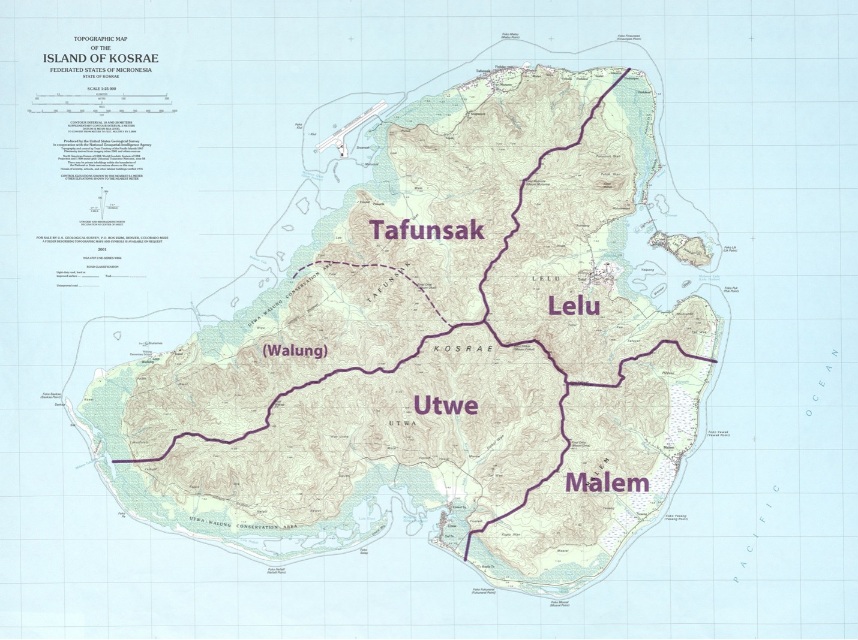 US Geological Survey map of Kosrae and its municipalities, 2001. Wikimedia Commons.
In 1979 Kosrae joined the states of Yap, Chuuk, and Pohnpei to adopt a constitution and declare independence as the Federated States of Micronesia (FSM). While COFA continued providing aid from the United States, the funds were reduced significantly, which immediately shrank the economy and reduced internal migration, with many returning to Kosrae in the 1980s and later migrating to outer islands to relieve population pressures. However, COFA also granted citizens of FSM the right to travel, live, and work in places like Guam and the United States, which incentivized migration outside of FSM. Around 15 percent of Micronesians now live in the United States and its territories. On June 25, 2004, a twenty-year renewal of COFA took effect. It is set to expire in 2023, unless it is renewed again—a prospect being heavily debated today among both Micronesians and the US government.[15] Restrictions on access to Medicare and other healthcare services for COFA residents in Hawai‘i and the US mainland have sparked criticism and accusations of discrimination.[16] Additionally, in recent decades obesity and diabetes have increased significantly on Kosrae, largely as a result of the increased availability of foods from the United States with high fat and sugar content combined with a less active lifestyle on the island. These health issues have led to increased mortality rates and a declining population.[17] A significantly restructured COFA in 2023 or perhaps a shift to a relationship with China—which has significantly increased aid and real estate development in FSM over the last three decades—may alter these trends.
The Church Arrives in Kosrae
Missionary work entered Micronesia in 1975 when the president of the Hawai‘i Honolulu Mission sent elders to Saipan, near Guam. Missionaries arrived on Pohnpei in 1976 and on Chuuk and Yap in 1977, but they would not reach Kosrae until March 26, 1985, when two Pingelapese missionaries from Pohnpei, Maderson Ramon and Ioichey Diapolos, arrived on the island. They were accompanied by Hazel Paxman and her husband, Willard Paxman, who was serving at the time as the president of the Pohnpei District. A Pohnpeian named Naomi Johnny had arrived earlier to find accommodations for the missionaries. Joseph B. Keeler, president of the Micronesia Guam Mission, dedicated the island for missionary work on Wednesday, March 27, 1985. In attendance at this meeting were Katherine Keeler, Elder and Sister Paxman, Elder Ramon, Elder Diopolos (who would be set apart as a full-time missionary at this meeting), Naomi Johnny, Roy and Helen Seveir (visiting from the Marshall Islands), and a Kosraean woman named Sepei Hein, who attended with her two-year-old child. At the close of the meeting, a man knocked at the door and identified himself as Ted Skilling, a state senator. He announced that the government did not want “any other religions” seeking to establish themselves on the island for fear of causing divisions within families.[18]
President Keeler and his missionaries already knew they would face resistance as they attempted to establish the Church on Kosrae, not only because of the overwhelming majority of Congregationalists on the island but also because Naomi had experienced some harassment while looking for lodging for the missionaries before their arrival. This antagonistic stance adopted by some islanders would be the most salient and enduring challenge to a stable Latter-day Saint presence on the island. The Church would also share in the challenges that all Kosraeans faced because of the island’s nature as a Small Island Developing State (or SIDS) and its entry as part of an independent confederation of states into COFA. The Church’s US roots would also sit close to the surface, and tensions would sometimes flare between US and local missionaries and Church leaders, particularly when the latter sensed a degree of paternalism from the former. One story from 1988 serves to illustrate the power asymmetries and the biases embedded in the island’s relationship with the United States. Kent Harmon, a senior missionary who supported mission leadership in the late 1980s, recorded the following in his journal:
Phone message from Kosrae to [Mission] President [David] Rollins: The elders have been attacked by a Kosraean native, a fellow who is on leave from the U.S. Military. He hit Elder Kendell, the new district leader, and tried to run over Elder Jameson. Fortunately, neither was hurt seriously. Unfortunately, in the eyes of the natives, the white-skin is always to be blamed in a difficulty with a brown-skin, and the police and district attorney were unwilling to take any action. When President Rollins told the (white) Assistant D.A. that he was going to press charges with the U.S. Military, the D.A. replied that the missionaries could expect retaliation if that were done. President Rollins then allowed as how the U.S. State Department would be quite interested to hear that the Kosraean authorities were not willing to assure the safety of American nationals on Kosrae. This brought quite a change of attitude on the part of the D.A., who may lose his job over this matter.[19]
The day after the dedication of Kosrae for missionary work, the elders met with the governor of Kosrae, Yosiwo George, to state their purpose for being there. The governor, who had become friends with a Latter-day Saint professor while in college, was friendly to the Church, though he acknowledged that the missionaries would face an uphill battle. After the meeting in the governor’s office, the elders began door-to-door contacting, establishing friendships with several receptive families—one of whom stated that it was “time the Mormons arrived”—and finding three members of the Church who had previously relocated to Kosrae. On March 29 the elders took an announcement regarding their presence on the island to the local radio station, which they reported was well received. The same day, however, the island’s legislature passed a resolution calling on the Church to “defer attempts to establish a church and to proselytize within the state,” citing a 1983 resolution by the First State Leadership Conference asserting that attempts to introduce new religions to the island “would be unacceptably disruptive to Kosraean society and family life.”[20] Because this was only a resolution, and not a law, mission leaders decided to ignore the request and push forward with the missionary work. Elder Ramon noted that some in Kosrae wanted to force the missionaries to leave, but Elders Ramon and Diapolos were citizens of the Federated States of Micronesia, so nothing came of that effort.[21]
The next month, Joseph C. Murphy, the editor of the Pacific Daily News, published an opinion piece that was critical of the resolution. He declared that the legislators, by their resolution, “seem to be violating everything we’ve all been taught to believe, especially the freedom of religion.”[22] On June 10 the Paxmans would meet with two state senators, including the sponsor of the March 29 resolution, Senate speaker Thurston Seba. While the meeting was not hostile, Senator Seba concluded the meeting by insisting that he would petition President Keeler to have the missionaries removed. There are no reports of anything having come from any such petition.
The first sacrament meeting on Kosrae was held at the missionaries’ apartment on March 31, 1985. In addition to the missionaries, the Paxmans, Naomi Johnny, and three children of the owner of the co-op next door attended. Sacrament meeting attendance would increase in small bursts over the next several weeks. In August of that year, Elder Ramon completed his mission and returned home; he was replaced by Elder Sean Weight. In November, Elder Diopolos was transferred to Pohnpei for the remainder of his mission, and he was replaced by Elder Mamoru Bridge, a Pingelapese man from Pohnpei whose father and grandfather had previously lived on Kosrae. In February of 1986, Kosrae’s first missionary couple, Ward and Madge Little, arrived. Upon the Littles’ arrival, Sister Little recorded, “The elders have been doing their best here but have had very little success. There is one member family. There are some investigators but no baptisms.”[23] The strong Congregationalist opposition to the Church had bred a persistent if unorganized hostility toward the Church’s representatives. The Littles hoped to begin changing the public perception of the Church, so they immediately began searching for ways to ingratiate themselves with the local community. Sister Little was proficient at playing the organ and found several opportunities to play for and even offer lessons to locals (including the governor’s wife), and Elder Little helped with a local baseball league and volunteered his time in the local high school’s woodshop.
However, before he was allowed to help in the woodshop, Elder Little had to meet with and secure the approval of a district supervisor and a Reverend Harrison. His story about the meeting reveals some of the concerns the locals had about the missionaries:
The supervisor started off the meeting by asking, suspiciously, “Why do you want to help us?”
“Because I enjoy working with wood and am good at it,” I said. “I heard that you had a good lathe but no one to operate it. I can teach you how,” I said.
At this the supervisor said, “How long are you going to be here and what are you doing here—what is your occupation?”
I replied that my wife and I were LDS missionaries and that we would be in Kosrae about four months. I explained that we were here to oversee our church and to supervise the two young elders here.
“We’ve had offers from other people who want to help in the schools, but they always want to be paid,” said the supervisor.
I assured them that I would do whatever I did without pay, just as a favor to the school, as I had done previously in Tuvalu.
The supervisor was visibly nervous—standing up and sitting down and glancing back and forth at the Reverend. I knew that the punch line was inevitable. “You know that when the community finds out that there is a Mormon helping here they will be upset!” he blurted, gesturing with his hands to indicate waves. “But we [meaning the four Kosraeans sitting there] decided that you could help the school if you do not teach Mormon doctrine in class!” He looked at the Reverend and said, “Isn’t that right?” The Reverend smirked and nodded but said nothing.
“We’ve seen these young men around the island,” he said, referring to Elder Weight and [implying] that he knew that they were teaching Mormon doctrine. “But,” he inserted, “we don’t get an opportunity like this very often.”
“I’m not about to teach any Mormon doctrine in class. I’m here strictly to help the teacher and the students,” I told them.
“We’ve seen what the Mormons have done in Polynesia, and we’d rather stay the way we are—keep to ourselves,” the supervisor remarked.
At this point in the meeting the supervisor reiterated everything that he had said before about not teaching Mormon doctrine in class and only helping the instructor and the students. “We believe in separation of church and state,” he added, with the definite [insinuation] that Mormons do not. This statement brought Elder Weight to attention. “Where I come from the church and state are much more separated than they are here, and it’s a Mormon state!” he said.
I then told them that I teach my religion by living it. “I don’t need to teach it in class,” I said.
The Reverend had not uttered a word during the whole meeting. He voiced his approval of the proceedings by a slight nod and a half-smile. It was very clear that the decision had been cut and dried in a previous meeting.[24]
The Littles also recorded several negative experiences they had while trying to secure a place to rent on the island, including a confrontation with a future president of FSM that left an impression on Sister Little (but that the missionaries could have handled better):
In the evening Dad & the elders went to find Jacob [Nena] who has a house to rent. He hid from them—his wife said he had gone to feed the pigs. They walked down to the pigpens—he was not there. They left Elder Bridge on guard at the house. He saw someone come out of the house and go to his pickup. They rushed to the pickup and cornered him. He stalled around about the house. Dad said, “Is it because we’re Mormons?” He replied that that was part of it—then he got mad and said he was late for a church meeting. He spun the wheels on his car and took off. This man is an ex-governor of Kosrae and plans to run for governor again the next election. What an example for a public official!
The Church Begins to Grow
Despite setbacks and disappointments, the missionaries carried on, and on April 26, 1986, more than a year after the missionaries’ arrival, twenty-two-year-old Isidro Abraham became the first Kosraean to be baptized. Sister Little described the event in a journal entry from the next day:
Yesterday was our big day—the first baptism on Kosrae. Isidro Abraham was baptized. He is a young man 22 yrs. of age. The baptism took place in a very secluded place in the mountainous areas where a river runs through. We had to go down a steep trail going there and climb up coming back. We crossed a small creek on two logs. Elder Weight performed the baptism. The confirmation, by Elder [Michael] Summer, was held in a little shelter with a corrugated roof and two sheets of plywood on the floor. We gave Abraham a new white shirt as a gift, and I took a cake for refreshments. We six missionaries and Bedwin Abraham’s family attended.
Abraham and the elders came back to our house, and I cooked a baptismal dinner for all of them—Abraham’s first American-style food.[25]
Two weeks later, on Saturday, May 10, two more Kosraeans, Irwin and Alsiter Elley, were baptized in Utwe. Sister Little noted that there were several onlookers at the ceremony, in part because as she was walking to the baptism, Naomi Johnny called to men on the side of the road and invited the men to join them, adding, “You might learn something!” Three more baptisms took place in June. Whether on Pohnpei or Kosrae, Naomi remained a constant missionary force for the Church and would later serve as district Relief Society president. Her exemplary role as a member missionary shines through in two conversion stories told to Sister Marjorie Elsby in 1991. The first is about the conversion of Elisha Philip and Rose Kurr:
One day while working on the boat Mutunlik, which travels between Pohnpei and Kosrae, Elisha Philip Kurr was given a Book of Mormon by a friend of his, Naomi Johnny. When he quit being a sailor and stayed at home in Kosrae, he often saw the Mormon elders passing by. One day he talked to them, and arrangements were made for him to be taught. His wife, Rose, didn’t want anything to do with them, but as she listened in on the discussion she became interested. The story of Joseph Smith’s First Vision she did not believe, because it wasn’t in the Bible, but then she prayed about it and had her own personal witness that it was true.
Elisha and Rose were baptized in a river in Lafensak in 1986 by Elders [Mark] Scovel and Bridge. The couple and the missionaries had two vans that transported the members from Utwe and Malem to the Lelu Chapel. When the vans were disposed of, three branches were organized and Brother Kurr was called as Malem’s Branch President, and the meetings were held in his home, until a missionary couple moved to Malem. The meetings were moved to the couple’s home. Rose was a Primary teacher at Lelu, and President [Elisha] Kurr was counselor to the first branch president on Kosrae, Justin Aloka.[26]
The next conversion story is that of Lelida Charley:
In 1987 I stayed on Pohnpei with a family, and I went to the Mormon Church with Naomi Johnny. I’m really sorry that I forget the names of the elders teaching me there.
I came home to Kosrae and went to church in the elders’ apartment on Lelu Island. They taught me all about the story of Joseph Smith and Oliver Cowdery and about the Holy Ghost and baptism. They taught me to repent of all things bad and to change and become a Christian.
I was really happy that I became a Christian, and we went together to the church in Lelu. I was baptized February 7, 1988, by Elisha Philip Kurr, who is my branch president now. I became a Primary teacher along with Rose Kurr and Sepe Lowary. I am teaching Primary again in Malem. I know some stories about the Book of Mormon.[27]
Organizing the Church in Kosrae
The Lelu Branch was organized on June 18, 1986, and two years later, the district president received authorization from the Area Presidency to organize two new units on the islands at Malem (just south of Lelu) and Utwe (in the south). Elder Harmon told of meeting with the future Utwe branch president (and future district president) while on the island of Pohnpei:
I meet with Charley Jim, a grandfather type from Kosrae, to ask him about his plans. He will finish his Pohnpei construction job in mid-July and return to Kosrae and has no plans to leave again. I tell him of our intention to organize a branch centered around his family in the village of Utwe on Kosrae, call him as branch president, and set him apart. A little unorthodox, since the branch isn’t organized yet and he hasn’t been sustained by anyone except the mission president. But this is an unorthodox area of the world, and sometimes you just do what needs doing.
I also tell Brother Jim about our plans to build a meeting house in the village of Malem on Kosrae and ask if he will be willing to serve as contractor for the job. He would be happy to and assures me that he can find the help he needs for the temporary building we plan to erect.[28]
Elder Harmon then traveled to Kosrae, where he secured the use of Brother Kurr’s home for sacrament meetings until the meetinghouse could be built. Brother Kurr suggested that it would be premature to begin such a construction project because only four members and one regular investigator would be attending sacrament meetings. This concern would become moot, however, because disputes over land ownership stalled these construction projects for some time. In the meantime, Charley Jim added a large porch to his house in Utwe to accommodate the members attending sacrament meeting there.
A priority for the Church in Micronesia was calling local members to unit leadership positions as quickly as possible, but this was often much easier said than done. Senior missionaries from the United States filled or supported the earliest leadership roles, and they were rarely equipped to navigate the disputes and other problems that could arise in a culture far more attuned to honor, shame, and collectivism than that of the United States. Kosrae had the additional challenge of the overwhelming presence of a Christian denomination whose clergy received not only a great deal more deference than the lay clergy of The Church of Jesus Christ of Latter-day Saints but also a paycheck. Expectations had to be tempered for new leadership, which was frequently made up of new converts. In 1991 eight of the ten leadership positions across the three branches were filled by converts of less than a year, with two having been baptized a week before being called. In the early days of the Church on Kosrae, leadership changed frequently, and mission leadership was constantly addressing challenges that arose as a result.
 The Lelu Chapel as of 2015. Courtesy of Jeanette Hurst.
The Kosrae Micronesia District was organized on March 14, 1990, with Charley Jim called as the district president. The district had units in Malem, Utwe, and Lelu and a total membership of sixty-four. By this time, leadership reported a significant change in the public perception of the Church and noted that, just a few days after the district was organized, the vice president of the Women’s Christian Association in Lelu dropped off a large selection of fruits as a friendly gesture. There were also seventeen convert baptisms recorded in 1990, which represented a 70 percent increase over the number of baptisms in 1989. Missionary couples were indispensable to early attempts at public relations. Walter and Marjorie Elsby, who served on the island in the early 1990s, increased the visibility of the missionaries and implemented the practice of warmly greeting everyone they saw, which managed to facilitate an increased degree of tolerance for some time.[29] This increased tolerance allowed for the first assignment of full-time sister missionaries to the island, Sisters Andrea Torgeson and Myrna Finau, in February of 1992. Unfortunately, among other challenges, the sisters had to repeatedly chase off intruders who broke into their home located on the Utwe chapel’s property. They spent several nights with the senior missionaries because of these break-ins. As with other cases of breaking and entering and of theft from the chapels and the missionaries’ homes, the district attorney refused to prosecute Kosraeans, even after they had secured confessions from the guilty parties (who were sometimes the sons of local officials).
Mission president Michael Dowdle described missionary and member progress in Kosrae:
September 14, 2009. The senior couple in Kosrae, the Footes, have been hard at work this past transfer, as usual. They are bundles of endless energy and ideas. Elder Foote has been working tirelessly with the prospective elders to ready more brethren for the Melchizedek Priesthood. In the August district conference there, five brethren were ordained. It was a wonderful thing to see. He hopes to double that this next conference. He is working actively with the branch presidents to see it come about. He is also a tireless scouter and has worked hard to establish a boy scout troop and varsity team since January. They have already had several camps, including a summer camp. Sister Foote is working with the Young Women and also with the youth to teach them the piano. They arranged for the delivery of fifteen keyboards by a major electric piano company, as a humanitarian effort, and there are now many young people in Kosrae learning to play the piano. This goes along with the schools there teaching young people to play the guitar and ukulele. Kosrae is a very musical place. We love Kosrae and its beautiful people. Missionary work there has taken a surge forward this past year. We will likely have between twenty and twenty-five baptisms there this year, up from six in 2007 and nine last year. Things are going well there, and the young missionaries and the Footes are proving that missionary work can succeed in Kosrae, with the Lord’s help. . . .
January 11, 2010. On the morning of the 11th, we flew to Kosrae for zone conference, arriving midafternoon. We held zone conference at the Footes’ home, taking a break halfway through for dinner. It was a great conference. The work in Kosrae is going very well, and the missionaries are excited to be so busy and engaged. They have set a baptismal goal of twenty-five! In Kosrae! They have standards of excellence that, if they meet them, will get the zone to its lofty goal. Don’t get me wrong, I truly believe that this zone, with these missionaries, can make miracles happen here—and twenty-five baptisms will be exactly that. For an island that has rarely, if ever, seen more than ten baptisms in its best years, Kosrae is seeing miracles.[30]
President Dowdle later described missionary work and progress toward translating the scriptures into Kosraean:
We arrived in Kosrae late in the afternoon of June 12th and went to the Nautilus Resort to check in to our rooms. With the farewell at the Pohnpei airport, it had been an exhausting day, and we knew that Kosrae would be no less so. On Monday morning, the 13th, after a delicious breakfast of banana pancakes, we held our last zone conference in Kosrae zone. We again taught the fourth missionary lesson and spent a thoroughly enjoyable morning with our missionaries. There are six young elders here now, along with our senior couple, the Wrights, because we have opened the area of Mallum, where Sasaki and Jessamyn George live, as a new proselyting area. It is good to see the work progressing here now. It won’t be long before the Book of Mormon translation is completed. It is in the final review stage, and printing will be next. The missionaries and members are very excited about it.[31]
English and Kosraean in the Church
The use of English as a second official language on Kosrae has presented its own challenges to the Church. In the early decades of the Church’s presence there, missionaries taught primarily in English because most Kosraeans spoke English to some degree. The senior missionaries who filled leadership roles were able to operate only in English. As a result, it was difficult for full-time missionaries to pick up the native language, and the Church’s nature as a foreign institution was always salient. Missionaries from elsewhere in Micronesia sometimes had an easier time, but friction could develop within missionary companionships if one could communicate with locals in Kosraean while the other was left unaware of what was being said. This language disparity could also exacerbate biases and cultural tensions that frequently arose between missionaries from the Pacific and those from the United States. The administration of the Church in English also required the members to read or hear the ordinances and the scriptures in the English language, with widely varying degrees of comprehension. Members who were given leadership positions and other callings also had to interact with a variety of documents written in English that were not always easy to understand, which made the leader-support role of senior missionaries that much more necessary in the 1980s and 1990s.
The Book of Mormon would not be translated into Kosraean until well into the twenty-first century, and the Church did not designate a preferred translation of the Bible in Kosraean until the former project was approved. As a result, members have long used the King James Version, which is difficult enough for native speakers of English to understand. Members would roughly translate from the King James Version on the spot if they wanted to quote the Bible in Kosraean in meetings or talks. In 1997 the Church gave conditionally approved status to the Baibel Mutal ke Kas Kusaie, a 1928 Bible translation by Congregationalist missionary Elizabeth Baldwin. The Church recommended and sourced that translation for the Kosraean-speaking membership, and it was quoted in translations of Church materials. Yet the conditional status meant that the translation did not meet the First Presidency’s standards for doctrinal accuracy, literalness, and style. Within a decade that translation was out of print. In 2010 a 2006 edition of the Bible in Kosraean called the Bible Mutal (published by the Bible Society of Micronesia) was given the same conditional approval.
The membership’s early overreliance on the King James Version has led to the belief held by many Kosraean members of the Church—indeed, by many members all over the world—that their translation of the Bible is “the King James Version in our language.” While there are some languages (primarily minority, pidgin, and creole languages) that translate directly from the King James Version, it is more common for such translations from English to be based on the New International Version or the Good News translation of the Bible. Most non-English translations of the Bible that the Church designates as preferred are translations from the ancient source texts, and because they are most commonly the products of evangelical Bible translation organizations, they also tend to align with the translation choices of the New International Version or the Good News translation.[32]
 Lance Mongkeya portraying the appearance of Jesus Christ in the Americas during a Book of Mormon performance at the Book of Mormon celebration. Courtesy of Jeanette Hurst.
In 2009 the First Presidency and Quorum of the Twelve approved requests to begin translating the Book of Mormon into Kosraean and Chuukese (a language spoken in another FSM state). At the time, there were around three hundred Kosraean-speaking members of the Church. Over the course of the project, the contributors to the translation changed as a result of illness and fluctuating employment and family situations, but the team that carried the project over the finish line was made up of MaryRuth Forsberg (who was living in Idaho at the time), Randolph Jonathan, and Jordan Betteridge, a United States citizen who had learned Kosraean during a full-time mission in the Micronesia Guam Mission and had helped with translation and interpretation for general conference.[33] Several members of the Church in Kosrae were called and set apart as “ecclesiastical reviewers” with responsibility to assess the translation’s doctrinal accuracy and linguistic acceptability. The members who oversaw the final ecclesiastical review were Elkena Auro Hadley, Yulsin Philip, and Molton Mongkeya. The final ecclesiastical review meeting with representatives from Church headquarters took place in Kosrae on May 30–31, 2014. In July 2015, copies of the newly published Puk Luhn Mormon—the 110th translation of the Book of Mormon—began to be distributed on the island during a cultural celebration organized between the local government and the Micronesia Guam Mission. Elder Grant and Sister Jeanette Hurst were assigned to Kosrae for several months to oversee preparations for the celebration, which included a large feast, scenes acted out from the Book of Mormon and from Church history, and a number of donations to local Kosraean institutions.[34] While the better educated members on Kosrae largely prefer to read the Book of Mormon in English, the Kosraean translation is widely viewed as a good one, and it facilitates much easier access to the scriptures for the older generation and for less educated members of the Church.
The Church and Kosrae Today
Despite its difficult beginnings on Kosrae, the Church has made significant headway since the 1980s and 1990s, in large part thanks to its humanitarian efforts, which are frequently vital to a Small Island Developing State. To recognize these efforts, on November 12, 2003, the Kosrae state legislature passed a resolution thanking the Church for its humanitarian aid to the island. In addition to countless hours of volunteer time by missionaries and the Church’s Mormon Helping Hands program, the Church had donated multiple forty-foot containers of hospital and school supplies, twenty-five sewing machines for the Girl Scouts, computers for Kosrae High School and the local radio station, volunteer dental services, and vision training for hospital staff.[35] On a number of occasions, the Church has also donated wheelchairs and books for local libraries, and it is engaged in a number of training programs related to education, health, self-reliance, and gardening. As part of a program started in 2018, the Church has partnered with the Lelu Farmers Association to help build greenhouses for home gardens, which are frequently overrun with rainwater and crabs. The Church also donated an excavator to the association to help with the extraction of topsoil. As with so many Church initiatives on Kosrae, this endeavor was supported by the work of senior missionaries.
 Kosrae District president Elkena Hadley turning over excavator key to Robert Sigrah. Courtesy of Intellectual Reserve, Inc.
In 2016 Kosrae made international news when the Malem Municipal Council proposed an ordinance banning religious practices “not based on Christianity,” including the gathering of two or more non-Christian people to worship.[36] The primary target of the proposed ordinance was Islam, which arrived in the state with the establishment of an Ahmadiyya Muslim Community in 2011. In 2014 a petition to ban Islam from the state had received almost one thousand signatures. While Kosrae’s own state constitution does not guarantee religious freedom, the constitution of the Federated States of Micronesia does include that guarantee, and the FSM Department of Justice warned the council that any such ordinance would violate the federation’s constitution and could result in criminal charges. As a result, the ordinance did not pass. Muslims on the island continued to face persecution, however, as they were denied service by stores and taxis, had their buildings vandalized, and were occasionally targets of physical assault and death threats. In 2017 the Ahmadiyya Muslim Community organized a peace conference, which drew speakers from the local community—including representatives from The Church of Jesus Christ of Latter-day Saints—as well as support and speakers from Pohnpei, Majuro (Marshall Islands), and Tarawa (Kiribati).[37] In October 2019 David W. Panuelo, president of the Federated States of Micronesia, visited Church headquarters in Salt Lake City and met with the First Presidency and Elder Gerrit W. Gong of the Quorum of the Twelve. President Panuelo expressed his appreciation for the work the Church has done in Micronesia (highlighting Kosrae’s greenhouse project) and emphasized the state’s commitment to religious freedom and to loving and understanding other people.[38]
The Church’s dedication to service and acceptance will continue to be tested as Kosrae and the other islands in the Micronesia region face future challenges. Climate change will be one of the most significant of these challenges. Rising sea levels are already threatening many of the lower-lying islands of Kiribati. On Kosrae, the largest threat is coastal erosion, which in combination with the El Niño/
Conclusion
The Church has been operative in the state of Kosrae for only thirty-six years, but it has exercised an outsized influence on the island’s people and institutions. From humble and unsure beginnings, the Church has set down roots on the island and has been a constant force for good in a variety of ways. However, the Church and its members still face many struggles there. For instance, today only the Lelu and Utwe Branches are operative. Some individuals and families who were prominent members have left the island for Guam, Hawai‘i, or elsewhere in the United States. Many of the struggles faced by the Church are the product of Kosrae’s colonial history and nature as a Small Island Developing State. Closely related are the challenges presented by the perceptions of the Church as a US institution and a denomination that occupies the periphery of mainstream Christianity. No doubt these challenges will remain for the foreseeable future, but as members continue to share the gospel, as Kosraeans begin to attend the newly constructed Yigo Guam Temple with unprecedented accessibility and to serve missions in Micronesia and elsewhere, and as the Church invests time, attention, and resources that benefit the members and the island at large, the Church’s position and its capacity to face those challenges will continue to improve.
Notes
[1] The viewpoints in this chapter are my own and should in no way be understood to reflect the viewpoints of my employer. I have taken the liberty of standardizing spelling (particularly the spelling of names) and correcting critical grammatical errors in the quotations shared in this paper.
[2] A discussion of the island’s archaeology is found in Rainbird, Archaeology of Micronesia, 200–223.
[3] Richards et al., “New Precise Dates,” 1–5. On population dynamics, see Athens, “Prehistoric Population Growth,” 257–77.
[4] Athens, “Kosrae Pottery,” 182; Intoh, “Human Dispersals,” 25; Lynch, Ross, and Crowley, Oceanic Languages, 117–19.
[5] On this comparison and social structure, see Cordy, “Built Environment.”
[6] Cordy, “Respect Behaviour on Kosrae,” 96–108.
[7] Ritter and Ritter, European Discovery of Kosrae Island, 1.
[8] For a history of this Christian mission to Kosrae, see Buck, Island of Angels, 34–43. The Snows would remain on the island except for a return trip home from 1868 to 1871 and another that began in 1877 and ended with Rev. Snow’s death in Brewer, Maine, on March 15, 1880. Lydia went back to Kosrae but was forced to return to the United States in 1882 and died on May 18, 1887, in Auburndale, Massachusetts.
[9] Poyer, Falgout, and Carucci, Typhoon of War, 23.
[10] For information on the role of prominent members of The Church of Jesus Christ of Latter-day Saints in this trust, see Jensen, “Micronesia’s Coming of Age,” 43–62.
[11] On this period, see McHenry, Micronesia; Peoples, Island in Trust.
[12] See Naylor et al., “Migration, Markets, and Mangrove Resources.”
[13] The federation’s only real internal source of revenue is the deep-sea tuna fishing rights it has long leased to China, but the income generated by those leases represents only about one-tenth of what FSM imports.
[14] Gorenflo, “Demographic Change in Kosrae State.”
[15] Gaynor Dumat-ol Daleno, “FSM Resolution Proposes to End Compact Agreement with U.S.,” Pacific Daily News, December 4, 2015. In 2015, FSM’s congress introduced (but did not pass) a resolution calling for an early termination of COFA.
[16] On such failures of COFA, see Diaz, “Compact of Free Association.”
[17] See, for instance, Cassels, “Overweight in the Pacific”; Murdock et al., “Longitudinal Study Shows Increasing Obesity.”
[18] This early history of the Church on Kosrae is taken from the journals of Elder and Sister Paxman and Sister Little.
[19] Kent Midgley Harmon Journal, Church History Library, Salt Lake City, Utah, 56 (hereafter CHL).
[20] “New Church Unwelcome,” National Union, April 15, 1985, 7.
[21] Maderson Ramon, interview, CHL.
[22] Joseph C. Murphy, “Take Another Look,” Pacific Daily News, April 20, 1985, 26.
[23] Madge P. Little Journal, CHL, 73.
[24] Little, “Encounter with the Kosrae Schools,” CHL, 1–2.
[25] Madge P. Little Journal, CHL, 97–98.
[26] Elsby, “Testimony of Elisha Philip Kurr and Rose Kurr,” CHL, 3, 7.
[27] Charley, “Testimony of Lelida Charley,” CHL, 3, 8.
[28] Kent Midgley Harmon Journal, CHL, 54.
[29] Burton, Missionaries Two, 107–8.
[30] Michael Dowdle, unpublished mission journal, 2021, entries for September 14, 2009, and January 11, 2010; in author’s possession.
[31] Dowdle, mission journal, June 12–13, 2011.
[32] While it is often true that an individual can best comprehend the scriptures in their native language, or their “heart language,” this is not universally true. In situations in which a language of wider communication (an LWC) has a much longer and richer literary history than one’s own native language (this is more common than you may think), reading comprehension can be higher for that LWC. See Nehrbass, “Do Multilingual Speakers Understand.”
[33] A scripture translation team is also responsible for content review—that is, ensuring that the translator has correctly understood the English source text. Native speakers of English are well suited for that role, even if they do not speak the target language with native ability.
[34] For more photographs of the celebration and its preparation, see http://
[35] “Kosrae Legislature Honors Church,” Deseret News, November 15, 2003.
[36] Bill Jaynes, “Kosrae’s Malem Municipal Council Introduces Ordinance to Ban Religious Freedom within Its Borders,” Kaselehlie Press, February 15, 2016.
[37] “Muslims Held First Annual Conference of Peace in Kosrae,” Kaselehlie Press, March 20, 2017.
[38] Richard Clark, “President Panuelo Meets the First Presidency of The Church of Jesus Christ of Latter-Day Saints; Emphasizes the Importance of the Freedom of Religion” (press release, October 11, 2019).
[39] Monnereau and Abraham, Loss and Damage from Coastal Erosion in Kosrae, 6–7.
[40] Nurse and Moore, “Adaptation to Global Climate Change,” 100–103.
