
 menu icon in the top, right corner of the screen.
 icon above to close this box.
 icon at the bottom of the screen below the browser—if you don't see it, swipe up to unhide it.
The Church in Chuuk
R. Devan Jensen, Rosalind Meno Ram, and Herryann Anepo Hinton
R. Devan Jensen, Rosalind Meno Ram, and Herryann Anepo Hinton, "The Church in Chuuk," in Battlefields to Temple Grounds: Latter-Day Saints in Guam and Micronesia, ed. R. Devan Jensen and Rosalind Meno Ram (Provo, UT: Religious Studies Center, Brigham Young University; Salt Lake City: Deseret Book), 149–64.
 Weno Island. Photograph by Motoki Kurabayashi.
For a decade leading up to World War II, Japan built and developed a naval base in Chuuk (Truk) that rivaled Pearl Harbor. More than 37,000 Japanese dominated 9,000 Chuukese, the latter being conscripted to build five airstrips and seaplane bases.[1] “Under Japanese military control,” wrote historian Lin Poyer, “Micronesians were subjected to harsh discipline, forced labor, relocation, and the confiscation of farm products. Some men were drafted into the military and took part in the fighting. Other men, women, and children worked on military construction and picked up the load of extra labor to provide food, clothing, and shelter for themselves and the Japanese soldiers and civilians living with them. Micronesians also suffered the danger and destruction of Allied military attack, and the material shortages and psychological pressures of the war years.”[2] The authors of The Typhoon of War wrote, “The war forced a rethinking of cultural values. . . . World War II in Micronesia meant, in short, both terrible suffering and momentous change. Nothing would ever be the same again.”[3] Such national trauma led to generational cultural challenges that continue to the present.
After the Pacific War, the United Nations recognized the need to rebuild Micronesia’s infrastructure, and in 1947 they formed a strategic trusteeship called the Trust Territory of the Pacific Islands. When the Congress of Micronesia met in the summer of 1970, Hans Williander, a political leader from the village of Nechocho on the island of Tol, proposed full independence from the United States.[4] His leadership led to creation of the Federated States of Micronesia in 1979.
 At the Congress of Micronesia meeting in the summer of 1970, Hans Williander from the island of Tol recommended independence from the United States. Trust Territory Photo Archives, Pacific Collection, University of Hawai‘i–Manoa Library.
In the mid-1980s, Hans and his wife, Sechia, befriended Latter-day Saint missionaries in Nechocho, allowing them to stay in their home while missionary quarters were being constructed. Hans had a personal library in his home with books on all different subjects, as well as an international certificate of training leadership from Harvard displayed on his wall. He joined the Church and became a dynamic speaker and leader, inviting all his friends to listen to the missionaries. Elder Chad Ellis says they “taught from sunup to sundown for the whole eleven months I was there (building our house in whatever spare time we had—with help also on the building from missionaries from nearby islands).” The missionaries quickly baptized around a hundred members and formed a branch in Nechocho. Hans became a district president, helped complete the translation of the Book of Mormon, and went to Salt Lake City in 1994 to translate the temple ceremony into Chuukese.[5] The future looked promising.
Soon thereafter, however, Hans Williander obeyed the dying wishes of his father and returned to the Protestant church. Many members followed him, leading to disruption of the branches in Tol and throughout Chuuk. His story reflects obedience to family and cultural pressures to return to the dominant churches in the area. Like the tides in Chuuk’s famous lagoon, members and leaders have risen, fallen, and risen again. This chapter focuses on the history of the Church in Chuuk beginning in 1976: early missionaries, indigenous converts and leaders, formation of a district, and ongoing cultural challenges with alcoholism, crime, and corruption. It also discusses Chuuk’s bright prospects, including youth programs.
Chuukese Geography and Culture
Chuuk consists of sixteen high, eroded volcanic islands. Britannica notes that “the name Chuuk means ‘high mountains’ in the Chuukese language” and that the Chuuk Islands “are encircled by a barrier bank composed of some 85 sand and coral islets. The bank (often referred to as a reef) encloses a lagoon 822 square miles (2,129 square km) in area and has a diameter of some 40 miles (65 km).”[6] Three of Chuuk’s five island groups (Faichuk, Northern Namoneas, and Southern Namoneas) are located in Chuuk Lagoon. The other two (Mortlocks and Oksoritod) are in the outer islands. The larger islands include Weno (formerly known as Moen), Tonoas, Fefan, Uman, Udot, and Tol.
Along with many other islands in the Micronesian group, Chuuk mingles many aspects of indigenous culture with colonial and Christian influences. In terms of religion, about 60 percent of the population is Catholic and 40 percent is Protestant.[7]
Church History in Chuuk
The year 1976 was a dynamic time to discuss freedom in Micronesia. Tuvalu and the Marshall Islands were both seeking independence from Great Britain. The Chuukese, Pohnpeians, Kosraeans, and Yapese were actively seeking greater freedom from US oversight.[8] During that year of political debate about Micronesian independence, Elder John H. Groberg of the Seventy arrived in Honolulu on July 28 as an Area Supervisor for the Hawaii–Pacific Isles Area. He requested a meeting with William W. Cannon, president of the Hawaii Honolulu Mission, to establish local branches throughout Micronesia.[9]
On August 24, 1976, Elder Groberg and President Cannon met to decide where to send missionaries first. Nearly a year later, on July 7, 1977, President Cannon sent Donald Baldwin and Torlik Tima (who was Marshallese) to serve in Ebeye in the Marshall Islands. En route to Ebeye, the missionaries stopped at Chuuk. When they arrived at the airport in Chuuk, the foreign minister politely denied them entry, but they obtained permission to stay. They had only twelve dollars in their possession, which they spent on a hotel. After their time at the hotel ran out, they had nowhere to go. As it rained, they knelt beneath a breadfruit tree, fasting and praying for a place to stay. After receiving a feeling of reassurance, they walked up a hill and a woman beckoned to them. She happened to speak Marshallese. It turned out that she was Elder Tima’s aunt, whom he hadn’t seen since childhood. She had dreamed that she needed to wait on that hill for two men in white shirts who needed help. Elder Tima’s aunt housed and fed the missionaries. After Elders Baldwin and Tima continued onward to Ebeye, Elders Kenway Kua and Dennis Comber took their place in Chuuk.
T. M. Mailo, First Convert and First Local Branch President
 T. M. Mailo family. Courtesy of Mark H. Butler.
On October 22, 1977, T. M. Conrad Mailo and his wife, Nisor Cerly David, became the first Chuukese converts. Mailo described his conversion in a newsletter written in 1982:
In July of 1977, the true gospel first came to my island of Moen, Truk. Within three months, the gospel was brought to me by two missionaries, Elder Dennis Comber of Colorado and Elder Kenway Kua from Hawaii. . . .
 Early missionaries Kenway Kua and Dennis Comber, 1977. Courtesy of Mark H. Butler.
My life has really changed. It’s not like it used to be. Before I heard the gospel I was a wicked person. I was in prison twice. I’ve been arrested many times for drunkenness and bad behavior. I stole and did all kinds of bad things. But because I have the gospel and the true Church of Jesus Christ, I have changed. . . .
I was the first from Truk State to be baptized, along with my wife, Nisor. Now, I am the Moen Branch president. We have around sixty members in the branch. There is also a second branch in Sapuk at the other end of the island.[10]
Early Convert and First Local Missionary in Chuuk
The next convert was T. M. Mailo’s cousin Happyness Ichin. Happyness described the process of gathering and finding places to worship as the number of converts grew:
We started organizing a group, according to procedure to become a branch. But before that we had our meeting house especially under the trees, coconut trees, you know. We made [a roof with] some coconut leaves. And we made a wall and we started having a meeting. And then when we become more people, we asked the government to use their building, . . . a school building. [Then they] had [us move] a few days later. So we move from place to place when we try to have our church meeting, because people start say, “Hey, how come you accepting that false church? You know, don’t let the church come here and using our building. Let them go and look for worse place to have there.” So we moved to place to place. From different village to different village or different place to different place. Finally, when we moved to a school, now they call it Mizpah High School. It belonged to the Protestant Church. We asked to use the building. At that time we start using that building, and later on they moved us [out] from that building.
 Happyness Ichin and Esencia (Esen) Ichin.
Yeah, we asked a lady [who] became a member of the Church [to meet at her home because] there [was] no place to [meet]. . . . We asked if she can let us use her tin house. When we have rain . . . during our meeting, the house was leaking during our sacrament meeting because the house was very old, you know. The roof was rusty—too many holes. When it was raining, we just squished into each other [laughs] when we had our sacrament service. . . .
And then finally we have a church building. We fasted and prayed, and they announced, “There are people from Hawaii, from the Church engineer department coming to check if you can help them to find your place for the chapel.” We were very happy during that time, “Okay! Okay!”
When we became a district, we had an attorney; he [worked in] the government. He joined the Church. His name is Fujita Peter. When we started teaching [him] about the Church, he was really hating us. He was really saying things like, “Hey, you guys move! Don’t come to my house!” Because at that time, that guy was a preacher, he was a priest in the Protestant Church, and he was an attorney. Yeah, and it turned out he joined the Church.[11]
Happyness became the first Chuukese missionary to serve in Chuuk, and he taught in Weno, Uman, and Tonoas. He reported on the success of seminary and sports teams in attracting converts: “During that time of the Church growing [in Chuuk], we started having seminary, a youth program. Another thing about the youth program was we had our first program, Utah basketball and volleyball, because the missionaries are really interested in doing those. That’s another thing that brought members to the Church or brought people to join the Church, when we started our Church team in volleyball and basketball and we joined a tournament.”[12]
Early Branches and a District
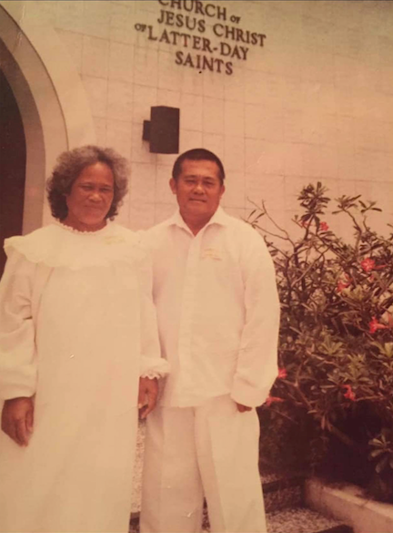 Fumie and Masaru Matisima at the Manila Philippines Temple. Courtesy of Mymai Matisima.
Membership in Chuuk reached 170 in 1980. After organizing the Moen Branch, mission leaders organized branches in Sapuk (1981), Uman (1983), and Romanum (1984). In 1985 the Church created the Namoneas Chuuk District and went on to form branches in Tonowas (1985), Nechocho (1986), and Paata (1986). Masaru Matisima was called to serve as president of the Chuuk Namoneas District. Following is a story about President Matisima, shared by Marlo Lopez, a Seminaries and Institutes country director in Guam:
I was traveling with President Masaru Matisima, the district president of the Chuuk Namoneas District in Micronesia, to visit a seminary class. He normally accompanied me in all my travels in his district. A seventeen-year-old young man, a seminary student, was our regular boat driver. We were traveling from the main island of Moen to an island called Uman to visit this seminary class. On a clear day, the journey only took twenty minutes, and you could always see the island of Uman from the small port of Moen. However, on this particular day, as we traveled between the two islands, we were overcome by a dark cloud that poured heavy rain on us, limiting our visibility. Having lost sight of Uman, our young boat driver became disoriented. The uncertainty made me scared and extremely worried. Minutes felt like hours as each member of the boat remained silent. I prayed in my heart for our safety and deliverance.
Suddenly, President Matisima stood up, spread his arms, and closed his eyes. After a few seconds, he opened his eyes and told our boat driver which direction to take. As we began moving in that direction, the dark clouds slowly began to lessen and disperse. Light began to grow, and at last we came out of those dark clouds and saw Uman in the distance. I asked President Matisima how he knew what direction to take. He told me that when he stood up, he felt the wind and knew that its direction was towards Uman.
That day, I learned that President Matisima was a true seafarer. Through his own preparation and experience, he knew the wind and the waters. After that experience, every time I traveled with him, I felt secure. I trusted him as a leader and as my friend. I knew I would always be safe with him as I followed his direction. [13]
By 1988 Chuuk had twelve hundred members, and Hans Williander and Fujita Peter had translated selected passages of the Book of Mormon into Chuukese. Missionaries said that having the scriptures in Chuukese significantly helped them to explain the message of the Restoration.
Tasiana Walter Wolbert
 Tasiana Walter and Rendi Wolbert. Photograph by R. Devan Jensen.
Tasiana Walter Wolbert, from the village of Mwan in Weno, was an early convert. She became one of the first full-time sister missionaries in the Micronesia Guam Mission, serving in Pohnpei from 1987 to 1988. A couple years after Tasiana’s return, Michaelene P. Grassli, Primary General President, and Virginia Hinckley Pearce, Primary general board member, visited Chuuk, Pohnpei, Kosrae, and Kawajalein in June 1991. They provided inspirational training sessions and learned about the strengths and challenges of local members.
Tasiana married Rendi Wolbert, and they had twelve children. In an interview for the Liahona magazine, Tasiana’s daughter Rentalyn said, “I show my love for my friends by dancing with them, singing with them, and inviting them to church. . . . My friends and I like to sing together. My favorite songs are ‘Kindness Begins with Me,’ ‘I Am a Child of God,’ and ‘I Love to See the Temple.’ I love my family, and I want to go to the temple to be sealed with them.”[14]
Tasiana’s brother Hermen Walter served for seventeen years as the president of the Chuuk District. In an interview, Tasiana said of her brother, “He’s the one that made me strong in this Church, because he’s always a good example. And he really loves his sisters, all the sisters. Whenever we have troubles in our family, he never done anything bad to his sisters. He always prays for us to go have our sealing together in the temple.”[15]
Tarsi Wainis
 Mary Jane and Tarsi Wainis. Photograph by R. Devan Jensen.
Replacing Hermen Walter as district president of Chuuk was Tarsi Wainis. President Wainis shared his family’s conversion story:
I have ten kids. I converted to The Church of Jesus Christ of Latter-day Saints in 2002. My wife and my family, we started investigating the Church in 2000. Two years after I was baptized in the Church, I became the branch president in the Mwan Branch when we still had the other chapel in the other place [Mechitiw]. After that, about four to five years later I learned that I was going to be the district president. So in 2006 I was called to be a district president. And I have been serving as a district president since that year.[16]
The Wainises are both solid and committed Chuukese leaders.
Challenges in Chuuk
As mentioned, Hans Williander’s decision to return to the Protestant church influenced many Chuukese members to follow him. The Church building in Nechocho was left empty, and missionaries were initially restricted from visiting the village until later missionaries restored friendly relations with the chief.[17]
Mission president Gary L. Marshall reported on conditions in Tol during his visit in 2007:
President Walter, who drives the Church missionary boat, met us there with Esmate and Charnes. . . . [We] went out to Tol, one of the islands in the lagoon that has a Church building that is not being used. It took us about forty-five more minutes to get there. The lagoon was really rough, and part of the way it was raining. The boat has a cab which kept the rain off. When we got to Tol we had to anchor the boat about two hundred yards from the shore. Charnes had to hold on to a rope connected to the boat all the time we were on shore. We had to wade in thigh-high water to get to the shore. We walked along a path to get to the church. Sister Williander’s house is on the way, and we met her. She is the only member in the village who still believes in the Church. Her brother was a district president at one time who had been to the temple and actually translated the temple ceremony into Chuukese. He left the Church, and the Church just fell apart there. The Church building, which is one of the biggest in Chuuk, had graffiti written all over it. The facilities management people go out and cut the grass and try to keep it painted, but the people just put graffiti back as soon as they finish. It was a beautiful, quiet place but also a sad place.[18]
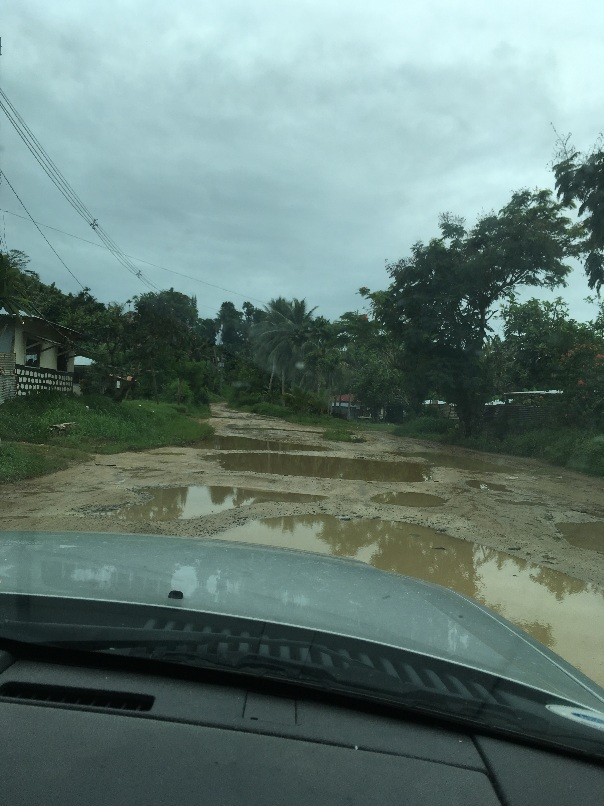
 Chuuk has roads with potholes and nearby garbage. Photographs by R. Devan Jensen.
Even bigger than the rise and fall of the Church in Chuuk are the political and cultural challenges in Weno in particular: alcoholism, crime, and corruption. Based on the Word of Wisdom in Doctrine and Covenants section 89, Church leaders teach members not to drink alcohol or use tobacco or harmful drugs. Negative peer pressure can be influential for members to return to behavior patterns before members were baptized.
Corruption in the government is widespread, leading to other societal problems such as mismanagement of funds. Michael Dowdle, the mission president who succeeded President Marshall, described conditions in 2008:
Driving to the chapel from the airport, we were introduced to the roads on Weno (pronounced “Wehdah”), the main island of Chuuk, and to the seemingly endless piles of trash in the jungle. Everywhere we looked, we saw piles of plastic bottles, bags, containers, and raw garbage discarded on the side of the roads. We saw abandoned, rusted-out cars everywhere. The roads, in some areas unpaved (made of dirt and crushed coral), were full of potholes and standing water. Some of the holes were big enough to swallow a car. We were shell-shocked. We also had the opportunity to go to most of the islands in the lagoon where we have missionaries, to see the missionary quarters and the chapels there. These included Romanum, Paata, Uman, Tonoas, and several areas on Weno. The living conditions of our missionaries are substandard and, in some cases, appalling. In at least one instance, in Tonoas, raw sewage seeps up through the ground when the rains are heavy (which happens quite frequently here).[19]
Willy K. Weita
 Willy K. Weita and Reiko Weita. Photograph by R. Devan Jensen.
The rise and fall and rise of the Church are evident in the story of Willy K. Weita. He and his wife, Reiko, lived in Saipan and Chuuk. They joined the Church while he was working at a restaurant called The Canteen, and he remembers being bothered by the tobacco smoke there. After moving to the village of Mechitiw, he talked about starting a branch of the Church there, and he worked very hard with the missionaries to teach other local families. In an interview, he said,
We worked together with those missionaries, we were very careful to start teaching our own families or neighbors. We had the missionaries, and we taught the gospel quite well, I think. About a year, I’m not sure, but I think we ended up with thirty members in a year or two years. We got up that many members, about eighty members. So maybe a year after, in 1997, we had a conference, and the mission president, he took my words to ask, and they told us to start a place here in Mechitiw. I told my friends, my family to watch, if they had land which was a good location so that we could call many people. . . . That’s how we got this chapel here in 1997.[20]
Willy Weita became branch president in the village of Mwan. He then ran for the office of mayor and won, but the results were contested, so he hired an attorney. He had little money, and the attorney talked him into using Church funds to pay his fees. When leaders in Guam found this out, Willy was excommunicated. This was a difficult time in his life. He expressed remorse and a desire to make restitution.[21]
President Dowdle described the circumstances of Willy Weita’s rebaptism in May 2011:
The Church used to have an active congregation on the island where Nechocho is, led by a man who was a political leader in Chuuk. He was involved in the loss of Church funds that ended up with the excommunication of Willy Weita, and soon thereafter many left the Church and took all members from this island with them. Soon thereafter, the branch there was closed, and the chapel has not been used since. With the building of the new district center in Mwan, and the renewed interest in the Church it has brought, this man has reached out to President Wainis here and expressed interest in coming back to the Church. It was sobering to see this chapel, which stood as a reminder to all of us that we have to proceed carefully when dealing with some of the people in positions of influence here. I also have received authorization from President Stevenson to interview Willy Weita and, if he is otherwise worthy, to proceed to have him rebaptized. Willy has made significant progress, within his limited financial abilities, to repay monies to the Church over the past two-plus years. He is presently unemployed with some significant health challenges but has done all that he can do to make amends for his error so long ago. President Stevenson has personally been aware of and reviewed his case and has now authorized him to be rebaptized. . . .
Immediately following the conference, we adjourned to the baptismal font to see Willy Weita rebaptized by President Wainis.[22]
All at the district meeting rejoiced to receive Willy Weita back in the fold, and he was later called to serve as president of the Mechitiw Branch, a sign of confidence in his leadership.
A New District Center in Weno
Construction began for a brand-new district center in the village of Mwan on the main island of Weno. On May 12, 2010, Elder D. Todd Christofferson and Elder Gary E. Stevenson accompanied the Dowdles to dedicate the new district center meetinghouse in Weno. This facility has a long dock that allows access to members arriving by boat.[23] President Dowdle described this stirring spiritual experience:
 Namoneas Chuuk District Center showing boat dock. Photograph by R. Devan Jensen.
As we arrived at the airport in Chuuk, Gayla and I went through the immigration checkpoint and into the customs area first. As we stood in the customs area waiting for the Stevensons and Christoffersons, we heard the members outside begin to sing “We Thank Thee, Oh God, for a Prophet.” The music wafted throughout the customs area and into the immigration checkpoint, where Elder and Sister Christofferson were just coming through. We could see the look of surprise and delight on their faces. The music truly was heavenly. If you ever want to know what an angelic choir sounds like, come to Chuuk and attend a district conference or other special occasion. They pull out all the stops—and they certainly did for this visit. As this was the first visit to Chuuk ever by an Apostle, the people greeted us in royal fashion. There were about twenty-five to thirty people there singing, many of whom had walked for some miles to be there. Some were from Sapuk, some from Mwan, and other branches represented as well. It brought tears to my eyes and warmed my heart. How I love the Chuukese members. . . .
We then went to the Blue Lagoon resort for a luncheon with Governor Westley Simina and several other local leaders, including the speaker of the house and president of the senate of Chuuk State. At the luncheon, following introductions and a fine meal, Elder Christofferson presented a donation from the Church of a desalination unit to the people of Chuuk. This unit will produce 26,500 gallons of fresh water per day from sea water and will alleviate much suffering in Chuuk during times of drought. The unit will take significant maintenance and dedication on the part of the Chuuk government to keep it operational, so the Church also included the first year of replacement parts and instruction for the water department in the use and maintenance of the unit. The unit is also to be mounted on a trailer to make it mobile and able to move around the main island to meet local needs. It includes a large diesel generator to power it. The total donation amounts to between $175,000 and $200,000. The government officials were dumbstruck at the donation, except the governor, who knew it was under consideration. We also gave each guest a double-framed portrait of the Savior, with the family proclamation for his own. Gayla had worked very hard to make the latter donation a reality, by making sure that all the elements arrived on time (which almost didn’t happen because of a shipping snafu in Japan) and then assembling all of them with the help of the staff at the Service Center. It all ended up working out very well, and the governor in his remarks made some very nice comments about the Church and expressed his desire to see the Church grow in Chuuk because of the effect that it has on home and community.
Following the luncheon, we went directly to the new Namoneas Chuuk District Center for a VIP tour and then the dedication. Ten minutes before our arrival, all electrical power on the island went out (a frequent occurrence), so we all got a genuine “Chuuk experience” as we sweated our way through the afternoon. . . .
(As a side note, the public open house for the building was held on the Saturday after we left. It also was a huge success, with music, dancing, food, and a great introduction to the programs of the Church. There was also a baptism that day, where five people entered the water, and were confirmed the next day. In all, 1,200+ people attended the open house [which had been advertised for weeks by a large banner across the front of the building], and 300+ attending the baptism! The Lord’s work is truly moving forward in Chuuk.)[24]
Prospects of a Stake, but Challenges Remain
Chuuk has bright prospects ahead. Together with missionaries, local members work hard to establish and expand local branches and districts, important steps toward wards and stakes. In 2013 demographer Matthew Martinich noted challenges before a stake can be formed:
The district remains possibly as many as 500 nominal members away from reaching the minimal qualifications to become a stake. However, with up to 40 converts baptized per month in Chuuk within some months of 2013 suggests that the district may reach the qualifications to become a stake within the next few years if accelerated growth continues and good convert retention is achieved. . . .
There are some cultural and societal conditions that pose barriers for LDS growth. Corruption in government, child abuse, and domestic violence are problematic in Chuuk.[25] These practices stand in opposition to LDS teachings.[26]
Such harmful trends in Chuukese culture may be counteracted in part by Latter-day Saint leaders, teachers, and young people. Many of the brightest crop of Chuukese youth have attended seminary and are preparing to serve as missionaries and future leaders. Tasiana Wolbert, whose story appears earlier, has taught as a seminary teacher for many years. She said in a 2016 interview, “We have fourteen seminary kids in my class, and I teach them about the Old Testament. And we learn about the gospel, like more about Jesus Christ, and we verily enjoy the scripture mastery that I give them. They like to play with the scripture mastery. They really work hard on their attendance so that they can take their certificates.”[27]
Several of Tasiana’s seminary students, including her children, were featured in the New Era in an article about keeping the Sabbath day holy. “I love the Sabbath day,” said Kidyon Emor, who began attending seminary as soon as it started on his island in 2014 and later accepted a call to serve a full-time mission. “It all centers on the Savior. When we take the sacrament, we promise to always remember Him. We commit to living the gospel and try to do better each week than we did the week before. Sunday is a day to be completely dedicated to the Lord. If you honor the Sabbath, it becomes different from all other days. It becomes sacred.”[28] Young leaders such as these are rising to take the place of the pioneering converts who went before.
Conclusion
Cultural challenges with alcohol, corruption, and crime remain challenges in Chuuk. Latter-day Saint leaders, teachers, and young people provide counterbalances to those cultural challenges because of the focus on Christlike values of faith, honesty, love, and service and the Church’s emphasis on family unity and the Word of Wisdom. Still, both positive and negative peer pressure continue to powerfully influence Chuukese members. Like the tides in the Chuuk lagoon, membership has risen and fallen and risen again. Many indigenous leaders are rock-solid and are establishing a rising generation of faithful future leaders. Inspiring stories from the many faithful members in Chuuk—particularly leaders and teachers, young adults and children—show promise that a stake is on the horizon.
Notes
[1] National Park Service, “War in Paradise: World War II Sites in Truk Lagoon, Chuuk, Federated States of Micronesia,” https://
[2] Poyer, “Micronesia Experiences of the War,” 79.
[3] Poyer, Falgout, and Carucci, Typhoon of War.
[4] Hezel, Strangers in Their Own Land, 334.
[5] Chad Ellis, “Miracle in Hawaii,” Tiffany’s Micronesia Island Adventures, June 19, 2012, http://
[6] Britannica, s.v. “Chuuk Islands,” https://
[7] U.S. Department of State, International Religious Freedom Report for 2015, s.v. “Micronesia, Federated States of,” https://
[8] Nufer, Micronesia under American Rule, 61–85. See also generally Willens and Siemer, National Security and Self-Determination.
[9] Cannon, Beachheads in Micronesia, 3.
[10] T. M. Mailo to missionaries and friends, February 1982, in the Micronesian Guam Mission’s Voice of the Elders newsletter.
[11] Happyness Ichin, interview, Church History Library, The Church of Jesus Christ of Latter-day Saints, Salt Lake City, Utah (hereafter CHL).
[12] Ichin, interview.
[13] Marlo O. Jensen, “Sharing Love with Friends,” Liahona, February 2017, 68-69.
[14] R. Devan Jensen, “Sharing Love with Friends,” Liahona, February 2017, 68–69.
[15] Tasiana Wolbert, interview, CHL.
[16] Tarsi Wainis and Mary Jane Wainis, interview, CHL.
[17] Luke Dela Cruz, email to Rosalind Meno Ram, May 28, 2022.
[18] Gary and Ramona Marshall to family, March 1, 2007, in author’s possession.
[19] Michael Dowdle, missionary journal, July 9–19, 2008.
[20] Willy K. Weita, interview, CHL.
[21] Weita, interview.
[22] Dowdle, missionary journal, May 7–9, 2011.
[23] Merrill Dimick, Myrle Dimick, and David Robertson, “Members in Chuuk Open Arms to Apostle,” Church News, June 5, 2010, https://
[24] Michael Dowdle, missionary journal, May 12–13, 2010.
[25] “2008 Human Rights Report: Federated States of Micronesia,” 2008 Country Reports on Human Rights Practices, February 25, 2009, https://
[26] Matthew Martinich, “Recent Missionary Successes on Chuuk, Micronesia,” https://
[27] Wolbert, interview.
[28] R. Devan Jensen, “Keeping Faith Afloat,” New Era, December 2016, 15–17.
